Review
. 2021 Jan;40(3):475-491.
doi: 10.1038/s41388-020-01560-0. Epub 2020 Nov 24.

Insights from transgenic mouse models of PyMT-induced breast cancer: recapitulating human breast cancer progression in vivo

Affiliations
Review

Insights from transgenic mouse models of PyMT-induced breast cancer: recapitulating human breast cancer progression in vivo

Sherif Attalla et al. Oncogene. 2021 Jan.

Abstract

Breast cancer is associated with the second highest cancer-associated deaths worldwide. Therefore, understanding the key events that determine breast cancer progression, modulation of the tumor-microenvironment and metastasis, which is the main cause of cancer-associated death, are of great importance. The mammary specific polyomavirus middle T antigen overexpression mouse model (MMTV-PyMT), first published in 1992, is the most commonly used genetically engineered mouse model (GEMM) for cancer research. Mammary lesions arising in MMTV-PyMT mice follow similar molecular and histological progression as human breast tumors, making it an invaluable tool for cancer researchers and instrumental in understanding tumor biology. In this review, we will highlight key studies that demonstrate the utility of PyMT derived GEMMs in understanding the molecular basis of breast cancer progression, metastasis and highlight its use as a pre-clinical tool for therapeutic discovery.


Conflict of interest statement

The authors declare that they have no conflict of interest.

Figures
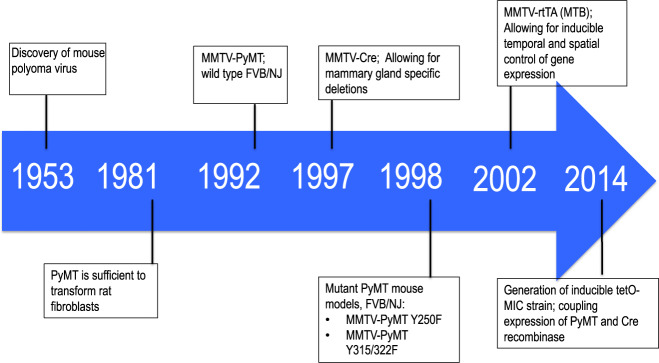
Fig. 1
Fig. 1. Notable advances in GEMMs of breast cancer.
The unenveloped double stranded murine polyomavirus was discovered in 1953. The viral antigen with transformative capacity, the middle T (PyMT), was identified in 1981. Our lab published the first highly metastatic mammary tumor model expressing PyMT in the mammary gland in an FVB/NJ background. Introduction of MMTV-Cre to the field of oncomice in 1997 allowed for conditional ablation within the mammary epithelium. Mutant PyMT strains in 1998 were instrumental in dissection of PyMT associated signaling. The MTB strain was introduced in 2002 which is used to drive expression of the PyMT coupled to Cre recombinase in the tetO-MIC published in 2014.
Fig. 2
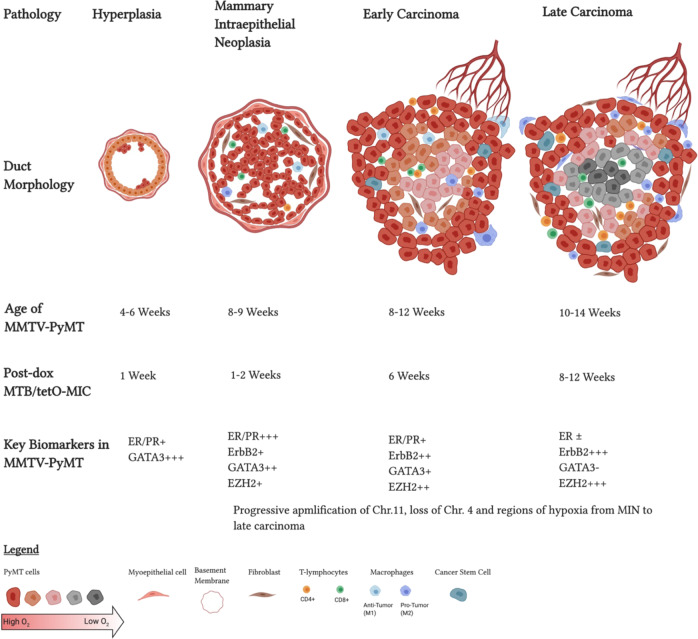
Fig. 2. Progression of PyMT GEMMs.
Both PyMT driven mouse models progress through the four main stages of cancer, akin to human tumors. Tumorigenesis starts with abnormal proliferation and hyperplasia, which then progresses through adenomas, mammary intraepithelial neoplasia (MIN), early carcinomas and culminates in late carcinomas that metastasizes to the lungs, forming adenocarcinomas in the lung parenchyma. Time points at which 50% of the animals have these pathologies for either MMTV-PyMT or MTB/tetO-MIC in weeks. Biomarkers associated with breast cancer shown at corresponding time points based off the MMTV-PyMT. Created with Biorender.com.
Fig. 3
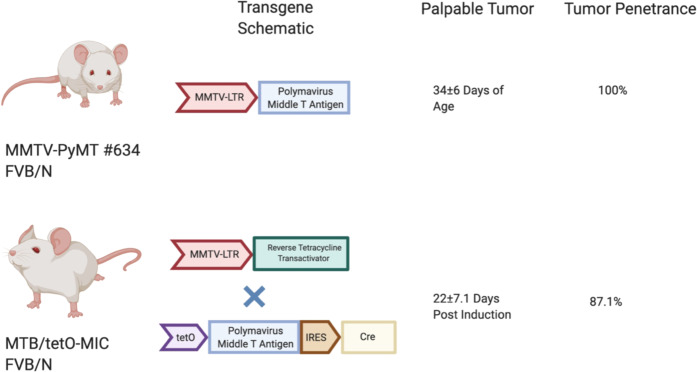
Fig. 3. Comparison of PyMT GEMMs.
Both strains were initially generated on an FVB/N background. Line #634 is the commonly used line for the MMTV-PyMT, which develop palpable tumors by 34 ± 6 days of age at a 100% penetrance. The MTB/tetO-MIC requires a genetic cross between the MTB (MMTV-rtTA) and the tetO-MIC strain. Bigenic mice develop multifocal palpable tumors at 22 ± 7.1 days post doxycycline induction in drinking water. Only 87.1% of bigneics are expected to develop tumors. Created with Biorender.com.
Fig. 4
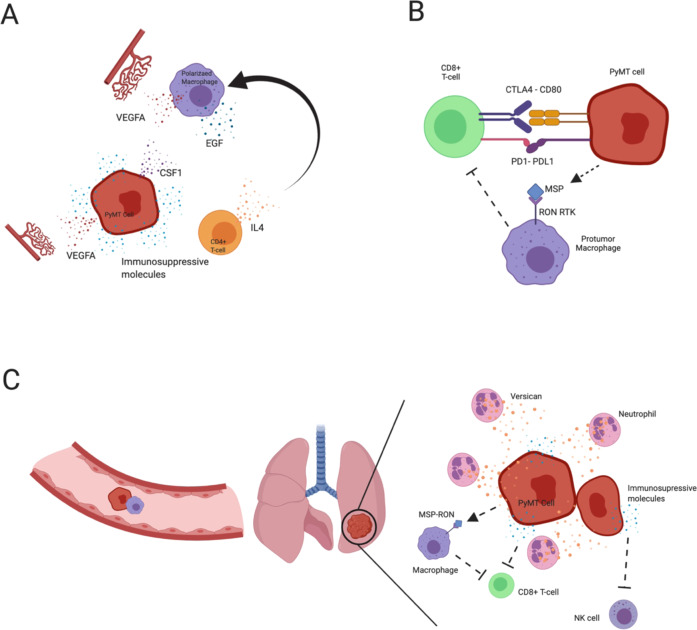
Fig. 4. TME factors that promote metastasis in PyMT.
a At the primary tumor, PyMT cancer cells secrete a range of immunosuppressive and chemotactic molecules. CD4+ T cells recruited to the primary tumor secrete IL-4 which polarizes macrophages to the M2 state. Polarized macrophages in turn release EGF which promotes cancer cell growth and migration. Myeloid and cancer cell derived VEGFA 6 promotes angiogenesis. PyMT cancer cells release CSF1 which promote taxis of macrophages. b Within the primary tumor, PyMT cancer cells suppress activity of cytotoxic T cells both directly via PD1/PDL1 and CTLA4/CD80 interactions, inhibiting their tumor killing ability. PyMT also suppress cytotoxic T cell activity indirectly via release of MSP which binds the RON receptor on macrophages which leads to suppression of cytotoxic T cell activity. c PyMT cancer cells metastasize via hematogenous route along with macrophages to reach the lung. At the metastatic site, neutrophils release versican which supports growth of the PyMT cancer cells and promotes mesenchymal to epithelial transition. Within the lung microenvironment, PyMT cancer cells supress the cytotoxic T cells and natural killer (NK) cells directly and indirectly. Created with Biorender.com .

References

    1. Brenner DR, Weir HK, Demers AA, Ellison LF, Louzado C, Shaw A, et al. Projected estimates of cancer in Canada in 2020. CMAJ. 2020;192:E199–205. doi: 10.1503/cmaj.191292. - DOI - PMC - PubMed
    1. Guy CT, Cardiff RD, Muller WJ. Induction of mammary tumors by expression of polyomavirus middle T oncogene: a transgenic mouse model for metastatic disease. Mol Cell Biol. 1992;12:954–61. doi: 10.1128/mcb.12.3.954. - DOI - PMC - PubMed
    1. Lin EY, Jones JG, Li P, Zhu L, Whitney KD, Muller WJ, et al. Progression to malignancy in the polyoma middle T oncoprotein mouse breast cancer model provides a reliable model for human diseases. Am J Pathol. 2003;163:2113–26. doi: 10.1016/S0002-9440(10)63568-7. - DOI - PMC - PubMed
    1. Gross L. A filterable agent, recovered from Ak leukemic extracts, causing salivary gland carcinomas in C3H mice. Proc Soc Exp Biol Med. 1953;83:414–21. doi: 10.3181/00379727-83-20376. - DOI - PubMed
    1. Treisman R, Novak U, Favaloro J, Kamen R. Transformation of rat cells by an altered polyoma virus genome expressing only the middle-T protein. Nature. 1981;292:595–600. doi: 10.1038/292595a0. - DOI - PubMed

Publication types

MeSH terms

Substances