


COVID-19, staying at home, and domestic violence
- PMID: 33235551
- PMCID: PMC7677908
- DOI: 10.1007/s11150-020-09526-7
COVID-19, staying at home, and domestic violence
Abstract
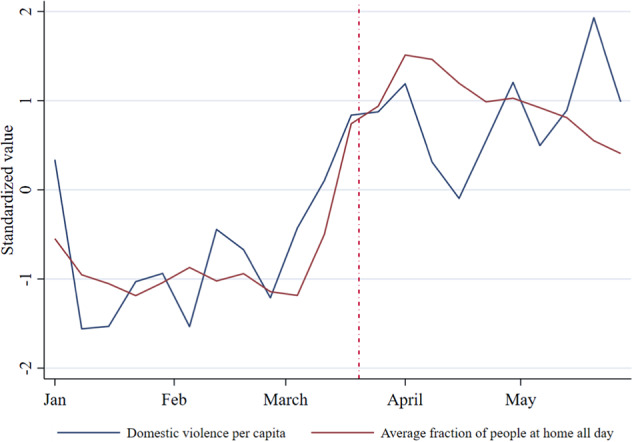
We analyze how staying at home during the COVID-19 pandemic affects the rates of domestic violence in the U.S. Using police dispatch and crime data from 36 police and sheriff's departments and mobile device tracking data, we find that reported incidents of domestic violence increase as more people stay at home. Specifically, we estimate that staying at home due to COVID-19 increased domestic violence by over 5% on average from March 13 to May 24, 2020. This is consistent with a theory of exposure reduction, where victims and abusers stuck at home are more likely to fight.
Keywords: COVID-19; Domestic violence; Exposure reduction; Pandemics; Social distancing.
© Springer Science+Business Media, LLC, part of Springer Nature 2020.
Conflict of interest statement
Conflict of interestThe authors declare that they have no conflict of interest.
Figures
Similar articles
-
COVID-19 and Domestic Violence: Economics or Isolation?J Fam Econ Issues. 2022;43(2):296-309. doi: 10.1007/s10834-022-09829-0. Epub 2022 Mar 12. J Fam Econ Issues. 2022. PMID: 35310373 Free PMC article.
-
Sheltering in place and domestic violence: Evidence from calls for service during COVID-19.J Public Econ. 2020 Sep;189:104241. doi: 10.1016/j.jpubeco.2020.104241. Epub 2020 Jul 23. J Public Econ. 2020. PMID: 32834179 Free PMC article.
-
Domestic violence calls for police service in five US cities during the COVID-19 pandemic of 2020.BMC Public Health. 2022 Dec 29;22(1):2455. doi: 10.1186/s12889-022-14901-3. BMC Public Health. 2022. PMID: 36581916 Free PMC article.
-
[Domestic violence: any progress?].Bull Acad Natl Med. 2014 Apr-May;198(4-5):893-903. Bull Acad Natl Med. 2014. PMID: 26753414 Review. French.
-
[The elderly as victims of violent crime].Z Gerontol. 1994 Sep-Oct;27(5):289-98. Z Gerontol. 1994. PMID: 7810194 Review. German.
Cited by
-
The impact of COVID-19 lockdowns on physical domestic violence: Evidence from a list randomization experiment.SSM Popul Health. 2021 Apr 17;14:100792. doi: 10.1016/j.ssmph.2021.100792. eCollection 2021 Jun. SSM Popul Health. 2021. PMID: 33948480 Free PMC article.
-
Competitive survival in a devastated industry: Evidence from hotels during COVID-19.J Econ Manag Strategy. 2022 Spring;31(1):3-24. doi: 10.1111/jems.12446. Epub 2021 Aug 18. J Econ Manag Strategy. 2022. PMID: 34548775 Free PMC article.
-
Unequal consequences of Covid 19: representative evidence from six countries.Rev Econ Househ. 2021;19(3):769-783. doi: 10.1007/s11150-021-09560-z. Epub 2021 Apr 7. Rev Econ Househ. 2021. PMID: 33841055 Free PMC article.
-
The incidence of psychosocial disturbances during the coronavirus disease-19 pandemic in an Iranian sample.Curr Psychol. 2023;42(10):8562-8571. doi: 10.1007/s12144-021-02341-y. Epub 2021 Oct 20. Curr Psychol. 2023. PMID: 34690476 Free PMC article.
-
Does Journal Content in the Field of Women's Health Represent Women's Burden of Disease? A Review of Publications in 2010 and 2020.J Womens Health (Larchmt). 2022 May;31(5):611-619. doi: 10.1089/jwh.2021.0425. Epub 2022 Mar 24. J Womens Health (Larchmt). 2022. PMID: 35333604 Free PMC article. Review.
References
-
- Brassiolo P. Domestic violence and divorce law: when divorce threats become credible. Journal of Labor Economics. 2016;34(2):443–77. doi: 10.1086/683666. - DOI
-
- Chin Y-M. Male backlash, bargaining, or exposure reduction?: Women’s working status and physical spousal violence in India. Journal of Population Economics. 2012;25(1):175–200. doi: 10.1007/s00148-011-0382-8. - DOI
-
- Couture, V., Dingel J., Green, A., Handbury, J., Williams, K. (2020). Covid Exposure Indices. https://github.com/COVIDExposureIndices/.
-
- Fajardo-Gonzalez, J. (2020). Domestic violence, decision-making power, and female employment in Colombia. Review of Economics of the Household, 1–22. 10.1007/s11150-020-09491-1.
LinkOut - more resources
Full Text Sources