Review
. 2021 Jan;47(1):65-76.
doi: 10.3892/ijmm.2020.4798. Epub 2020 Nov 24.

Mechanism overview and target mining of atherosclerosis: Endothelial cell injury in atherosclerosis is regulated by glycolysis (Review)

Affiliations
Review

Mechanism overview and target mining of atherosclerosis: Endothelial cell injury in atherosclerosis is regulated by glycolysis (Review)

Ruiying Wang et al. Int J Mol Med. 2021 Jan.

Abstract

Atherosclerosis (AS) is a chronic disease with a complex pathology that may lead to several cardiovascular and cerebrovascular diseases; however, further research is necessary to fully elucidate its pathogenesis. The main risk factors for AS include lipid metabolism disorders, endothelial cell injury, inflammation and immune dysfunction, among which vascular endothelial cell damage is considered as the main trigger for AS occurrence and development. Endothelial cell damage leads to enhanced intimal permeability and leukocyte adhesion, promoting thrombus formation and accelerating disease progression. The function of endothelial cells is affected by glycolysis regulation, since 80% of ATP in these cells is produced via this pathway. Genes associated with AS and endothelial cell glycolysis, including AKT1, interleukin‑6, vascular endothelial growth factor A, TP53, signal transducer and activator of transcription 3, SRC and mitogen‑activated protein kinase 1, were screened. Through integrated analysis, these genes were found to play a key role in AS by regulating multiple signaling pathways associated with cell signal transduction, energy metabolism, immune function and thrombosis. In conclusion, endothelial cell injury in AS may be alleviated by glycolysis and is a potential clinical treatment strategy for AS.

Keywords: endothelial injury; atherosclerosis; glycolysis; target; mechanism.


Figures
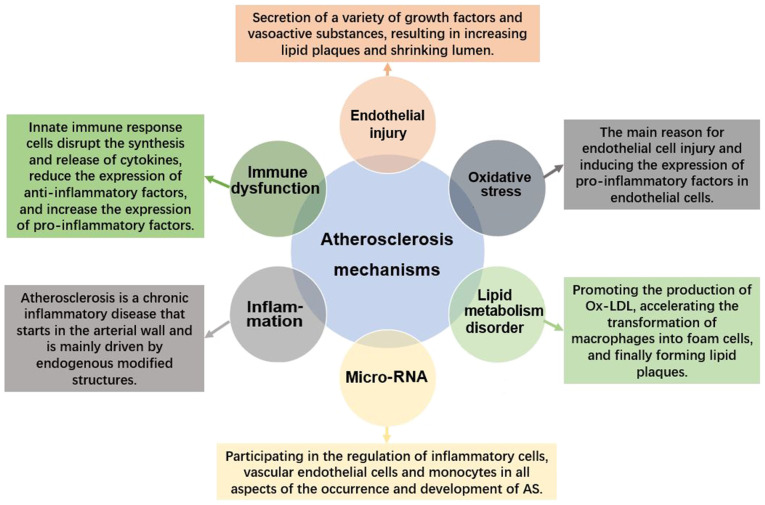
Figure 1
Figure 1
Overall diagram of atherosclerosis pathogenesis. (AS) pathogenesis is generally considered to be the result of the interaction among various mechanisms including lipid metabolism disorder, inflammatory cell infiltration, oxidative stress, immune dysfunction, and vascular endothelial cell damage, the latter of which ultimately leads to plaque rupture and thrombosis, causing serious cardiovascular and cerebrovascular diseases. Besides, miRNAs are involved in inflammatory cell regulation and thus other aspects of AS pathogenesis. AS, atherosclerosis; Ox-LDL, oxidized low-density lipoprotein.
Figure 2
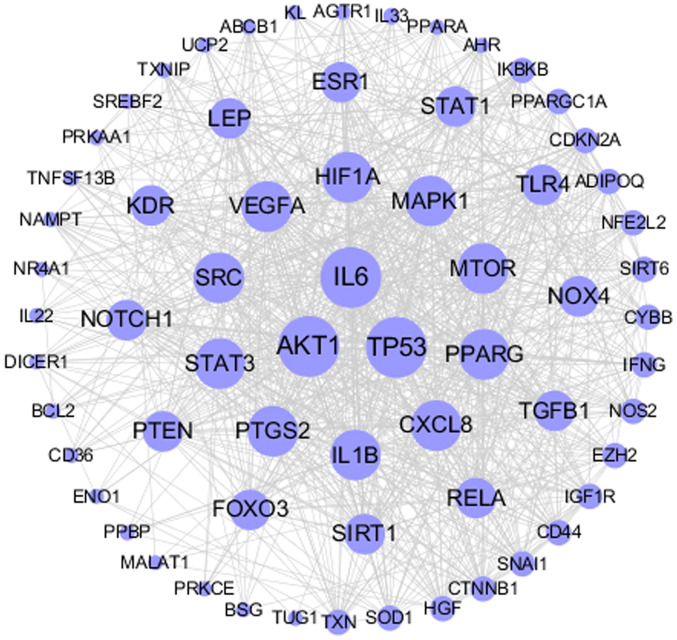
Figure 2
Protein interaction network of endothelial glycolysis and AS. The round nodes represent genes associated with endothelial glycolysis and AS. The size of the node reflects the importance of the node in the network to a certain extent: The larger the node, the greater the connectivity of the node in the network, and vice versa. Gray lines represent the interaction between two nodes. AS, atherosclerosis.
Figure 3
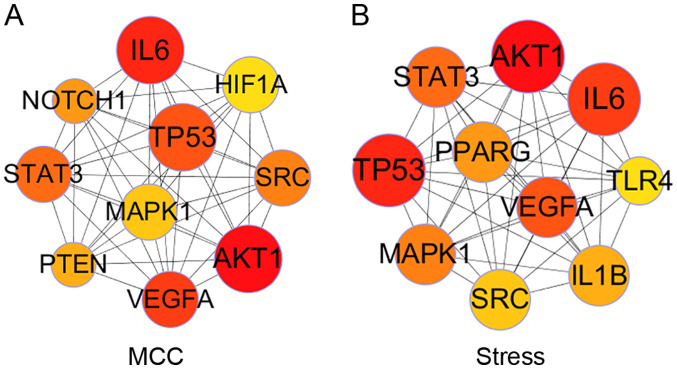
Figure 3
Identification of key protein targets. The top 10 key targets were identified based on the two algorithms, namely (A) MCC and (B) Stress, in Cytoscape software. The size and color of the nodes reflect the importance of the target (the larger the size and the darker the color, the more important the target). MCC, Matthews correlation coefficient.

References

    1. Kobiyama K, Ley K. Atherosclerosis. Circ Res. 2018;123:1118–1120. doi: 10.1161/CIRCRESAHA.118.313816. - DOI - PMC - PubMed
    1. Spinelli FR, Barone F, Cacciapaglia F, Pecani A, Piga M. Atherosclerosis and autoimmunity. Mediators Inflamm. 2018;2018:6730421. doi: 10.1155/2018/6730421. - DOI - PMC - PubMed
    1. Lu H, Daugherty A. Atherosclerosis. Arterioscler Thromb Vasc Biol. 2015;35:485–491. doi: 10.1161/ATVBAHA.115.305380. - DOI - PMC - PubMed
    1. Libby P, Buring JE, Badimon L, Hansson GK, Deanfield J, Bittencourt MS, Tokgözoğlu L, Lewis EF. Atherosclerosis. Nat Rev Dis Primers. 2019;5:56. doi: 10.1038/s41572-019-0106-z. - DOI - PubMed
    1. Bories GFP, Leitinger N. Macrophage metabolism in athero-sclerosis. FEBS Lett. 2017;591:3042–3060. doi: 10.1002/1873-3468.12786. - DOI - PubMed