


How many people with type 2 diabetes fulfil the eligibility criteria for randomized, controlled trials of insulin glargine 300 U/mL in a real-world setting?
- PMID: 33236461
- PMCID: PMC7898683
- DOI: 10.1111/dom.14264
How many people with type 2 diabetes fulfil the eligibility criteria for randomized, controlled trials of insulin glargine 300 U/mL in a real-world setting?
Abstract
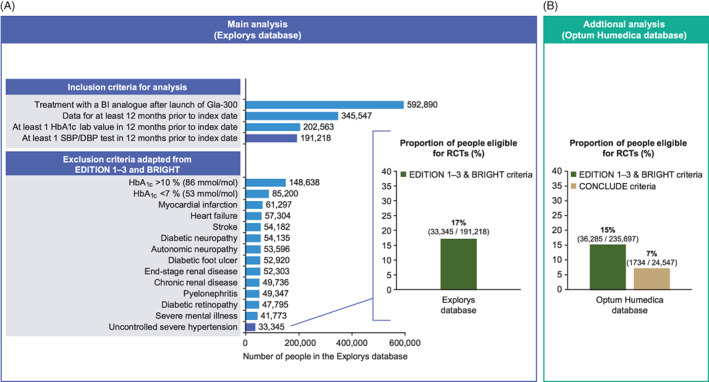
Randomized controlled trial (RCT) populations often do not reflect those typically seen in clinical practice. This retrospective, observational cohort study analysed the real-world data of people with type 2 diabetes (T2DM) prescribed basal insulin analogues from electronic medical records (EMRs) in the Explorys database, which includes data from 39 integrated healthcare systems in the United States, to determine how representative selected RCTs investigating insulin glargine 300 U/mL (Gla-300) are of T2DM populations in a real-world setting. Applying eligibility criteria derived from the EDITION 1, 2 and 3 (Gla-300 vs. insulin glargine 100 U/mL [Gla-100]) and BRIGHT (Gla-300 vs. insulin degludec) RCTs, we observed that only 17% (33 345/191 218) of people captured in the real-world database would have been eligible for such trials. Those who were ineligible tended to be older, had more comorbidities and a higher baseline hypoglycaemia rate than the eligible group. Using another large US EMR database (Optum Humedica) as corroboration, we found that 15% (36 285/235 697) would have been eligible to participate in the EDITION/BRIGHT RCTs. Furthermore, only 7% (1734/24 547) would have been eligible for the CONCLUDE (insulin degludec vs. Gla-300) RCT. Our findings remind us of the value of real-world data studies, complementing the results of RCTs, and providing additional insights into groups who would typically be excluded from RCTs.
Keywords: basal insulin; cohort study; database research; randomized trial; type 2 diabetes.
© 2020 The Authors. Diabetes, Obesity and Metabolism published by John Wiley & Sons Ltd.
Conflict of interest statement
D.M. has served on Advisory boards for AstraZeneca, Ferrer, Merck, Novo Nordisk, Praxis Pharmaceutical and Sanofi, and on the Speakers' bureau for Boehringer Ingelheim, Eli Lilly, GlaxoSmithKline, Menarini, Merck, Novartis, Novo Nordisk and Sanofi. J. Westerbacka and C.N. are employees of Sanofi. J. Wu was a Sanofi employee when the work was conducted but has since left the company. R.G. has provided consultancy work for Sanofi. B.E. has served on Advisory boards and received consultancy fees from Amgen, AstraZeneca, Boehringer Ingelheim, Eli Lilly, MSD, Mundipharma, Navamedic, Novo Nordisk and RLS Global, and has received research support from Sanofi.
Figures
References
-
- Schulz KF, Altman DG, Moher D, Group C . CONSORT 2010 statement: updated guidelines for reporting parallel group randomized trials. Ann Intern Med. 2010;152:726‐732. - PubMed
-
- Riddle MC, Bolli GB, Ziemen M, et al. New insulin glargine 300 units/mL versus glargine 100 units/mL in people with type 2 diabetes using basal and mealtime insulin: glucose control and hypoglycemia in a 6‐month randomized controlled trial (EDITION 1). Diabetes Care. 2014;37:2755‐2762. - PubMed
-
- Yki‐Jarvinen H, Bergenstal R, Ziemen M, et al. New insulin glargine 300 units/mL versus glargine 100 units/mL in people with type 2 diabetes using oral agents and basal insulin: glucose control and hypoglycemia in a 6‐month randomized controlled trial (EDITION 2). Diabetes Care. 2014;37:3235‐3243. - PubMed
-
- Rosenstock J, Cheng A, Ritzel R, et al. More similarities than differences testing insulin glargine 300 units/mL versus insulin degludec 100 units/mL in insulin‐naive type 2 diabetes: the randomized head‐to‐head BRIGHT trial. Diabetes Care. 2018;41:2147‐2154. - PubMed
Publication types
MeSH terms
Substances
LinkOut - more resources
Full Text Sources
Medical
