Perceived Care and Well-being of Patients With Cancer and Matched Norm Participants in the COVID-19 Crisis: Results of a Survey of Participants in the Dutch PROFILES Registry
- PMID: 33237294
- PMCID: PMC7689559
- DOI: 10.1001/jamaoncol.2020.6093
Perceived Care and Well-being of Patients With Cancer and Matched Norm Participants in the COVID-19 Crisis: Results of a Survey of Participants in the Dutch PROFILES Registry
Abstract
Importance: As the resolution of the coronavirus disease 2019 (COVID-19) crisis is unforeseeable, and/or a second wave of infections may arrive in the fall of 2020, it is important to evaluate patients' perspectives to learn from this.
Objective: To assess how Dutch patients with cancer perceive cancer treatment and follow-up care (including experiences with telephone and video consultations [TC/VC]) and patients' well-being in comparison with a norm population during the COVID-19 crisis.
Design, setting, and participants: Cross-sectional study of patients participating in the Dutch Patient Reported Outcomes Following Initial Treatment and Long-term Evaluation of Survivorship (PROFILES) registry and a norm population who completed a questionnaire from April to May 2020.
Main outcomes and measures: Logistic regression analysis assessed factors associated with changes in cancer care (treatment or follow-up appointment postponed/canceled or changed to TC/VC). Differences in quality of life, anxiety/depression, and loneliness between patients and age-matched and sex-matched norm participants were evaluated with regression models.
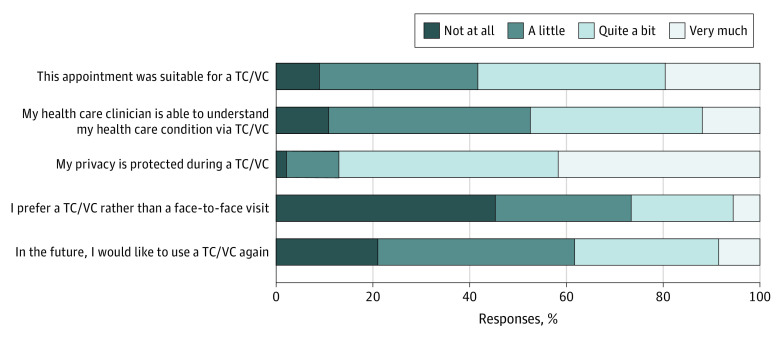
Results: The online questionnaire was completed by 4094 patients (48.6% response), of whom most were male (2493 [60.9%]) and had a mean (SD) age of 63.0 (11.1) years. Of these respondents, 886 (21.7%) patients received treatment; 2725 (55.6%) received follow-up care. Treatment or follow-up appointments were canceled for 390 (10.8%) patients, whereas 160 of 886 (18.1%) in treatment and 234 of 2725 (8.6%) in follow-up had it replaced by a TC/VC. Systemic therapy, active surveillance, or surgery were associated with cancellation of treatment or follow-up appointment. Younger age, female sex, comorbidities, metastasized cancer, being worried about getting severe acute respiratory syndrome coronavirus 2 (SARS-CoV-2), and receiving supportive care were associated with replacement of a consultation with a TC/VC. Patients and norm participants reported that the COVID-19 crisis made them contact their general practitioner (852 of 4068 [20.9%] and 218 of 979 [22.3%]) or medical specialist/nurse (585 of 4068 [14.4%] and 144 of 979 [14.7%]) less quickly when they had physical complaints or concerns. Most patients who had a TC/VC preferred a face-to-face consultation, but 151 of 394 (38.3%) were willing to use a TC/VC again. Patients with cancer were more worried about getting infected with SARS-CoV-2 compared with the 977 norm participants (917 of 4094 [22.4%] vs 175 of 977 [17.9%]). Quality of life, anxiety, and depression were comparable, but norm participants more often reported loneliness (114 of 977 [11.7%] vs 287 of 4094 [7.0%]) than patients with cancer (P = .009).
Conclusions and relevance: Among patients with cancer in the Netherlands, 1 in 3 reported changes in cancer care in the first weeks of the COVID-19 crisis. Long-term outcomes need to be monitored. The crisis may affect the mental well-being of the general population relatively more than that of patients with cancer.
Conflict of interest statement
Figures
References
Publication types
MeSH terms
LinkOut - more resources
Full Text Sources
Other Literature Sources
Medical
Research Materials
Miscellaneous