


ALK alterations in salivary gland carcinomas
- PMID: 33237469
- PMCID: PMC8099847
- DOI: 10.1007/s00428-020-02971-w
ALK alterations in salivary gland carcinomas
Abstract
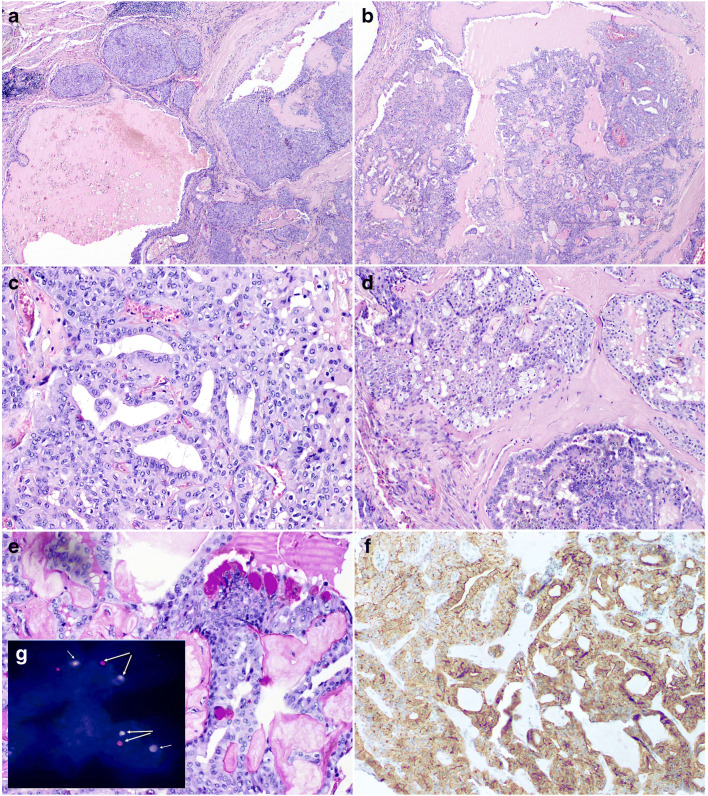
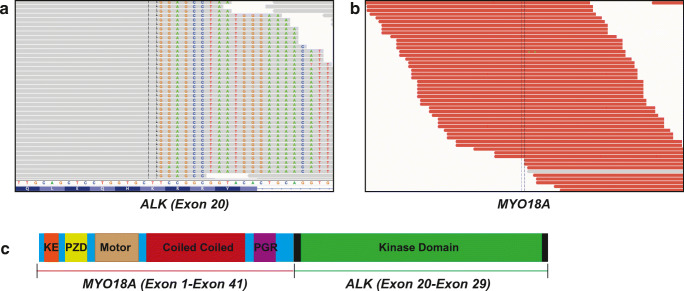
Salivary gland carcinomas represent a heterogeneous group of poorly characterized head and neck tumors. The purpose of this study was to evaluate ALK gene and protein aberrations in a large, well-characterized cohort of these tumors. A total of 182 salivary gland carcinomas were tested for anaplastic lymphoma kinase (ALK) positivity by immunohistochemistry (IHC) using the cut-off of 10% positive cells. ALK positive tumors were subjected to FISH analysis and followed by hybrid capture-based next generation sequencing (NGS). Of the 182 tumors, 8 were ALK positive by IHC. Further analysis using hybrid capture NGS analysis revealed a novel MYO18A (Exon1-40)-ALK (exon 20-29) gene fusion in one case of intraductal carcinoma. Additional genomic analyses resulted in the detection of inactivating mutations in BRAF and TP53, as well as amplifications of ERBB2 and ALK. ALK rearrangements are a rare entity in salivary gland carcinomas. We identified a potentially targetable novel ALK fusion in an intraductal carcinoma of minor salivary glands.
Keywords: Anaplastic lymphoma kinase; FISH; Immunohistochemistry; Intraductal carcinoma; Next generation sequencing; Salivary gland carcinoma.
Conflict of interest statement
Prof Rafał Dziadziuszko: Advisory board role for Pfizer, Novartis, Roche, Takeda, Merck, Seattle Genetics, and Foundation Medicine. Travel costs from Roche and AstraZeneca. Dr. Johannes Heuckmann is a full time employee of NEO New Oncology GmbH. Prof Jacek Jassem: Advisory board role for Boehringer, Astra Zeneca, BMS, and Merck. Other authors declare that they have no conflict of interest.
Figures
References
-
- El-Naggar AK, Chan JKC, Grandis JR, Takata T, Slootweg PJ. World Health Organization classification of head and neck tumours. Lyon: IARC; 2017.
-
- Schwarz S, Stiegler C, Muller M, Ettl T, Brockhoff G, Zenk J, Agaimy A. Salivary gland mucoepidermoid carcinoma is a clinically, morphologically and genetically heterogeneous entity: a clinicopathological study of 40 cases with emphasis on grading, histological variants and presence of the t(11;19) translocation. Histopathology. 2011;58:557–570. doi: 10.1111/j.1365-2559.2011.03777.x. - DOI - PubMed
MeSH terms
Substances
Grants and funding
LinkOut - more resources
Full Text Sources
Medical
Research Materials
Miscellaneous
