


A rapid review of the impact of quarantine and restricted environments on children's play and the role of play in children's health
- PMID: 33238034
- PMCID: PMC7753247
- DOI: 10.1111/cch.12832
A rapid review of the impact of quarantine and restricted environments on children's play and the role of play in children's health
Abstract
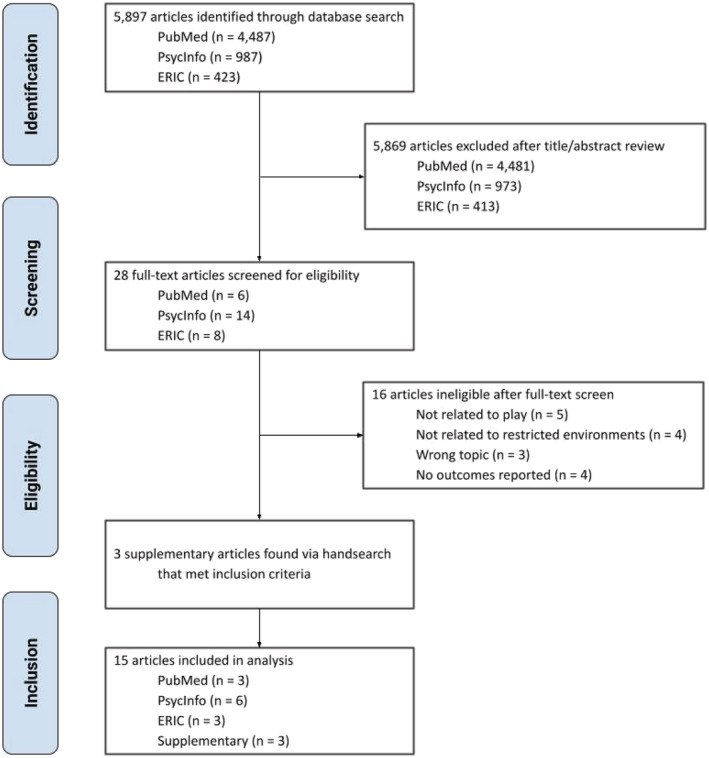
Amidst the coronavirus disease 2019 (COVID-19) pandemic, there is uncertainty regarding potential lasting impacts on children's health and educational outcomes. Play, a fundamental part of childhood, may be integral to children's health during crises. We undertook a rapid review of the impact of quarantine, isolation and other restrictive environments on play and whether play mitigates adverse effects of such restrictions. Fifteen peer-reviewed studies were identified, spanning hospitals, juvenile and immigration detention and refugee camps. We found evidence of changes in children's access to play in crises and quarantine. These studies indicated how play might support children enduring isolation but lacked robust investigations of play as an intervention in mitigating impacts of restriction. Studies pertaining to children in isolation due to infectious disease outbreaks were notably absent. It is important that the potential effects of changes to such a crucial aspect of childhood are better understood to support children in this and future crises.
Keywords: children; disease outbreak; isolation; mental health; play; restriction.
© 2020 John Wiley & Sons Ltd.
Conflict of interest statement
There are no conflicts of interest to declare.
Figures
References
-
- Armitage, R. , & Nellums, L. B. (2020). Considering inequalities in the school closure response to COVID‐19. The Lancet Global Health, 8(5), e644. Retrieved from https://www.ncbi.nlm.nih.gov/pmc/articles/PMC7195275/pdf/main.pdf, 10.1016/S2214-109X(20)30116-9 - DOI - PMC - PubMed
-
- Berkman, B. E. (2008). Mitigating pandemic influenza: The ethics of implementing a school closure policy. Journal of Public Health Management and Practice, 14(4), 372–378. Retrieved from <Go to ISI>://WOS:000256855500010 - PubMed
-
- Brodsky, W. (1989). Music therapy as an intervention for children with cancer in isolation rooms. Music Therapy, 8(1), 17–34. 10.1093/mt/8.1.17 - DOI
