


Semiconductor Gas Sensors: Materials, Technology, Design, and Application
- PMID: 33238459
- PMCID: PMC7700484
- DOI: 10.3390/s20226694
Semiconductor Gas Sensors: Materials, Technology, Design, and Application
Abstract
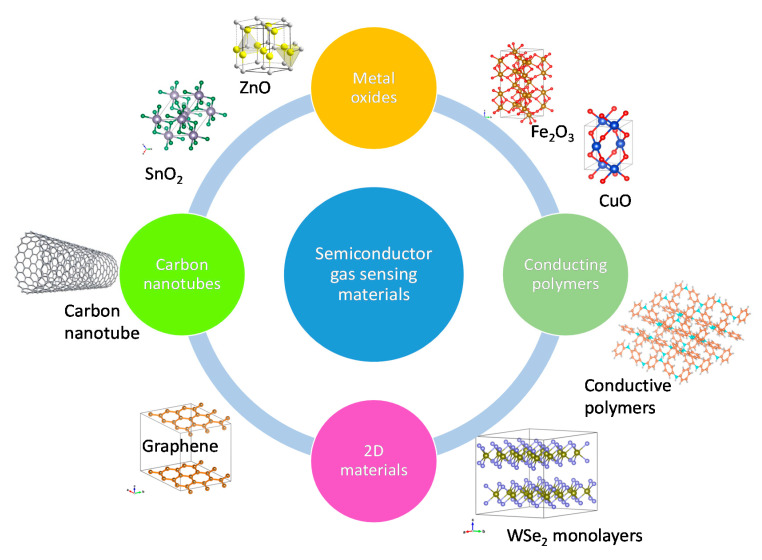
This paper presents an overview of semiconductor materials used in gas sensors, their technology, design, and application. Semiconductor materials include metal oxides, conducting polymers, carbon nanotubes, and 2D materials. Metal oxides are most often the first choice due to their ease of fabrication, low cost, high sensitivity, and stability. Some of their disadvantages are low selectivity and high operating temperature. Conducting polymers have the advantage of a low operating temperature and can detect many organic vapors. They are flexible but affected by humidity. Carbon nanotubes are chemically and mechanically stable and are sensitive towards NO and NH3, but need dopants or modifications to sense other gases. Graphene, transition metal chalcogenides, boron nitride, transition metal carbides/nitrides, metal organic frameworks, and metal oxide nanosheets as 2D materials represent gas-sensing materials of the future, especially in medical devices, such as breath sensing. This overview covers the most used semiconducting materials in gas sensing, their synthesis methods and morphology, especially oxide nanostructures, heterostructures, and 2D materials, as well as sensor technology and design, application in advance electronic circuits and systems, and research challenges from the perspective of emerging technologies.
Keywords: gas sensing materials; gas sensor applications; semiconductor gas sensors; sensing technology.
Conflict of interest statement
The authors declare no conflict of interest. The funders had no role in the design of the study; in the collection, analyses, or interpretation of data; in the writing of the manuscript, or in the decision to publish the results.
Figures
References
-
- Centers for Disease Control and Prevention (CDC); [(accessed on 6 November 2020)]. Air Pollutants. Available online: https://www.cdc.gov/air/pollutants.htm.
-
- EPA—United States Environmental Protection Agency; [(accessed on 6 November 2020)]. Overview of Greenhouse Gases. Greenhouse Gas Emissions. Available online: https://www.epa.gov/ghgemissions/overview-greenhouse-gases.
-
- Blank T.A., Eksperiandova L.P., Belikov K.N. Recent trends of ceramic humidity sensors development: A review. Sens. Actuators B. 2016;228:416–442. doi: 10.1016/j.snb.2016.01.015. - DOI
-
- Mehmood F., Ahmad S., Kim D.H. Desing and implementation of an interworking IoT platform and marketplace in Could of Things. Sustainability. 2019;11:5952. doi: 10.3390/su11215952. - DOI
Publication types
LinkOut - more resources
Full Text Sources
Other Literature Sources
