


Association of Ultrasound-Derived Metrics of the Quadriceps Muscle with Protein Energy Wasting in Hemodialysis Patients: A Multicenter Cross-Sectional Study
- PMID: 33238633
- PMCID: PMC7700501
- DOI: 10.3390/nu12113597
Association of Ultrasound-Derived Metrics of the Quadriceps Muscle with Protein Energy Wasting in Hemodialysis Patients: A Multicenter Cross-Sectional Study
Abstract
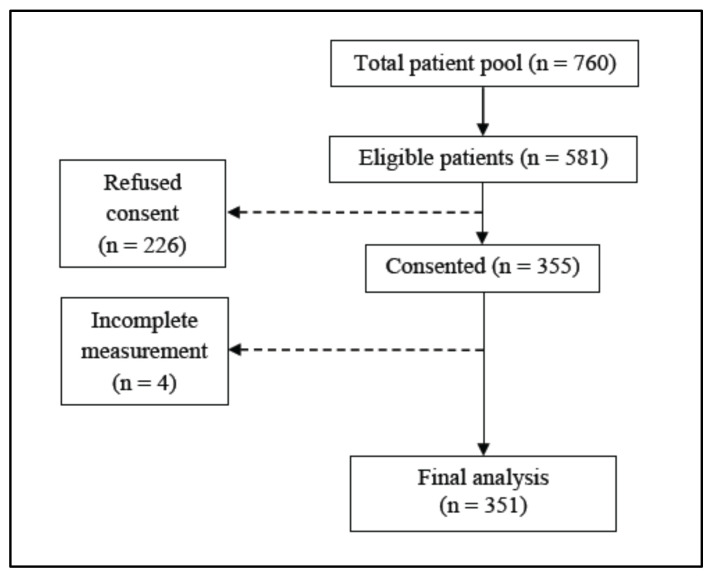
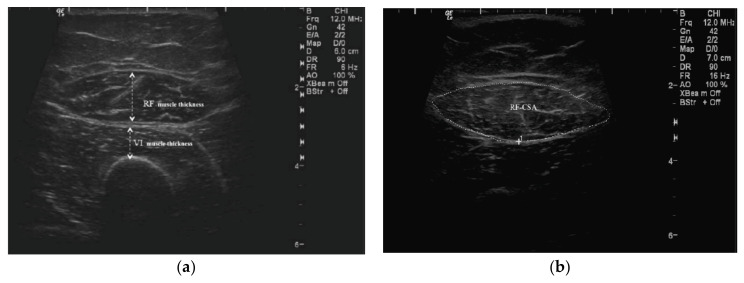
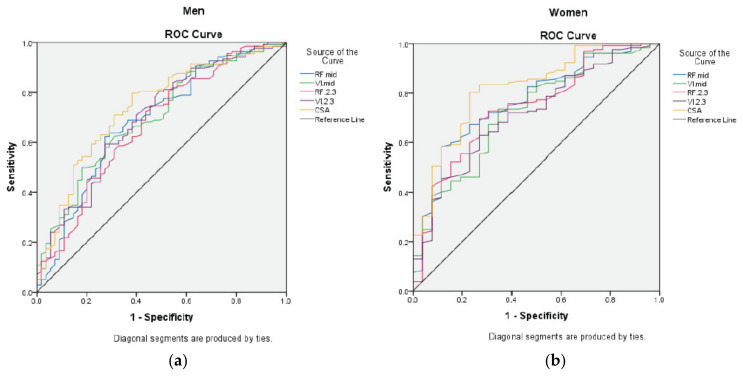
This study aimed to assess muscle wasting and risk of protein energy wasting (PEW) in hemodialysis (HD) patients using an ultrasound (US) imaging method. PEW was identified using the ISRNM criteria in 351 HD patients. Quadriceps muscle thickness of rectus femoris (RF) and vastus intermedius (VI) muscles and cross-sectional area (CSA) of the RF muscle (RFCSA) were measured using US and compared with other physical measures. Associations of US indices with PEW were determined by logistic regression. Irrespective of gender, PEW vs. non-PEW patients had smaller RF, VI muscles, and RFCSA (all p < 0.001). US muscle sites (all p < 0.001) discriminated PEW from non-PEW patients, but the RFCSA compared to bio-impedance spectroscopy had a greater area under the curve (AUC, 0.686 vs. 0.581), sensitivity (72.8% vs. 65.8%), and specificity (55.6% vs. 53.9%). AUC of the RFCSA was greatest for PEW risk in men (0.74, 95% CI: 0.66-0.82) and women (0.80, 95% CI: 0.70-0.90) (both p < 0.001). Gender-specific RFCSA values (men < 6.00 cm2; women < 4.47 cm2) indicated HD patients with smaller RFCSA were 8 times more likely to have PEW (AOR = 8.63, 95% CI: 4.80-15.50, p < 0.001). The US approach enabled discrimination of muscle wasting in HD patients with PEW. The RFCSA was identified as the best US site with gender-specific RFCSA values to associate with PEW risk, suggesting potential diagnostic criteria for muscle wasting.
Keywords: hemodialysis; muscle wasting; protein energy wasting; quadriceps muscle; ultrasound imaging.
Conflict of interest statement
The authors declare no conflict of interest.
Figures
References
-
- Fouque D., Kalantar-Zadeh K., Kopple J.D., Cano N., Chauveau P., Cuppari L., A Franch H., Guarnieri G.L., Ikizler T., A Kaysen G., et al. A proposed nomenclature and diagnostic criteria for protein–energy wasting in acute and chronic kidney disease. Kidney Int. 2008;73:391–398. doi: 10.1038/sj.ki.5002585. - DOI - PubMed
-
- Carrero J.J., Thomas F., Nagy K., Arogundade F., Avesani C.M., Chan M., Chmielewski M., Cordeiro A.C., Espinosa-Cuevas A., Fiaccadori E., et al. Global Prevalence of Protein-Energy Wasting in Kidney Disease: A Meta-analysis of Contemporary Observational Studies From the International Society of Renal Nutrition and Metabolism. J. Ren. Nutr. 2018;28:380–392. doi: 10.1053/j.jrn.2018.08.006. - DOI - PubMed
Publication types
MeSH terms
Grants and funding
LinkOut - more resources
Full Text Sources
Medical
