


Health system capacity for post-abortion care in Java, Indonesia: a signal functions analysis
- PMID: 33239059
- PMCID: PMC7687770
- DOI: 10.1186/s12978-020-01033-3
Health system capacity for post-abortion care in Java, Indonesia: a signal functions analysis
Abstract
Background: The quality of obstetric care has been identified as a contributing factor in Indonesia's persistently high level of maternal mortality, and the country's restrictive abortion laws merit special attention to the quality of post-abortion care (PAC). Due to unique health policies and guidelines, in Indonesia, uterine evacuation for PAC is typically administered only by Ob/Gyns practicing in hospitals.
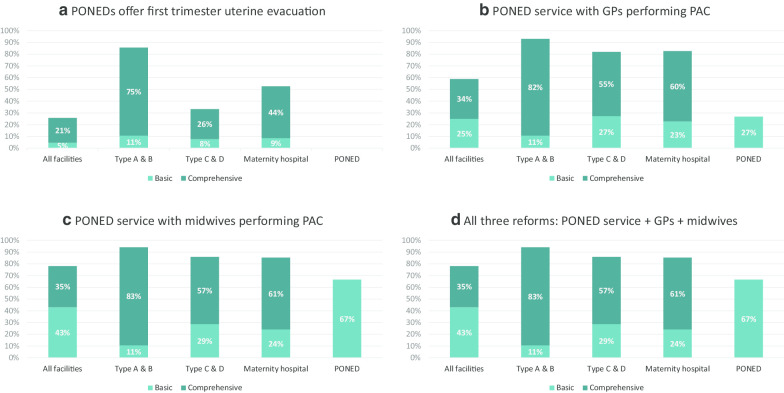
Methods: Using data from a survey of 657 hospitals and emergency obstetric-registered public health centers in Java, Indonesia's most populous island, we applied a signal functions analysis to measure the health system's capacity to offer PAC. We then used this framework to simulate the potential impact of the following hypothetical reforms on PAC capacity: allowing first-trimester uterine evacuation for PAC to take place at the primary care level, and allowing provision by clinicians other than Ob/Gyns. Finally, we calculated the proportion of PAC patients treated using four different uterine evacuation procedures.
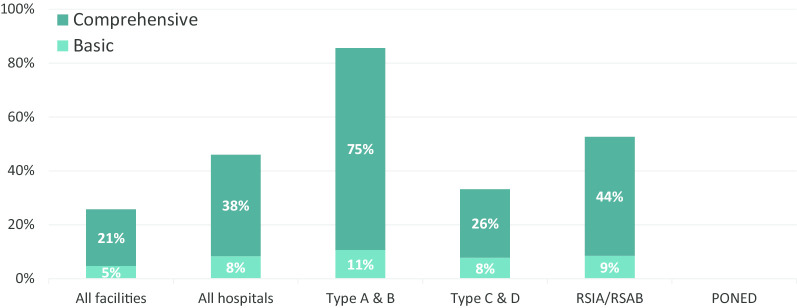
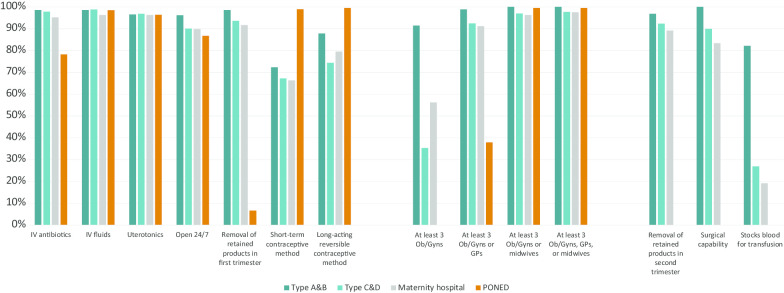
Results: Forty-six percent of hospitals in Java have the full set of services needed to provide PAC, and PAC capacity is concentrated at the highest-level referral hospitals: 86% of referral hospitals have the full set of services, staffing, and equipment compared to 53% of maternity hospitals and 34% of local hospitals. No health centers are adequately staffed or authorized to offer basic PAC services under Indonesia's current guidelines. PAC capacity at all levels of the health system increases substantially in hypothetical scenarios under which authorization to perform first-trimester uterine evacuation for PAC is expanded to midwives and general physicians practicing in health centers. In 2018, 88% percent of PAC patients were treated using dilation and curettage (D&C).
Conclusions: Offering first-trimester uterine evacuation for PAC in PONEDs and allowing clinicians other than Ob/Gyns to perform this procedure would greatly improve the capacity of Java's health system to serve PAC patients. Increasing the use of vacuum aspiration and misoprostol for PAC-related uterine evacuation would lower the burden of treatment for patients and facilitate the task-shifting efforts needed to expand access to this life-saving service.
Keywords: Abortion; Health system; Miscarriage; Post-abortion care; Service quality; Task-shifting.
Conflict of interest statement
The authors declare that they have no competing interests.
Figures
References
-
- National Population and Family Planning Board (BKKBN), Statistics Indonesia (BPS), Ministry of Health (Kemenkes), ICF. Indonesia Demographic and Health Survey 2017. Jakarta, Indonesia: BKKBN, BPS, Kemenkes, and ICF; 2019. p. 623. https://dhsprogram.com/pubs/pdf/FR342/FR342.pdf.
-
- Rokx C, Giles J, Satriawan E, Marzoeki P, Harimurti P, Yavuz E. New insights into the provision of health services in Indonesia: a health workforce study. World Bank; 2010. http://documents.worldbank.org/curated/en/799111468038325818/pdf/538830P....
-
- Badan Pusat Statistik (Statistics Indonesia). Indonesia 2015 Intercensal Survey report. Jakarta, Indonesia: Badan Pusat Statistik (BPS); 2017. p. 52. https://www.bps.go.id/publication/2016/11/30/63daa471092bb2cb7c1fada6/pr.... Accessed 22 July 2020.
-
- Ministry of Health, Republic of Indonesia. Action plan—acceleration of maternal mortality ratio reduction in Indonesia. Jakarta, Indonesia: Ministry of Health; 2013. https://indonesia.unfpa.org/en/publications/action-plan-acceleration-mat....
MeSH terms
Substances
LinkOut - more resources
Full Text Sources
Medical
Miscellaneous
