


Never Change a Brewing Yeast? Why Not, There Are Plenty to Choose From
- PMID: 33240329
- PMCID: PMC7677575
- DOI: 10.3389/fgene.2020.582789
Never Change a Brewing Yeast? Why Not, There Are Plenty to Choose From
Abstract
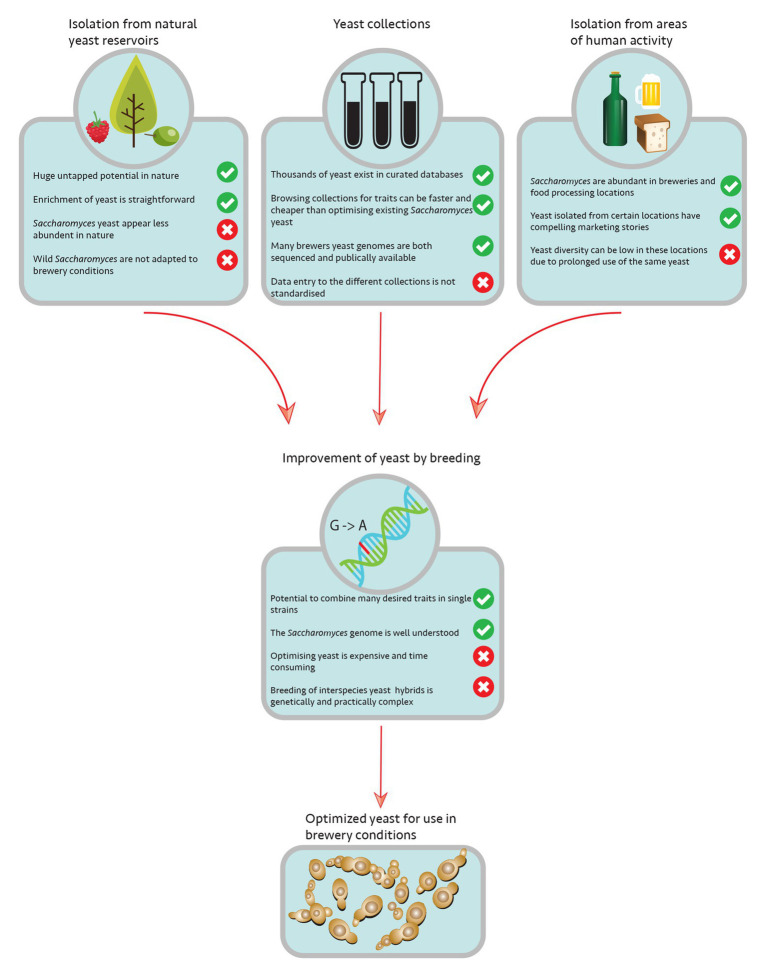
Fermented foods and particularly beer have accompanied the development of human civilization for thousands of years. Saccharomyces cerevisiae, the dominant yeast in the production of alcoholic beverages, probably co-evolved with human activity. Considering that alcoholic fermentations emerged worldwide, the number of strains used in beer production nowadays is surprisingly low. Thus, the genetic diversity is often limited. This is among others related to the switch from a household brewing style to a more artisan brewing regime during the sixteenth century and latterly the development of single yeast isolation techniques at the Carlsberg Research Laboratory in 1883, resulting in process optimizations in the brewing industry. However, due to fierce competition within the beer market and the increasing demand for novel beer styles, diversification is becoming increasingly important. Moreover, the emergence of craft brewing has influenced big breweries to rediscover yeast as a significant contributor to a beer's aroma profile and realize that there is still room for innovation in the fermentation process. Here, we aim at giving a brief overview on how currently used S. cerevisiae brewing yeasts emerged and comment on the rationale behind replacing them with novel strains. We will present potential sources of yeasts that have not only been used in beer brewing before, including natural sources and sources linked to human activity but also an overlooked source, such as yeast culture collections. We will briefly comment on common yeast isolation techniques and finally touch on additional challenges for the brewing industry in replacing their current brewer's yeasts.
Keywords: Saccharomyces cerevisiae; breweries; diversity; domestication; reservoirs; strain collection.
Copyright © 2020 Lengeler, Stovicek, Fennessy, Katz and Förster.
Figures
References
Publication types
LinkOut - more resources
Full Text Sources
Molecular Biology Databases
