Evaluation of the IOP-Lowering Effect of a Multi-Pressure Dial at Different Negative Pressure Settings
- PMID: 33240572
- PMCID: PMC7673999
- DOI: 10.1167/tvst.9.12.19
Evaluation of the IOP-Lowering Effect of a Multi-Pressure Dial at Different Negative Pressure Settings
Abstract
Purpose: To evaluate the intraocular pressure (IOP)-lowering effect of a multi-pressure dial (MPD) at targeted negative pressure settings.
Methods: Prospective, intrasubject controlled study of 65 healthy subjects randomized to receive no negative pressure for 60 minutes or negative pressure application at designated levels of 25%, 50%, and 75% of baseline IOP for 20 minutes each. The main outcome measure was mean IOP with application of negative pressure.
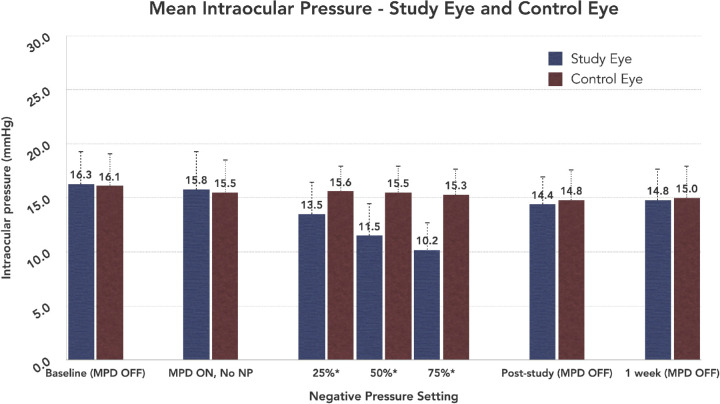
Results: In the study eye group, from a baseline IOP of 15.8 ± 3.6 mm Hg, the mean IOP was 13.5 ± 3.4, 11.5 ± 3.1, and 10.2 ± 2.7 mm Hg with negative pressure settings of 25%, 50% and 75%, respectively. In the control eye group, from a baseline IOP of 15.5 ± 3.0 mm Hg, the mean IOP values at the same time points, without negative pressure, were 15.6 ± 3.0, 15.5 ± 2.5 and 15.3 ± 2.4 mm Hg. The difference between the mean IOPs of the two groups was significantly different at all negative pressure settings (P < 0.001) in comparison with baseline. There was one minor adverse event, a corneal abrasion, that was unrelated to device wear.
Conclusions: Negative pressure application to the periocular space with a multi-pressure dial can produce titratable IOP reduction while the device is worn with active negative pressure. To our knowledge, this technology represents the first nonpharmacologic, nonlaser, nonsurgical method for IOP reduction.
Translational relevance: This represents the first study demonstrating the IOP-lowering ability of the multi-pressure dial, a device that uses a novel IOP-lowering strategy by delivering negative pressure to the periocular region.
Keywords: CSF pressure; MPD; multi-pressure dial; multi-pressure glaucoma management; normal tension glaucoma; open-angle glaucoma; severe open-angle glaucoma.
Copyright 2020 The Authors.
Conflict of interest statement
Disclosure: R.J. Swan, Equinox Ophthalmic, Inc. (C); T.J. Ferguson, Equinox Ophthalmic, Inc. (C); M. Shah, None; K.W. Muir, None; T.W. Samuelson, Equinox Ophthalmic, Inc. (C); I.I.K. Ahmed, Equinox Ophthalmic, Inc. (C); R.L. Lindstrom, Equinox Ophthalmic, Inc. (C); N.M. Radcliffe, Equinox Ophthalmic, Inc. (C); J.P. Berdahl, Equinox Ophthalmic, Inc. (I)
Figures
References
-
- Heijl A, Leske MC, Bengtsson B, et al.. Reduction of intraocular pressure and glaucoma progression: results from the Early Manifest Glaucoma Trial. Arch Ophthalmol. 2002; 120(10): 1268–1279. - PubMed
Publication types
MeSH terms
Substances
LinkOut - more resources
Full Text Sources