


The Power of a Positive Human-Animal Relationship for Animal Welfare
- PMID: 33240961
- PMCID: PMC7680732
- DOI: 10.3389/fvets.2020.590867
The Power of a Positive Human-Animal Relationship for Animal Welfare
Abstract
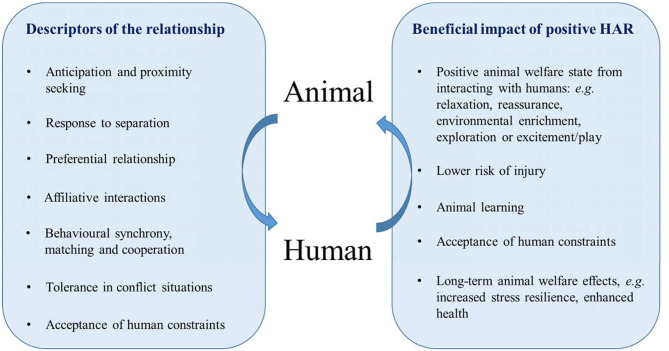
Domestic animals often seek and enjoy interacting with humans. Positive human-animal relationships can elicit positive emotions and other positive welfare outcomes. Nevertheless, our understanding of the underlying processes that govern the positive perception of humans by animals is incomplete. We cover the potential mechanisms involved in the development and maintenance of positive human-animal relationships from the perspective of the animal. This encompasses habituation, associative learning, and possibly attachment or bonding based on communication and social cognition. We review the indicators from the literature to assess a positive human-animal relationship. We operationally define this positive relationship as the animal showing voluntary approach and spatial proximity (seeking) and signs of anticipation, pleasure, relaxation, or other indicators of a rewarding experience from interacting with the human. For research, we recommend accounting for the baseline human-animal relationship in the animal's everyday life, and incorporating a control treatment rather than only comparing positive to negative interaction treatments. Furthermore, animal characteristics, such as previous experience, genetics, and individual predisposition, as well as contextual characteristics related to the social and physical environment, may modulate the perception of humans by animals. The human-animal relationship is also influenced by human characteristics, such as the person's familiarity to the animal, attitudes, skills, and knowledge. We highlight implications for current practices and suggest simple solutions, such as paying attention to the animal's behavioral response to humans and providing choice and control to the animal in terms of when and how to interact with humans. Practical applications to achieve a positive perception of humans could be better utilized, such as by incorporating training principles, while keeping in mind trust and safety of both partners. Overall, there is growing evidence in the scientific literature that a positive human-animal relationship can bring intrinsic rewards to the animals and thereby benefit animal welfare. Further research is needed on the underlying processes to establish an effective positive human-animal relationship, especially in regard to the type, frequency, and length of human interaction necessary. In particular, the importance of providing animals with a sense of agency over their interactions with humans remains poorly understood.
Keywords: agency; domestic; inter-species; interaction; perception; positive welfare; welfare assessment; well-being.
Copyright © 2020 Rault, Waiblinger, Boivin and Hemsworth.
Figures
References
-
- Hemsworth PH, Sherwen SL, Coleman GJ. Human contact. In: Appleby M. editor. Animal Welfare. Wallingford: CAB International; (2018). p. 294–314.
-
- Waiblinger S. Agricultural animals. In: Hosey G, Melfi V. editors. Anthrozoology: Human–Animal Interactions in Domesticated and Wild Animals. Oxford: Oxford University Press; (2019), p. 32–58.
-
- Boivin X. Animal experience of domestication. In: Butterworth A. editor. Animal Welfare in a Changing World. Wallingford: CABI; (2018). p. 154–61.
-
- Hemsworth PH, Coleman GJ. Human-Livestock Interactions: The Stockperson and The Productivity and Welfare of Intensively Farmed Animals. Wallingford: CABI; (2011).
Publication types
LinkOut - more resources
Full Text Sources
