


Pop-guide: Population modeling guidance, use, interpretation, and development for ecological risk assessment
- PMID: 33241884
- PMCID: PMC8751981
- DOI: 10.1002/ieam.4377
Pop-guide: Population modeling guidance, use, interpretation, and development for ecological risk assessment
Abstract
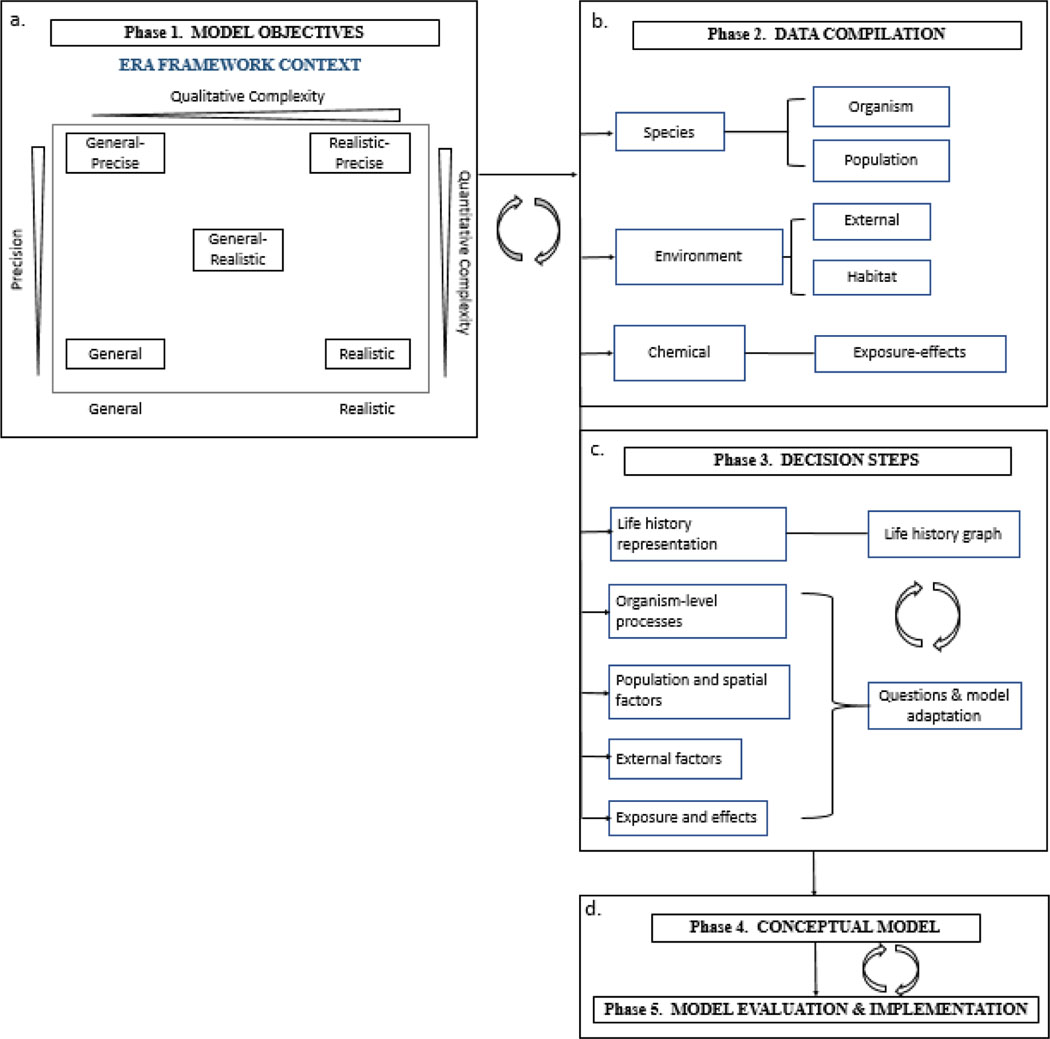
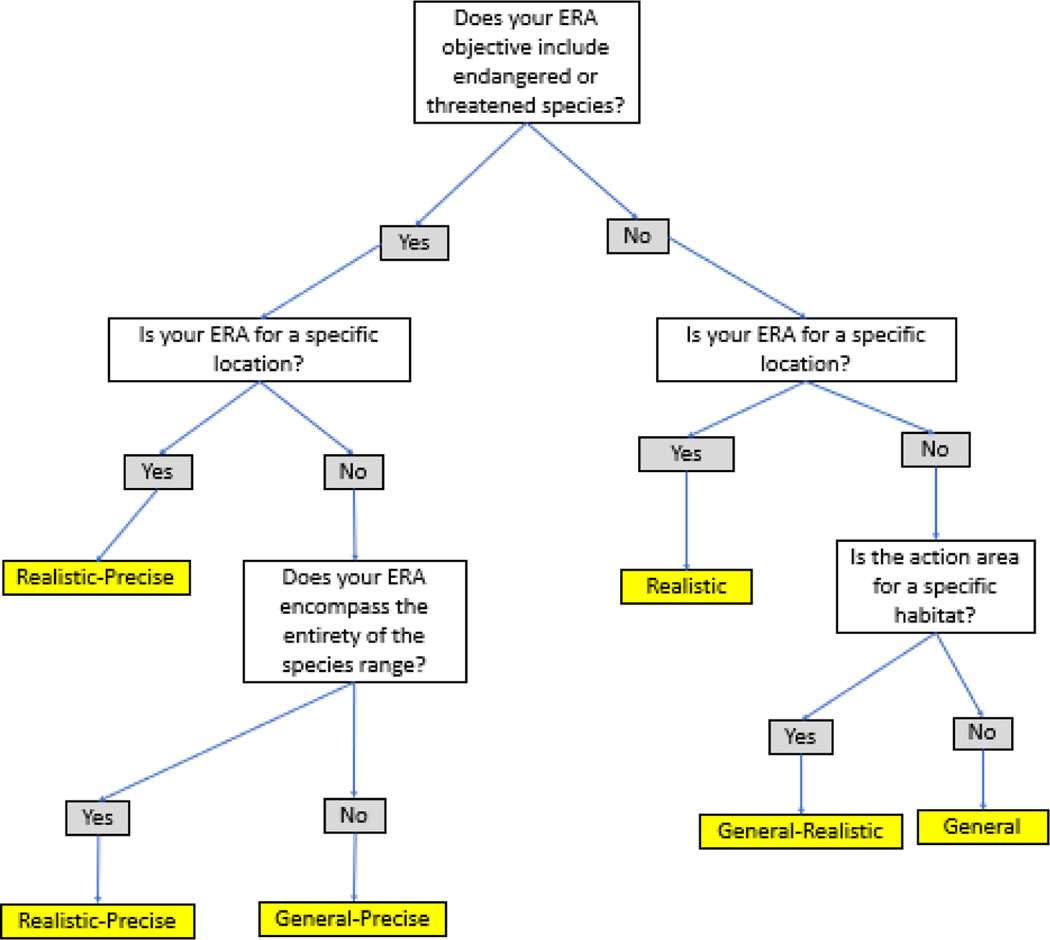
The assimilation of population models into ecological risk assessment (ERA) has been hindered by their range of complexity, uncertainty, resource investment, and data availability. Likewise, ensuring that the models address risk assessment objectives has been challenging. Recent research efforts have begun to tackle these challenges by creating an integrated modeling framework and decision guide to aid the development of population models with respect to ERA objectives and data availability. In the framework, the trade-offs associated with the generality, realism, and precision of an assessment are used to guide the development of a population model commensurate with the protection goal. The decision guide provides risk assessors with a stepwise process to assist them in developing a conceptual model that is appropriate for the assessment objective and available data. We have merged the decision guide and modeling framework into a comprehensive approach, Population modeling Guidance, Use, Interpretation, and Development for Ecological risk assessment (Pop-GUIDE), for the development of population models for ERA that is applicable across regulatory statutes and assessment objectives. In Phase 1 of Pop-GUIDE, assessors are guided through the trade-offs of ERA generality, realism, and precision, which are translated into model objectives. In Phase 2, available data are assimilated and characterized as general, realistic, and/or precise. Phase 3 provides a series of dichotomous questions to guide development of a conceptual model that matches the complexity and uncertainty appropriate for the assessment that is in concordance with the available data. This phase guides model developers and users to ensure consistency and transparency of the modeling process. We introduce Pop-GUIDE as the most comprehensive guidance for population model development provided to date and demonstrate its use through case studies using fish as an example taxon and the US Federal Insecticide Fungicide and Rodenticide Act and Endangered Species Act as example regulatory statutes. Integr Environ Assess Manag 2021;17:767-784. © 2020 SETAC. This article has been contributed to by US Government employees and their work is in the public domain in the USA.
Keywords: Complexity; Ecological risk assessment; Guidance; Population modeling; Uncertainty.
© 2020 SETAC. This article has been contributed to by US Government employees and their work is in the public domain in the USA.
Figures
References
-
- Accolla C, Vaugeois M, Grimm V, Moore AP, Rueda-Cediel P, Schmolke A, Forbes VE. 2020. A review of key features and their implementation in unstructured, structured, and agent-based population models for ecological risk assessment. Integrated Environmental Assessment and Management, 17(3), 521–540. - PubMed
-
- Anderson B, Phillips B, Hunt J, Siegler K, Voorhees J, Smalling K, Kuivila K, Hamilton M, Ranasinghe JA, Tjeerdema R. 2014. Impacts of pesticides in a Central California estuary. Environ Monit Assess 186: 1801–1814. - PubMed
-
- Ankley GT, Villeneuve DL. 2006. The fathead minnow in aquatic toxicology: Past, present, and future. Aquat Toxicol 78: 91–102. - PubMed
-
- Augusiak J, Van den Brink PJ, Grimm V. 2014. Merging validation and evaluation of ecological models to ‘evaludation’: A review of terminology and a practical approach. Ecol Modell 280: 117–128.
MeSH terms
Substances
Grants and funding
LinkOut - more resources
Full Text Sources
Other Literature Sources
