. 2021 Aug 17;45(4):fuaa062.
doi: 10.1093/femsre/fuaa062.

Advances and opportunities in image analysis of bacterial cells and communities

Affiliations

Advances and opportunities in image analysis of bacterial cells and communities

Hannah Jeckel et al. FEMS Microbiol Rev. .

Abstract

The cellular morphology and sub-cellular spatial structure critically influence the function of microbial cells. Similarly, the spatial arrangement of genotypes and phenotypes in microbial communities has important consequences for cooperation, competition, and community functions. Fluorescence microscopy techniques are widely used to measure spatial structure inside living cells and communities, which often results in large numbers of images that are difficult or impossible to analyze manually. The rapidly evolving progress in computational image analysis has recently enabled the quantification of a large number of properties of single cells and communities, based on traditional analysis techniques and convolutional neural networks. Here, we provide a brief introduction to core concepts of automated image processing, recent software tools and how to validate image analysis results. We also discuss recent advances in image analysis of microbial cells and communities, and how these advances open up opportunities for quantitative studies of spatiotemporal processes in microbiology, based on image cytometry and adaptive microscope control.

Keywords: biofilm; data science; machine learning; microbial community; phenotyping; segmentation; single cell.


Figures

Figure 1.
Figure 1.
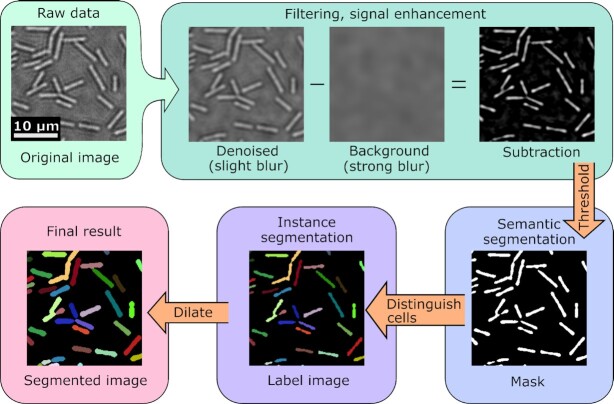
Typical segmentation workflow in traditional image analysis. A combination of filters, thresholding and morphological operations is applied to the original image (showing Bacillus subtilis cells on agar) to first achieve a semantic segmentation, followed by an instance segmentation. Here, two blurred images are subtracted to yield the image named ‘subtraction’. This modified image is thresholded to obtain the mask image, representing a semantic segmentation. A multitude of alternative operations could also lead to an accurate semantic segmentation. In an instance segmentation, individual objects are distinguished, which is represented by a label image. After segmentation, morphological operations such as a morphological dilation can help to improve the segmentation accuracy. The accuracy of segmentation results can be quantified as described in Box 3.
Figure 2.
Figure 2.
Typical segmentation workflow using convolutional neural networks. (A), A set of training data consisting of pairs of raw images and annotated images is used to train a convolutional neural network (CNN) indicated by a schematic icon of the network layers. The architecture of a CNN typically consists of several up- and downscaling layers as well as convolutions between layers. (B), After training, the resulting CNN can be used to obtain segmentation predictions for unseen raw images, which should be of the same type as the training data. Approaches for quantifying the accuracy of segmentation results are described in Box 3.
Figure 3.
Figure 3.
Integration of single-cell image analysis with adaptive microscopy enables highly specific imaging of communities. After capturing the raw image (panel A), cells are distinguished from background to provide a semantic segmentation as shown in panel B. These images are then further processed to identify individual cells, providing an instance segmentation (C). For each cell, a list of properties can be quantified from the imaging data (D). These properties can be interpreted as the dimensions of a high-dimensional space where each cell is represented by one point. (E), A dimensionality reduction, such as principal component analysis, may uncover distinct clusters in this image cytometry parameter space, which correspond to phenotypically different sub-populations. (F), Based on the high-dimensional cytometry analysis, the next experimental steps can be determined, for example zooming in on only those parts of the community with particular phenotypes, to increase the specificity and resolution of the experimental procedure. This concept of live image analysis and adaptation of the microscopy acquisition parameters may be repeated in a feedback loop to optimize and automate experiments.
Figure 4.
Figure 4.
Schematic figure of the intersection over union (IoU) and the segmentation accuracy for different image analysis methods, measured as a function of the IoU threshold. (A), Visualization of the IoU, which is defined as the fraction between the size of the intersecting area between two regions and the size of their union. (B), In this schematic plot, different colors represent different segmentation methods, with different segmentation performance. High Jaccard index values indicate a high segmentation accuracy. Note that the best method for a particular choice of IoU threshold does not need to be the best method for all threshold values.

References

    1. Aghaeepour N, Finak G, Hoos Het al. Critical assessment of automated flow cytometry data analysis techniques. Nat Methods. 2013;10:228–38. - PMC - PubMed
    1. Balomenos AD, Tsakanikas P, Aspridou Zet al. Image analysis driven single-cell analytics for systems microbiology. BMC Syst Biol. 2017;11:43. - PMC - PubMed
    1. Bannon D, Moen E, Borba Eet al. DeepCell 2.0: Automated cloud deployment of deep learning models for large-scale cellular image analysis. bioRxiv. 2018;12:505032.
    1. Becht E, McInnes L, Healy Jet al. Dimensionality reduction for visualizing single-cell data using UMAP. Nat Biotechnol. 2019;37:38–44. - PubMed
    1. Berg HC. How to Track Bacteria. Rev Sci Instrum. 1971;42:868–71. - PubMed

Publication types