


Variability in Kidney Function Estimates in Emerging Adults With Spina Bifida: Implications for Transitioning From Pediatric to Adult Care
- PMID: 33242556
- PMCID: PMC7880582
- DOI: 10.1016/j.urology.2020.10.050
Variability in Kidney Function Estimates in Emerging Adults With Spina Bifida: Implications for Transitioning From Pediatric to Adult Care
Abstract
Objective: To examine the variability of estimated glomerular filtration rate (eGFR) in emerging adults with spina bifida (SB) by comparing multiple equations across the transitional age period, hypothesizing that creatinine (Cr)-based equations show greater variability than cystatin-C (CysC)- or combination-based equations.
Methods: A retrospective cohort study was performed from 2012 to 2017 at a multidisciplinary SB clinic. Emerging adults were defined as patients ages 18-28 years old. Four pediatric, 3 adult, and 3 averaged eGFR equations were considered. Cross-sectional variability in eGFR data was assessed using coefficients of variation, chronic kidney disease (CKD) stage classification, and pairwise percent relative difference in eGFR between analogous pediatric and adult equations based on included lab values. Longitudinal changes in eGFR over time were compared across equations using a covariance pattern model accounting for repeated measures.
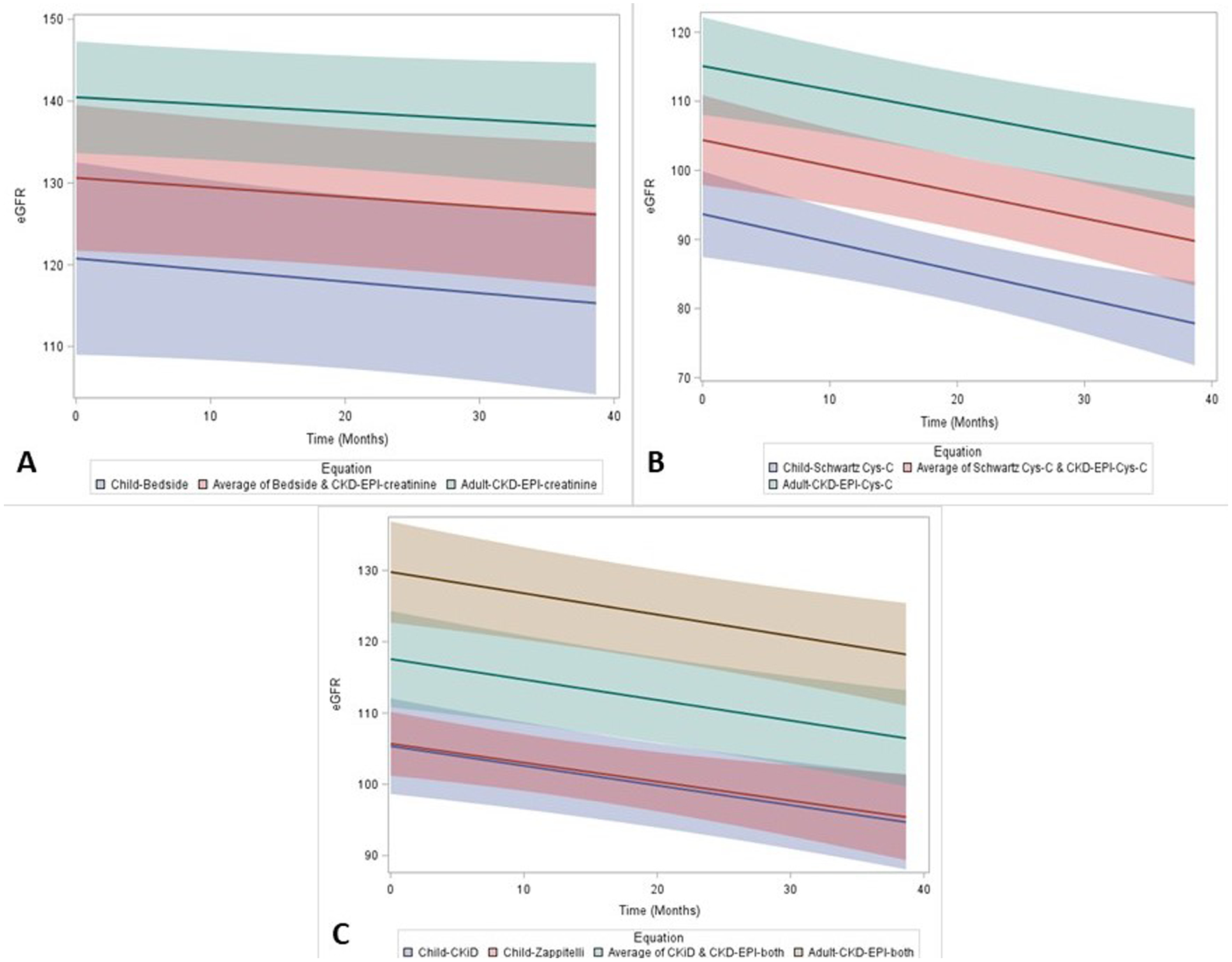
Results: Seventy-five emerging adults with SB (median age 21.8 years; 55% female; 83% with myelomeningocele) were included in cross-sectional analyses. Adult equations gave higher median eGFRs by 22%-27% and generally milder CKD stage classification than analogous pediatric equations. In longitudinal analyses (median follow-up of 22 months), all equations conferred negative eGFR changes over time (range -1.9 to -4.3 mL/min/1.73m2 per year) that were not significantly different.
Conclusion: In emerging adults with SB, adult equations demonstrated higher median eGFRs by 22%-27% compared to analogous pediatric equations, even with Cystatin-C, and generally downstaged CKD stage classification. The same eGFR equation should be used for serial kidney function monitoring in emerging adults with SB who transition care from pediatric to adult services.
Copyright © 2020 Elsevier Inc. All rights reserved.
Conflict of interest statement
Declarations of Interest: None.
Figures
Comment in
-
EDITORIAL COMMENT.Urology. 2021 Feb;148:312-313. doi: 10.1016/j.urology.2020.10.051. Urology. 2021. PMID: 33549222 No abstract available.
References
-
- Lloyd JC, Wiener JS, Gargollo PC, Inman BA, Ross SS, Routh JC. Contemporary epidemiological trends in complex congenital genitourinary anomalies. J Urol. 2013;190(4 Suppl):1590–1595. - PubMed
-
- Parker SE, Mai CT, Canfield MA, et al. Updated National Birth Prevalence estimates for selected birth defects in the United States, 2004–2006. Birth Defects Res A Clin Mol Teratol. 2010;88(12):1008–1016. - PubMed
-
- Shin M, Besser LM, Siffel C, et al. Prevalence of spina bifida among children and adolescents in 10 regions in the United States. Pediatrics. 2010;126(2):274–279. - PubMed
-
- Young NL, Anselmo LA, Burke TA, McCormick A, Mukherjee S. Youth and young adults with spina bifida: their utilization of physician and hospital services. Arch Phys Med Rehabil. 2014;95(3):466–471. - PubMed
MeSH terms
Substances
Grants and funding
LinkOut - more resources
Full Text Sources
Other Literature Sources
Medical
Research Materials
Miscellaneous
