Review
. 2021;111(11):1066-1085.
doi: 10.1159/000513346. Epub 2020 Nov 26.

Sex Disparities in COVID-19 Severity and Outcome: Are Men Weaker or Women Stronger?

Affiliations
Review

Sex Disparities in COVID-19 Severity and Outcome: Are Men Weaker or Women Stronger?

Rosario Pivonello et al. Neuroendocrinology. 2021.

Abstract

The coronavirus disease 2019 (COVID-19) outbreak, caused by severe acute respiratory syndrome coronavirus 2 (SARS-CoV-2), is a global public health issue which has profound effects on most aspects of societal well-being, including physical and mental health. A plethora of studies globally have suggested the existence of a sex disparity in the severity and outcome of COVID-19 patients, mainly due to mechanisms of virus infection, immune response to the virus, development of systemic inflammation, and consequent systemic complications, particularly thromboembolism. Epidemiological data report a sex difference in the severity of COVID-19, with a more favorable course of the disease in women compared to men regardless of age, although the rate of SARS-CoV-2 infection seems to be similar in both sexes. Sex hormones, including androgens and estrogens, may not only impact virus entry and load, but also shape the clinical manifestations, complications, and ultimately the outcome of the disease. The current review comprehensively summarizes the current literature on sex disparities in susceptibility and outcome of COVID-19 as well as the literature underpinning the pathophysiological and molecular mechanisms, which may provide a rationale to a sex disparity. These mechanisms include sex hormone influence on factors that facilitate virus entry and priming, immune and inflammatory response, as well as coagulation and thrombosis diathesis. Based on present evidence, women appear to be relatively protected from COVID-19 because of a more effective immune response and a less pronounced systemic inflammation, with consequent moderate clinical manifestations of the disease, together with a lesser predisposition to thromboembolism. Conversely, men appear to be particularly susceptible to COVID-19 because of a less effective immune response with consequent severe clinical manifestations of the disease, together with a greater predisposition to thromboembolism. In the elderly, generally characterized by the phenomenon of inflammaging, sex disparities in overall mortality following SARS-CoV-2 infection are even more palpable as elderly men appear to be more prone to severe COVID-19 because of a greater predisposition to infections, a weaker immune defense, and an enhanced thrombotic state compared to women. The information revealed from the review highlights potential novel therapeutic approaches employing the administration of hormonal or antihormonal therapy in combination with antiviral drugs in COVID-19 patients.

Keywords: Androgens; COVID-19; Estrogens; Inflammaging; Sex disparity; Sex hormones.


Conflict of interest statement

The authors have no conflicts of interest to declare.

Figures
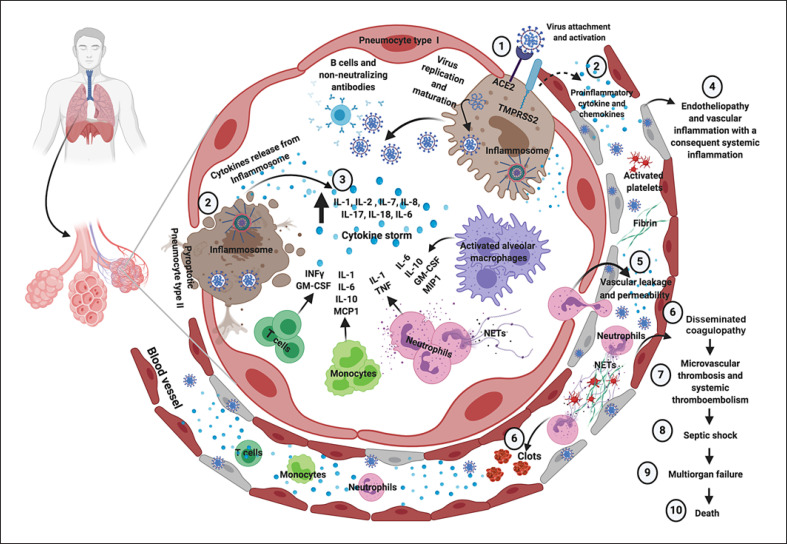
Fig. 1
Fig. 1
Immune, inflammatory, and thrombotic response to SARS-CoV-2 infection in case of severe COVID-19. SARS-CoV-2 enters into cells expressing the surface ACE2 receptors and TMPRSS2 (1). The replication and release of SARS-CoV-2 cause pyroptosis of host cells and release of proinflammatory cytokines by inflammasomes (mainly IL-1, IL-8, and IL-18) and cell debris that activate alveolar macrophages, which in turn further release proinflammatory cytokines (mainly IL-10, GM-CSF, and MIP1) and chemokines (2). These proteins attract other innate and adaptive immune cells in the lungs, damaging the lung infrastructure and with the addition of increasing release of IFN-γ by T cell promoting a proinflammatory feedback loop and cytokine storm (3). Moreover, production of non-neutralizing antibodies by B cells may enhance SARS-CoV-2 infection, further exacerbating organ damage. Concomitantly, the damage of endothelial tissue directly caused by SARS-CoV-2 entry and the local inflammation induce endotheliopathy characterized by injured endothelial tissue (4) with consequent vascular leaking (5). Neutrophil extracellular traps induce the aggregation of platelets and fibrin deposition, leading to blood clots formation and promoting disseminated coagulopathy (6). This mechanism finally results in microvascular thrombosis and systemic thromboembolism (7). As a consequence, septic shock and multiorgan failure may develop and represent potential major death determinants in COVID-19. Figure created with www.biorender.com. ACE2, angiotensin-converting enzyme 2; COVID-19, coronavirus disease 2019; GM-CSF, granulocyte-macrophage colony-stimulating factor; IFN-γ, interferon gamma; IL, interleukin; MCP1, monocyte chemoattractant protein 1; MIP1, macrophage inflammatory protein 1; NETs, neutrophil extracellular traps; SARS-CoV-2, severe acute respiratory syndrome coronavirus 2; TMPRSS2, transmembrane protease serine 2; TNF, tumor necrosis factor.
Fig. 2
Fig. 2
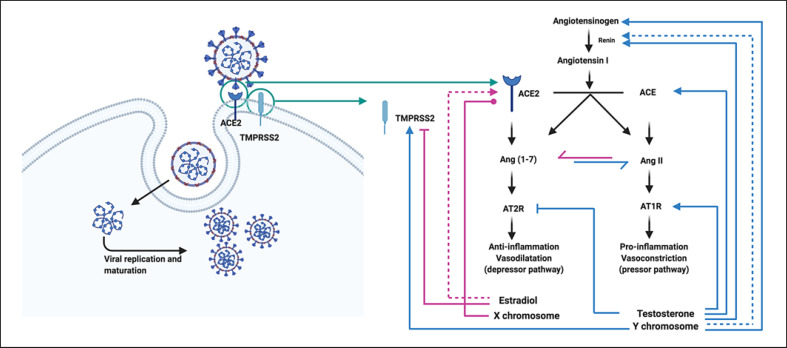
Sex chromosome and sex hormone regulation of TMPRSS2 and ACE2 expression and activity, and implications in RAS function. ACE2 and TMPRSS2 are stechiometrically contiguous and mediate SARS-CoV-2 cell fusion and entry. ACE2, being an X-linked gene, should be supposed to be more expressed in female tissue (pink line with dot). However, despite being an X-linked gene escaping from X inactivation, ACE2 displays a male-biased expression in several tissues. Subsequently to membrane fusion and virus entry into the host cell, SARS-CoV-2 infection leads to downregulation of ACE2. As a result, the ACE2/Ang(1-7)/AT2R axis is markedly attenuated, with amplification of the pressor ACE/AngII/AT1R axis. Sex chromosome and sex hormones contribute to RAS regulation. In males, sex hormones and genes in sex chromosomes contribute by differentially modulating the RAS. Specifically, testosterone upregulates the expression of angiotensinogen and AT1R (blue line with arrow), reduces the expression of AT2R (blue line with inhibitor), and concomitantly inhibits renin activity (blue dashed line with arrow). Moreover, SRY genes upregulate angiotensinogen, renin, and ACE expression (blue line with arrow) and downregulate ACE2 expression (blue line with inhibitor). These effects upregulate the classical constrictor and proinflammatory pathway ACE/AngII/AT1R axis. Moreover, testosterone positively regulates TMPRSS2 expression (blue line with arrow). In contrast, estradiol changes the balance towards depressor and anti-inflammatory ACE2/Ang(1-7)/AT2R axis increasing ACE2 activity (pink dashed line with arrow). Moreover, estradiol negatively regulates TMPRSS2 expression (pink line with arrow). Figure created with www.biorender.com. ACE, angiotensin-converting enzyme; ACE2, angiotensin-converting enzyme 2; Ang(1-7), angiotensin 1-7; AngII, angiotensin II; RAS, renin-angiotensin system; SARS-CoV-2, severe acute respiratory syndrome coronavirus 2; SRY, sex-determining region Y; TMPRSS2, transmembrane protease serine 2.
Fig. 3
Fig. 3
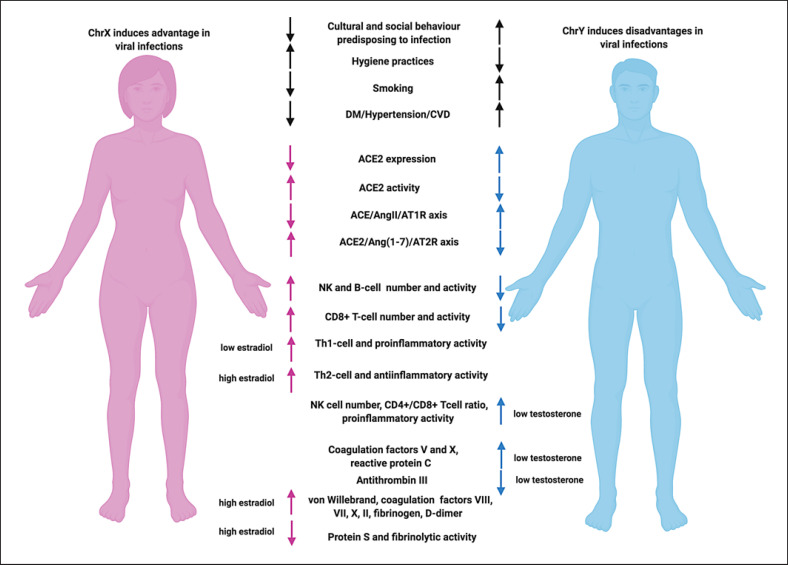
Sex differences in susceptibility to SARS-CoV-2 infection and sex hormone influence on innate and adaptive immune response, inflammation, and coagulatory state. Figure created with www.biorender.com. ACE, angiotensin-converting enzyme; ACE2, angiotensin-converting enzyme 2; Ang(1-7), angiotensin 1-7; AngII, angiotensin II; ChrX, chromosome X; ChrY, chromosome Y; CVD, cardiovascular disease; DM, diabetes mellitus; NK, natural killer; SARS-CoV-2, severe acute respiratory syndrome coronavirus 2.

References

    1. Wiersinga WJ, Rhodes A, Cheng AC, Peacock SJ, Prescott HC. Pathophysiology, Transmission, Diagnosis, and Treatment of Coronavirus Disease 2019 (COVID-19): A Review. JAMA. 2020 Aug;324((8)):782–93. - PubMed
    1. Zhou F, Yu T, Du R, Fan G, Liu Y, Liu Z, et al. Clinical course and risk factors for mortality of adult inpatients with COVID-19 in Wuhan, China: a retrospective cohort study. Lancet. 2020 Mar;395((10229)):1054–62. - PMC - PubMed
    1. Hu B, Guo H, Zhou P, Shi ZL. Characteristics of SARS-CoV-2 and COVID-19. Nat Rev Microbiol. 2020 Oct - PMC - PubMed
    1. Hoffmann M, Kleine-Weber H, Schroeder S, Krüger N, Herrler T, Erichsen S, et al. SARS-CoV-2 Cell Entry Depends on ACE2 and TMPRSS2 and Is Blocked by a Clinically Proven Protease Inhibitor. Cell. 2020 Apr;181((2)):271–280.e8. - PMC - PubMed
    1. Sungnak W, Huang N, Bécavin C, Berg M, Queen R, Litvinukova M, et al. HCA Lung Biological Network SARS-CoV-2 entry factors are highly expressed in nasal epithelial cells together with innate immune genes. Nat Med. 2020 May;26((5)):681–7. - PMC - PubMed

MeSH terms