


A one health framework to estimate the cost of antimicrobial resistance
- PMID: 33243302
- PMCID: PMC7689633
- DOI: 10.1186/s13756-020-00822-6
A one health framework to estimate the cost of antimicrobial resistance
Abstract
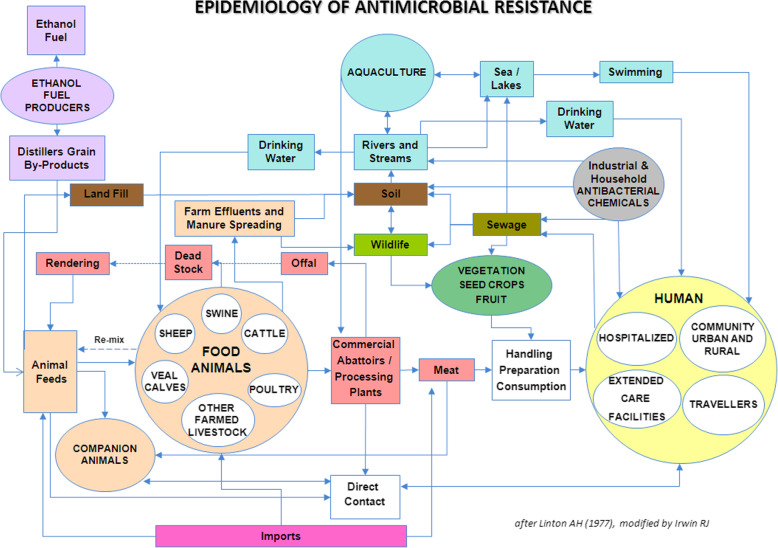
Objectives/purpose: The costs attributable to antimicrobial resistance (AMR) remain theoretical and largely unspecified. Current figures fail to capture the full health and economic burden caused by AMR across human, animal, and environmental health; historically many studies have considered only direct costs associated with human infection from a hospital perspective, primarily from high-income countries. The Global Antimicrobial Resistance Platform for ONE-Burden Estimates (GAP-ON€) network has developed a framework to help guide AMR costing exercises in any part of the world as a first step towards more comprehensive analyses for comparing AMR interventions at the local level as well as more harmonized analyses for quantifying the full economic burden attributable to AMR at the global level.
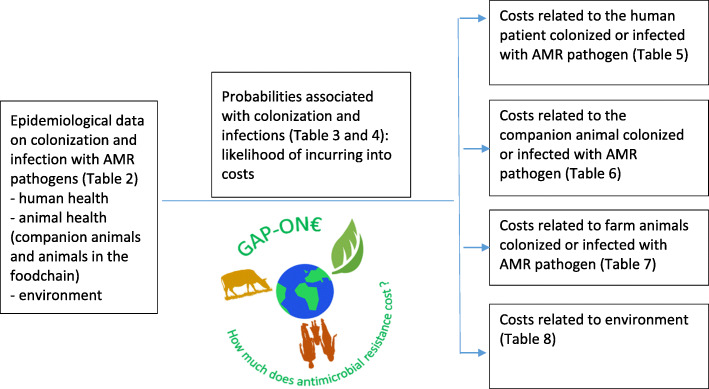
Methods: GAP-ON€ (funded under the JPIAMR 8th call (Virtual Research Institute) is composed of 19 international networks and institutions active in the field of AMR. For this project, the Network operated by means of Delphi rounds, teleconferences and face-to-face meetings. The resulting costing framework takes a bottom-up approach to incorporate all relevant costs imposed by an AMR bacterial microbe in a patient, in an animal, or in the environment up through to the societal level.
Results: The framework itemizes the epidemiological data as well as the direct and indirect cost components needed to build a realistic cost picture for AMR. While the framework lists a large number of relevant pathogens for which this framework could be used to explore the costs, the framework is sufficiently generic to facilitate the costing of other resistant pathogens, including those of other aetiologies.
Conclusion: In order to conduct cost-effectiveness analyses to choose amongst different AMR-related interventions at local level, the costing of AMR should be done according to local epidemiological priorities and local health service norms. Yet the use of a common framework across settings allows for the results of such studies to contribute to cumulative estimates that can serve as the basis of broader policy decisions at the international level such as how to steer R&D funding and how to prioritize AMR amongst other issues. Indeed, it is only by building a realistic cost picture that we can make informed decisions on how best to tackle major health threats.
Keywords: Antimicrobial resistance; Cost; One health.
Conflict of interest statement
MdK received funding from the Innovative Medicines Initiative Joint Undertaking under grant agreements nos. 115523, 115620, and 115737 (Combatting Bacterial Resistance in Europe projects [COMBACTE]), resources of which are composed of financial contribution from the European Union’s 7th Framework Programme (FP7/2007 ± 2013) and the European Federation of Pharmaceutical Industries and Associations (EFPIA) companies’ in kind contribution. CA as a part of EU-JAMRAI (European Union Joint Action on Antimicrobial Resistance and Healthcare-Associated Infections) has received funding from the health programme of the European Union (2014-2020) under grant agreement N°761296.
K.O. and R.A.A. was supported by the Cooperative Agreement Number IDSEP160030 from ASPR/BARDA and by awards from Wellcome Trust, the Global AMR Innovation Fund (GAMRIF) funded by the UK Government Department of Health and Social Care (DHSC), the German Federal Ministry of Education and Research (BMBF) and the Bill & Melinda Gates Foundation, as administrated by CARB-X. The contents do not necessarily represent the views of the CARB-X project nor any CARB-X project funder including the governments of the United States (BARDA, NIAID), the United Kingdom (DHSC, GAMRIF), or Germany (BMBF), the Wellcome Trust, or the Bill & Melinda Gates Foundation. KO is also supported by the Social Innovation on Drug Discovery program at Boston University.
None of the other Authors have conflicting interests.
Figures
References
-
- Transforming our world: the 2030 Agenda for Sustainable Development .:. Sustainable Development Knowledge Platform. https://sustainabledevelopment.un.org/post2015/transformingourworld. Accessed 11 Dec 2019.
-
- WHO. GLOBAL ACTION PLAN ON ANTIMICROBIAL' ' RESISTANCE. 2015.
-
- EU Commission. A European One Health Action Plan against Antimicrobial Resistance (AMR). https://ec.europa.eu/health/sites/health/files/antimicrobial_resistance/.... Accessed 9 Oct 2020.
-
- Smith E. Evaluation of the EC Action Plan against the rising threats from antimicrobial resistance. 2016.
-
- Drug-Resistant Infections: A Threat to Our Economic Future. https://www.worldbank.org/en/topic/health/publication/drug-resistant-inf.... Accessed 25 Feb 2020.
Publication types
MeSH terms
LinkOut - more resources
Full Text Sources
Medical
Miscellaneous
