. 2020 Nov;8(2):e000764.
doi: 10.1136/jitc-2020-000764.

Tumors establish resistance to immunotherapy by regulating Treg recruitment via CCR4

Affiliations

Tumors establish resistance to immunotherapy by regulating Treg recruitment via CCR4

Lisa A Marshall et al. J Immunother Cancer. 2020 Nov.

Abstract

Background: Checkpoint inhibitors (CPIs) such as anti-PD(L)-1 and anti-CTLA-4 antibodies have resulted in unprecedented rates of antitumor responses and extension of survival of patients with a variety of cancers. But some patients fail to respond or initially respond but later relapse as they develop resistance to immune therapy. One of the tumor-extrinsic mechanisms for resistance to immune therapy is the accumulation of regulatory T cells (Treg) in tumors. In preclinical and clinical studies, it has been suggested that tumor trafficking of Treg is mediated by CC chemokine receptor 4 (CCR4). Over 90% of human Treg express CCR4 and migrate toward CCL17 and CCL22, two major CCR4 ligands that are either high at baseline or upregulated in tumors on CPI treatment. Hence, CCR4 antagonism has the potential to be an effective antitumor treatment by reducing the accumulation of Treg into the tumor microenvironment (TME).

Methods: We developed in vitro and in vivo models to assess Treg migration and antitumor efficacy using a potent and selective CCR4 antagonist, CCR4-351. We used two separate tumor models, Pan02 and CT26 mouse tumors, that have high and low CCR4 ligand expression, respectively. Tumor growth inhibition as well as the frequency of tumor-infiltrating Treg and effector T cells was assessed following the treatment with CCR4 antagonist alone or in combination with CPI.

Results: Using a selective and highly potent, novel small molecule inhibitor of CCR4, we demonstrate that migration of CCR4+ Treg into the tumor drives tumor progression and resistance to CPI treatment. In tumor models with high baseline levels of CCR4 ligands, blockade of CCR4 reduced the number of Treg and enhanced antitumor immune activity. Notably, in tumor models with low baseline level of CCR4 ligands, treatment with immune CPIs resulted in significant increases of CCR4 ligands and Treg numbers. Inhibition of CCR4 reduced Treg frequency and potentiated the antitumor effects of CPIs.

Conclusion: Taken together, we demonstrate that CCR4-dependent Treg recruitment into the tumor is an important tumor-extrinsic mechanism for immune resistance. Blockade of CCR4 led to reduced frequency of Treg and resulted in increased antitumor activity, supporting the clinical development of CCR4 inhibitors in combination with CPI for the treatment of cancer.

Statement of significance: CPI upregulates CCL17 and CCL22 expression in tumors and increases Treg migration into the TME. Pharmacological antagonism of the CCR4 receptor effectively inhibits Treg recruitment and results in enhanced antitumor efficacy either as single agent in CCR4 ligandhigh tumors or in combination with CPIs in CCR4 ligandlow tumors.

Keywords: combination; drug therapy; immunotherapy; lymphocytes; tumor escape; tumor-infiltrating.


Conflict of interest statement

Competing interests: LAM, AJ, SJ, MZ, OR, JJJ, DP, JS, MB, AW, DW, PDK, GC, BW, DGB and OT are employees and stockholders of RAPT Therapeutics.

Figures

Figure 1
Figure 1
Chemokines CCL17 and CCL22 are highly expressed in human ‘hot’ tumors and have strong correlation with Treg recruitment. Messenger RNA (mRNA) expression analysis in human tumor patient samples (TCGA database) and normal tissue (GTEX database). Each cross plot indicates a specific type of tumor (left) or tissue (right). (A) Correlation plot of CD8 and FOXP3 expression in tumor (left graph) and normal tissue (right graph). (B) Correlation plot of CCL17+CCL22 and FOXP3 expression in tumor (left graph) and normal tissue (right graph). (C) Representative flow cytometry plots of chemokine receptor expression on CD25+ CD127low Treg in PBMCs from three different donors. CCR4, CC chemokine receptor 4; GTEX, Genotype-Tissue Expression; TCGA, The Cancer Genome Atlas.
Figure 2
Figure 2
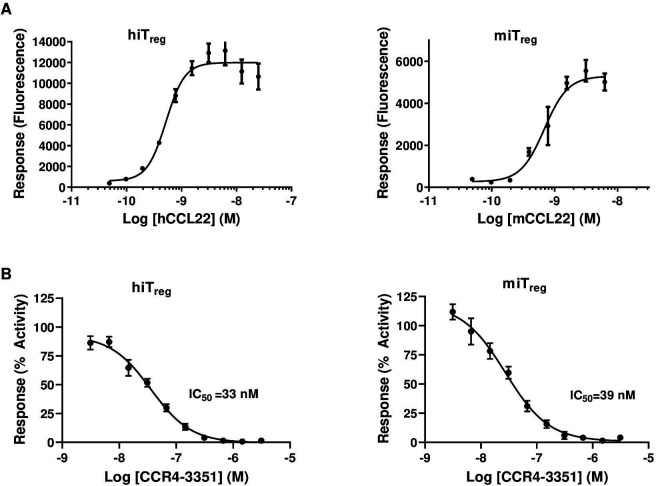
A potent and selective small molecule CCR4 antagonist, CCR4-351, blocks the in vitro chemotaxis of CCR4+ Treg. (A) Induced human (left) and mouse (right) Treg migration towards the CCL22 chemokine. (B) IC50 determination of CCR4-351. Representative data are shown from five independent experiments. hiTreg, human-induced Treg; miTreg, mouse-induced Treg.
Figure 3
Figure 3
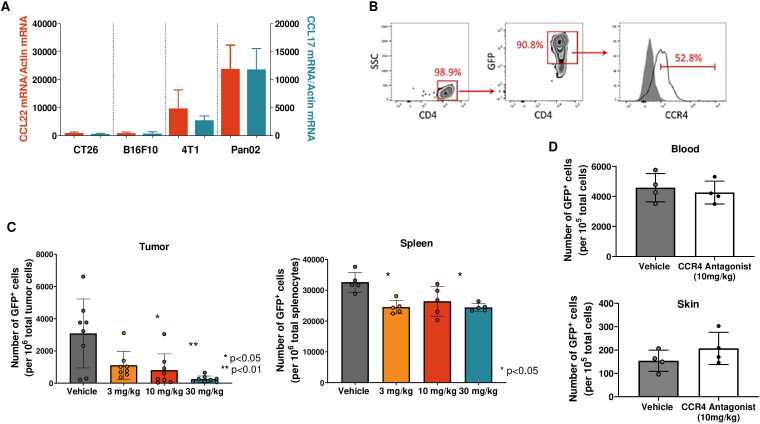
CCR4 blockade significantly reduces Treg trafficking into tumors. (A) Messenger RNA expression of CCL17 (teal) and CCL22 (red) in different mouse tumors. (B) Representative flow cytometry plots showing percent of in vitro generated GFP+ Treg and CCR4 expression prior to transfer into tumor-bearing animals. (C) In vivo Treg migration in Pan02 tumor-bearing mice dosed with CCR4-351. Number of GFP+ Treg in tumor (left) and spleen (right). (D) In vivo Treg migration in the periphery. Number of GFP+ Treg in blood and healthy skin tissue. For statistical analysis, the one-way analysis of variance (Kruskal-Wallis test; non-parametric or mixed) was used. n=8 mice (tumor), n=5 mice (spleen) and n=4 mice (skin and blood) were used in this study. Data is representative from two independent studies.
Figure 4
Figure 4
CCR4 inhibition in CCL17high CCL22high tumors showed antitumor efficacy. (A) Tumor efficacy study in Pan02-OVA-bearing mice. Mice (n=10 per group) were randomized on day 5 post tumor inoculation and treated with anti-CTLA-4 antibody (days 5, 9, 13 and 17 post inoculation), CCR4-351 alone (daily dose post randomization) or in combination. Median tumor growth and individual tumor growth plots are shown. Statistical significance from ordinary two-way analysis of variance (ANOVA) with Tukey test. (B, C) Tumors were harvested on day 28 post inoculation and analyzed for (B) Foxp3+ Treg frequency and (C) CD8:Treg ratios in the tumor. For statistical analysis, ordinary one-way ANOVA with Tukey test was used. n=7–8 mice were used in this study. Data is representative of two independent studies.
Figure 5
Figure 5
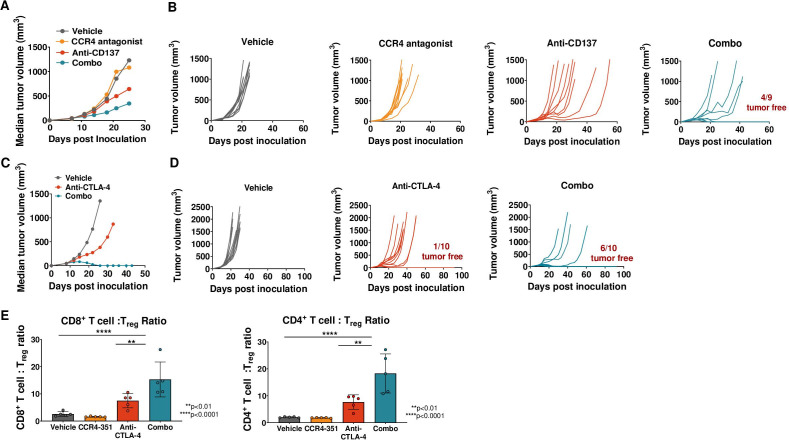
CCR4 inhibition leads to antitumor efficacy in combination with checkpoint inhibitor but not as single agent in CCL17/22low tumors. CT26 tumor-bearing mice were randomized on day 7 or 8 post tumor inoculation (tumor volume 40–70 mm3) and were dosed with anti-CD137 antibody (A, B) or anti-CTLA-4 antibody (C, D) on the days 0, 4, 8 and 12 post randomization. Mice receiving CCR4 antagonist were dosed daily post randomization. Median tumor volume (A, C) or individual tumor growth plots (B, D) are shown (n=10 mice). (E) Analysis of CD4+ and CD8+ T cell ratios to Treg (n=5 mice). For statistical analysis, ordinary one-way analysis of variance with Dunnet’s correction was used. This is representative data from three independent in vivo efficacy studies.
Figure 6
Figure 6
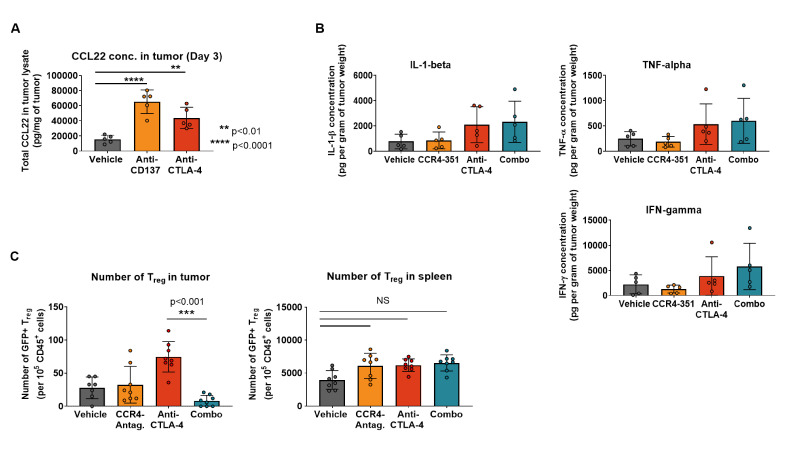
CCL22 ligand level in tumors is upregulated after CPI treatment in tumors. (A) CCL22 ligand concentration was measured in CT26 tumor lysates after treatment with checkpoint inhibitors or immune agonists days post dose (n=5). (B) Concentration of proinflammatory cytokines in the tumor was measured 3 days post randomization (n=5). (C) Treg migration study in CT26 tumors. Mice were dosed twice with anti-CTLA-4 antibody (on the day of randomization and 3 days later). GFP+ Treg were transferred 7 days post first antibody challenge. CCR4 antagonist treatment started 3 hours prior to Treg transfer. Number of migrated GFP+ Treg in the tumor (left graph) and spleen (right graph) 6 days post cell transfer (n=8). This is representative data from two independent studies. For statistical analysis, the ordinary one-way analysis of variance with Dunnet’s correction was used. CPI, checkpoint inhibitor; IFN-γ, interferon gamma; IL-1β, interleukin 1 beta; TNF-α, tumor necrosis factor alpha.

References

    1. Yang Y. Cancer immunotherapy: harnessing the immune system to battle cancer. J Clin Invest 2015;125:3335–7. 10.1172/JCI83871 - DOI - PMC - PubMed
    1. Drake CG, Jaffee E, Pardoll DM. Mechanisms of immune evasion by tumors. Adv Immunol 2006;90:51–81. 10.1016/S0065-2776(06)90002-9 - DOI - PubMed
    1. Hodi FS, O'Day SJ, McDermott DF, et al. Improved survival with ipilimumab in patients with metastatic melanoma. N Engl J Med Overseas Ed 2010;363:711–23. 10.1056/NEJMoa1003466 - DOI - PMC - PubMed
    1. Gibney GT, Weiner LM, Atkins MB. Predictive biomarkers for checkpoint inhibitor-based immunotherapy. Lancet Oncol 2016;17:e542–51. 10.1016/S1470-2045(16)30406-5 - DOI - PMC - PubMed
    1. Borghaei H, Paz-Ares L, Horn L, et al. Nivolumab versus docetaxel in advanced Nonsquamous non-small-cell lung cancer. N Engl J Med 2015;373:1627–39. 10.1056/NEJMoa1507643 - DOI - PMC - PubMed

Publication types