Review
. 2020 Nov;52(11):1798-1808.
doi: 10.1038/s12276-020-00528-0. Epub 2020 Nov 26.

Single-cell network biology for resolving cellular heterogeneity in human diseases

Affiliations
Review

Single-cell network biology for resolving cellular heterogeneity in human diseases

Junha Cha et al. Exp Mol Med. 2020 Nov.

Abstract

Understanding cellular heterogeneity is the holy grail of biology and medicine. Cells harboring identical genomes show a wide variety of behaviors in multicellular organisms. Genetic circuits underlying cell-type identities will facilitate the understanding of the regulatory programs for differentiation and maintenance of distinct cellular states. Such a cell-type-specific gene network can be inferred from coregulatory patterns across individual cells. Conventional methods of transcriptome profiling using tissue samples provide only average signals of diverse cell types. Therefore, reconstructing gene regulatory networks for a particular cell type is not feasible with tissue-based transcriptome data. Recently, single-cell omics technology has emerged and enabled the capture of the transcriptomic landscape of every individual cell. Although single-cell gene expression studies have already opened up new avenues, network biology using single-cell transcriptome data will further accelerate our understanding of cellular heterogeneity. In this review, we provide an overview of single-cell network biology and summarize recent progress in method development for network inference from single-cell RNA sequencing (scRNA-seq) data. Then, we describe how cell-type-specific gene networks can be utilized to study regulatory programs specific to disease-associated cell types and cellular states. Moreover, with scRNA data, modeling personal or patient-specific gene networks is feasible. Therefore, we also introduce potential applications of single-cell network biology for precision medicine. We envision a rapid paradigm shift toward single-cell network analysis for systems biology in the near future.


Conflict of interest statement

The authors declare that they have no conflict of interest.

Figures
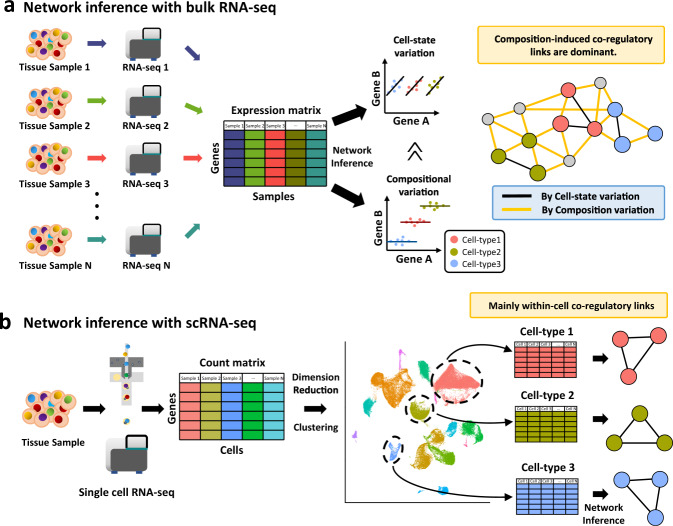
Fig. 1
Fig. 1. Comparison between network inference with bulk RNA-seq and scRNA-seq.
a Network inference with bulk RNA-seq analysis. Multiple tissue samples and sequencing are required to produce a gene-by-sample matrix. Correlation between genes can be detected from both expression variation across cell states and variation of cell-type composition across tissue samples. The resultant coregulatory network is mostly composed of cell-type composition-induced coexpression. b Network inference with scRNA-seq. A single tissue sample is disassociated into cells that are individually analyzed in parallel. Clustering of the cells along with dimension reduction enables the identification of cell populations for each of the major cell types. Using a gene-by-cell count matrix for each cell type, we can infer networks mainly composed of within-cell coregulatory links.
Fig. 2
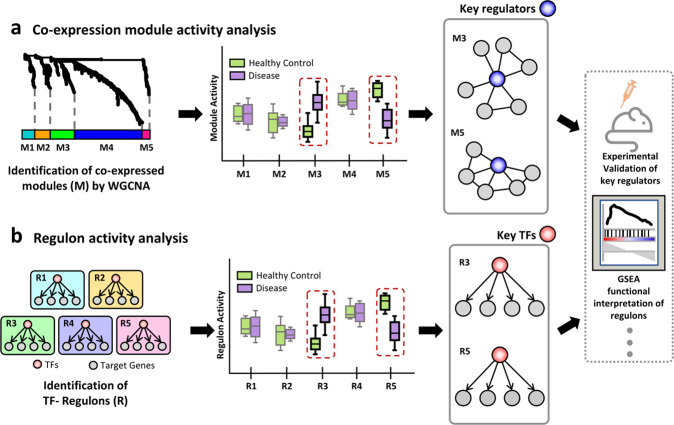
Fig. 2. Hypothesis generation from subnetwork analysis in single-cell network biology.
a Weighted correlation network analysis (WGCNA) of scRNA-seq data generally reveals multiple modules (M1-5) of coexpressed genes of various sizes. The activity of modules can be measured by the average gene expression level. Module activity may significantly differ between cells from different states (e.g., cells of disease samples versus those of healthy controls), which suggests that this coexpressed module is associated with the disease state and may contain key regulators for the disease, often those with high network centrality. b Transcription factor (TF)-target interaction inference generates a set of regulons (R1-5) that are genes regulated by each TF. Comparison of regulon activity between healthy and disease states, similar to module activity, can suggest its association with the disease state. Then, the TF for the associated regulon is predicted to be a key regulator. These candidate regulators are often subjected to experimental validation and gene set enrichment analysis (GSEA) for functional interpretation.
Fig. 3
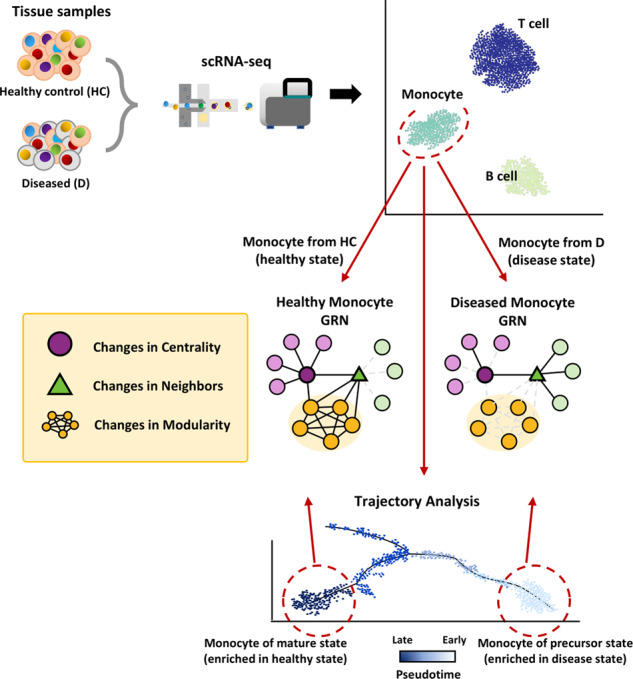
Fig. 3. Hypothesis generation from network topology analysis in single-cell network biology.
Inferences in coregulatory transcriptome profiles of cells from two distinct states (healthy control versus disease state) lead to the construction of different GRNs. Genes that show changes in three types of network topology are likely to be associated with the state: centrality, neighbors, and modularity. For example, correlation analyses for monocytes from healthy and diseased samples may generate different networks, and changes in three types of topology between them will be examined for every gene. Similarly, networks for different developmental times along with topological analysis would suggest disease-associated genes because many disease states are associated with defects in development. For example, defects in the maturation of monocytes into functional dendritic cells would result in immune disorders.
Fig. 4
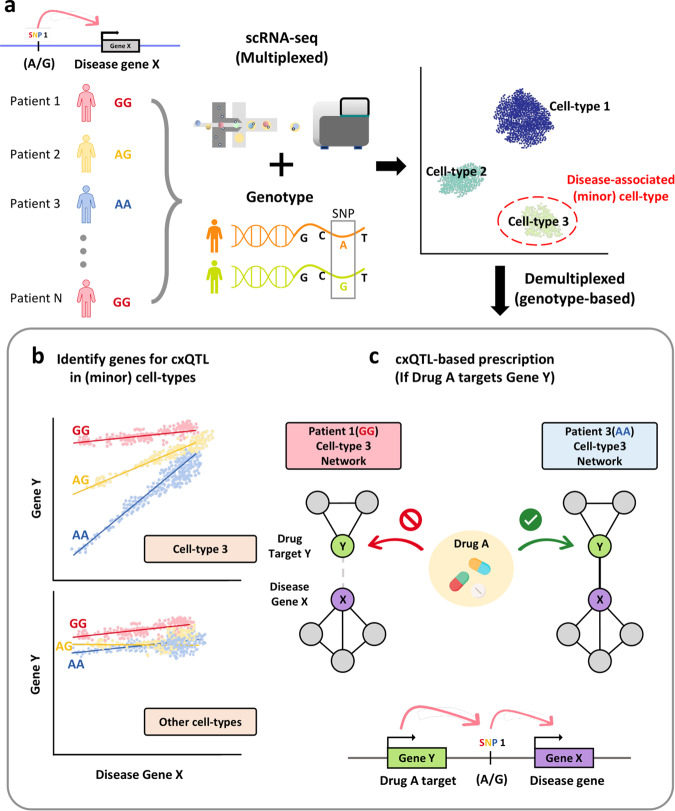
Fig. 4. Hypothesis generation from genotype-network association in single-cell network biology.
a Many disease-associated single nucleotide polymorphisms (SNPs), which are called expression QTLs (eQTLs), exert phenotypic effects through the regulation of gene expression in a cell type-specific manner. Therefore, eQTL analysis needs to be conducted for specific cell types, particularly for minor cell types. The recently developed multiplexed scRNA-seq technology along with demultiplexing based on genotype information will facilitate cell-type-specific eQTL mapping. b Some eQTL effects are dependent on the expression of other genes. This dependency is detected by genotype-specific coexpression, called coexpression QTL (cxQTL). Here, a disease gene X is coexpressed with gene Y only if its eQTL has a homozygous major allele (AA). c If the gene Y is a target of drug A that eventually inhibits the activity of disease gene X via interaction with gene Y, the genotype-dependent coregulatory interaction between genes X and Y is critical for drug action. Then, for prescription of drug A, the cxQTL genotype information can be utilized for precision medicine (e.g., prescribing it only for patients with SNP AA).

References

    1. Bianconi E, et al. An estimation of the number of cells in the human body. Ann. Hum. Biol. 2013;40:463–471. - PubMed
    1. Cano-Gamez E, Trynka G. From GWAS to function: using functional genomics to identify the mechanisms underlying complex diseases. Front Genet. 2020;11:424. - PMC - PubMed
    1. McKinnon KM. Flow cytometry: an overview. Curr. Protoc. Immunol. 2018;120:5 1 1–5 1 11. - PMC - PubMed
    1. Papalexi E, Satija R. Single-cell RNA sequencing to explore immune cell heterogeneity. Nat. Rev. Immunol. 2018;18:35–45. - PubMed
    1. Kolodziejczyk AA, Kim JK, Svensson V, Marioni JC, Teichmann SA. The technology and biology of single-cell RNA sequencing. Mol. Cell. 2015;58:610–620. - PubMed

Publication types