


Factors Associated With Psychological Readiness to Return to Sports With Cutting, Pivoting, and Jump-Landings After Primary ACL Reconstruction
- PMID: 33244476
- PMCID: PMC7678401
- DOI: 10.1177/2325967120964484
Factors Associated With Psychological Readiness to Return to Sports With Cutting, Pivoting, and Jump-Landings After Primary ACL Reconstruction
Abstract
Background: High psychological readiness is an important element for returning to sports after anterior cruciate ligament (ACL) reconstruction. Identifying factors that contribute to psychological readiness is essential for planning interventions to return to play. No studies have used multivariate analysis to clarify factors associated with psychological readiness to return to specific sports.
Hypothesis: To identify factors that contribute to an athlete's psychological readiness to return after ACL reconstruction to sports that require cutting, pivoting, and jump-landings.
Study design: Cross-sectional study; Level of evidence, 3.
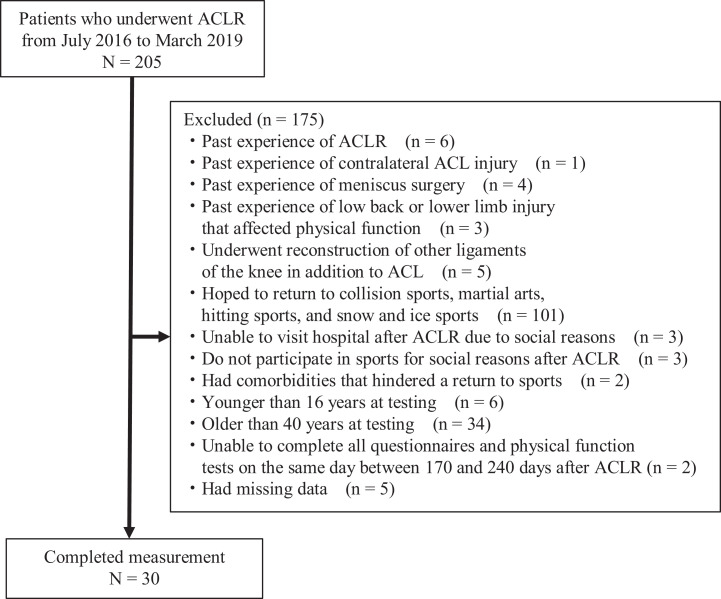
Methods: Study participants were athletes who before injury had participated in sports with limited contact that required cutting, pivoting, and jump-landings (basketball, soccer, futsal, volleyball, badminton, tennis, and frisbee) and hoped to return to the same sport after reconstruction. Psychological readiness was measured using the Anterior Cruciate Ligament-Return to Sport After Injury Scale (ACL-RSI) in athletes more than 6 months after primary ACL reconstruction. To clarify factors associated with the ACL-RSI, univariate regression analysis and multivariate regression analysis were performed using the following independent variables: age, sex, body mass index, time from injury to reconstruction, time from reconstruction to testing, meniscal surgery, modified Tegner activity scale before injury, kinesiophobia, limb symmetry index of knee strength, limb symmetry indices of single-leg hop (SLH) distances, and subjective running ability.
Results: Higher subjective running ability, a lower kinesiophobia score, and greater limb symmetry in the lateral SLH were positively associated with psychological readiness.
Conclusion: The psychological readiness of athletes aiming to return after ACL reconstruction to limited-contact sports that require cutting, pivoting, and jump-landings was affected by subjective running ability, kinesiophobia, and asymmetry of lateral SLH distance. This information may be useful in planning appropriate interventions and thereby increasing the likelihood of an athlete's returning to such sports.
Keywords: ACL-RSI; return to play; sport type.
© The Author(s) 2020.
Conflict of interest statement
One or more of the authors has declared the following potential conflict of interest or source of funding: This work was supported by the JSPS KAKENHI (grant No. JP26350606). AOSSM checks author disclosures against the Open Payments Database (OPD). AOSSM has not conducted an independent investigation on the OPD and disclaims any liability or responsibility relating thereto.
Figures
References
-
- Ardern CL, Österberg A, Tagesson S, et al. The impact of psychological readiness to return to sport and recreational activities after anterior cruciate ligament reconstruction. Br J Sports Med. 2014;48(22):1613–1619. - PubMed
-
- Ardern CL, Webster KE, Taylor NF, Feller JA. Return to sport following anterior cruciate ligament reconstruction surgery: a systematic review and meta-analysis of the state of play. Br J Sports Med. 2011;45(7):596–606. - PubMed
-
- Beischer S, Hamrin Senorski E, Thomeé C, Samuelsson K, Thomeé R. How is psychological outcome related to knee function and return to sport among adolescent athletes after anterior cruciate ligament reconstruction? Am J Sports Med. 2019;47(7):1567–1575. - PubMed
-
- Chmielewski TL, Jones D, Day T, et al. The association of pain and fear of movement/reinjury with function during anterior cruciate ligament reconstruction rehabilitation. J Orthop Sports Phys Ther. 2008;38(12):746–753. - PubMed
LinkOut - more resources
Full Text Sources
