


Non-linear association between admission temperature and neonatal mortality in a low-resource setting
- PMID: 33247153
- PMCID: PMC7695844
- DOI: 10.1038/s41598-020-77778-5
Non-linear association between admission temperature and neonatal mortality in a low-resource setting
Abstract
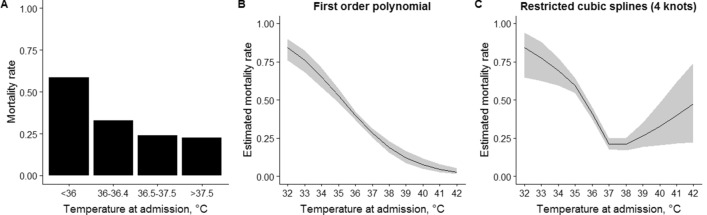
Both neonatal hypothermia and hyperthermia represent important risk factors for neonatal mortality, but information on mortality risk across a full range of neonatal temperatures is lacking in low-resource settings. We evaluated the association between neonatal mortality and a full range of admission temperatures in a low-resource setting. This retrospective observational study was conducted at Beira Central Hospital, Mozambique. The relationship between admission temperature and mortality was evaluated using multivariable analyses with temperature modeled as non-linear term. Among 2098 neonates admitted to the Special Care Unit between January-December 2017, admission temperature was available in 1344 neonates (64%) who were included in the analysis. A non-linear association between mortality rate and temperature was identified. Mortality rate decreased from 84% at 32 °C to 64% at 34.6 °C (- 8% per °C), to 41% at 36 °C (- 16% per °C), to 26% to 36.6 °C (- 25% per °C) and to 22% at 38.3 °C (- 2% per °C), then increased to 40% at 41 °C (+ 7% per °C). Mortality rate was estimated to be at minimum at admission temperature of 37.5 °C. In conclusions, the non-linear relationship highlighted different mortality risks across a full range of neonatal temperatures in a low-resource setting. Admission temperature was not recorded in one third of neonates.
Conflict of interest statement
The authors declare no competing interests.
Figures



References
-
- Perlman JM, Wyllie J, Kattwinkel J, Wyckoff MH, Aziz K, Guinsburg R, Kim HS, Liley HG, Mildenhall L, Simon WM, Szyld E, Tamura M, Velaphi S, Neonatal Resuscitation Chapter Collaborators Part 7: neonatal resuscitation: 2015 International consensus on cardiopulmonary resuscitation and emergency cardiovascular care science with treatment recommendations. Circulation. 2015;132(16 Suppl 1):S204–S241. doi: 10.1161/CIR.0000000000000276. - DOI - PubMed
Publication types
MeSH terms
LinkOut - more resources
Full Text Sources
