


Medial stabilised total knee arthroplasty achieves comparable clinical outcomes when compared to other TKA designs: a systematic review and meta-analysis of the current literature
- PMID: 33247352
- PMCID: PMC8866298
- DOI: 10.1007/s00167-020-06358-x
Medial stabilised total knee arthroplasty achieves comparable clinical outcomes when compared to other TKA designs: a systematic review and meta-analysis of the current literature
Abstract
Purpose: The purpose of this study was to perform a systematic review and meta-analysis to compare clinical and patient-reported outcome measures of medially stabilised (MS) TKA when compared to other TKA designs.
Methods: The Preferred Reporting Items for Systematic Review and Meta-Analyses algorithm was used. The Cochrane Central Register of Controlled Trials, MEDLINE, EMBASE, and EMCARE databases were searched to June 2020. Studies with a minimum of 12 months of follow-up comparing an MS TKA design to any other TKA design were included. The statistical analysis was completed using Review Manager (RevMan), Version 5.3.
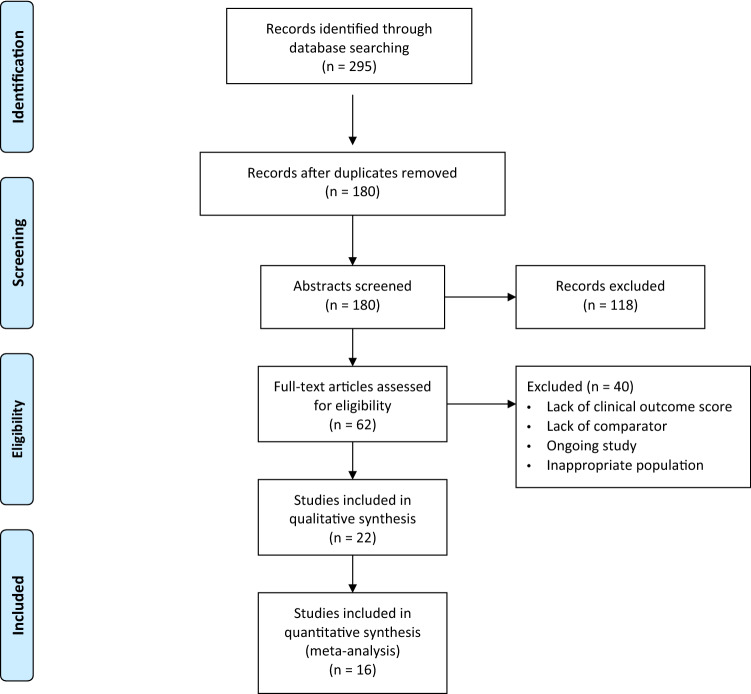
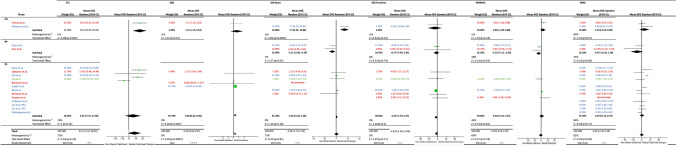
Results: The 22 studies meeting the inclusion criteria included 3011 patients and 4102 TKAs. Overall Oxford Knee Scores were significantly better (p = 0.0007) for MS TKA, but there was no difference in the Forgotten Joint Scores (FJS), Western Ontario and McMaster Universities Osteoarthritis Index (WOMAC), Knee Society Score (KSS)-Knee, KSS-Function, and range of motion between MS and non-MS TKA designs. Significant differences were noted for sub-group analyses; MS TKA showed significantly worse KSS-Knee (p = 0.02) and WOMAC (p = 0.03) scores when compared to Rotating Platform (RP) TKA while significantly better FJS (p = 0.002) and KSS-knee scores (p = 0.0001) when compared to cruciate-retaining (CR) TKA.
Conclusion: This review and meta-analysis show that MS TKA designs result in both patient and clinical outcomes that are comparable to non-MS implants. These results suggest implant design alone may not provide further improvement in patient outcome following TKA, surgeons must consider other factors, such as alignment to achieve superior outcomes.
Level of evidence: III.
Keywords: Medial pivoting; Medial stabilised; Total knee arthroplasty; Total knee replacement.
© 2020. The Author(s).
Conflict of interest statement
The authors report no conflicts of interest. The authors alone are responsible for the content and writing of the paper. Professor Pandit is a National Institute for Health Research (NIHR) Senior Investigator. Mr van Duren is a BRC-NIHR Academic Clinical Lecturer. Mr Nisar is a NIHR Academic Clinical Fellow. The views expressed in this article are those of the author(s) and not necessarily those of the BRC, NIHR, or the Department of Health and Social Care.
Figures
References
-
- Anderson MJ, Becker DL, Kieckbusch T. Patellofemoral complications after posterior-stabilized total knee arthroplasty: a comparison of 2 different implant designs. J Arthroplasty. 2002;17(4):422–426. - PubMed
-
- Bae DK, Do CS, Im SK, Song SJ. Comparison of midterm clinical and radiographic results between total knee arthroplasties using medial pivot and posterior-stabilized prosthesis—a matched pair analysis. J Arthroplasty. 2016;31(2):419–424. - PubMed
-
- Bercik MJ, Joshi A, Parvizi J. Posterior cruciate-retaining versus posterior-stabilized total knee arthroplasty: a meta-analysis. J Arthroplasty. 2013;28(3):439–444. - PubMed
Publication types
MeSH terms
LinkOut - more resources
Full Text Sources
Medical
Research Materials
