


Network meta-analysis of drug-coated balloon angioplasty versus primary nitinol stenting for femoropopliteal atherosclerotic disease
- PMID: 33249205
- PMCID: PMC8330618
- DOI: 10.1016/j.jvs.2020.10.075
Network meta-analysis of drug-coated balloon angioplasty versus primary nitinol stenting for femoropopliteal atherosclerotic disease
Abstract
Objective: Primary nitinol stenting (PNS) and drug-coated balloon (DCB) angioplasty are two of the most common endovascular interventions for femoropopliteal atherosclerotic disease. Although many prospective randomized controlled trials have compared PNS or DCB with plain balloon angioplasty (POBA), no studies have directly compared PNS against DCB therapy. The purpose of this network meta-analysis is to determine whether there is a significant difference in outcomes between PNS and DCB.
Methods: The primary outcome measure was binary restenosis, the secondary outcome measures were target lesion revascularization (TLR) and change in the ankle-brachial index (ABI). Outcomes were evaluated at 6, 12, and 24 months. A literature review identified all randomized controlled trials published before March 2020 that compared DCB with POBA or PNS with POBA in the treatment of native atherosclerotic lesions of the femoropopliteal artery. Studies were excluded if they contained in-stent stenosis or tibial artery disease that could not be delineated out in a subgroup analysis. Network meta-analysis was performed using the network and mvmeta commands in STATA 14.
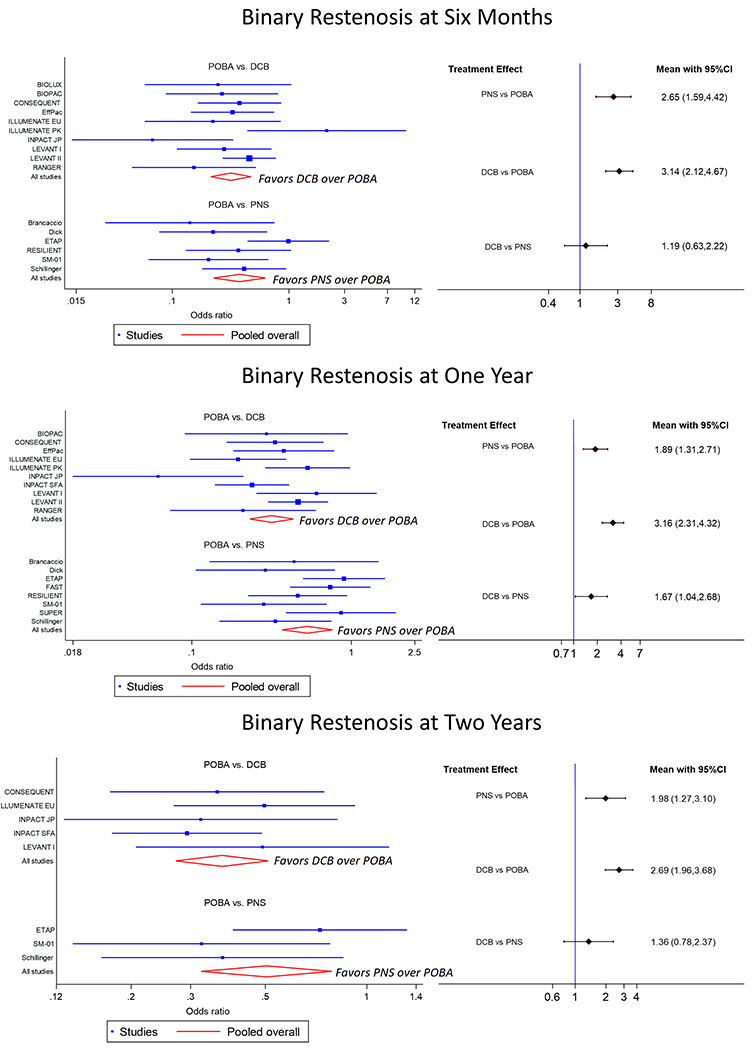
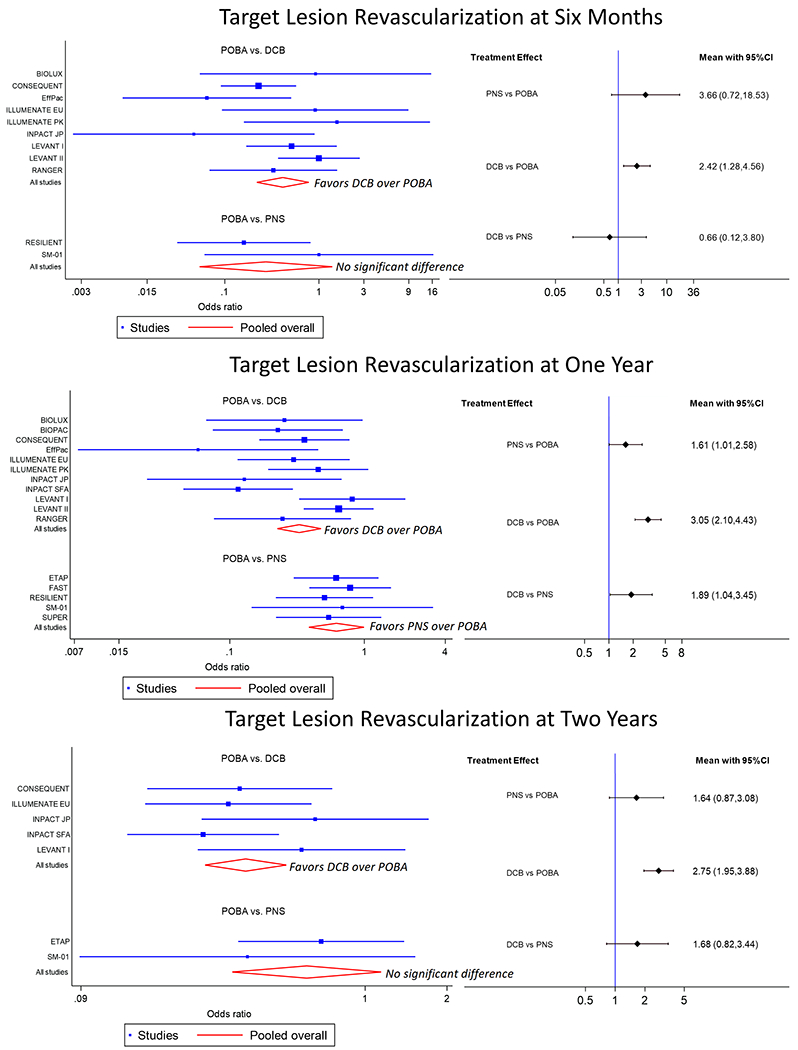
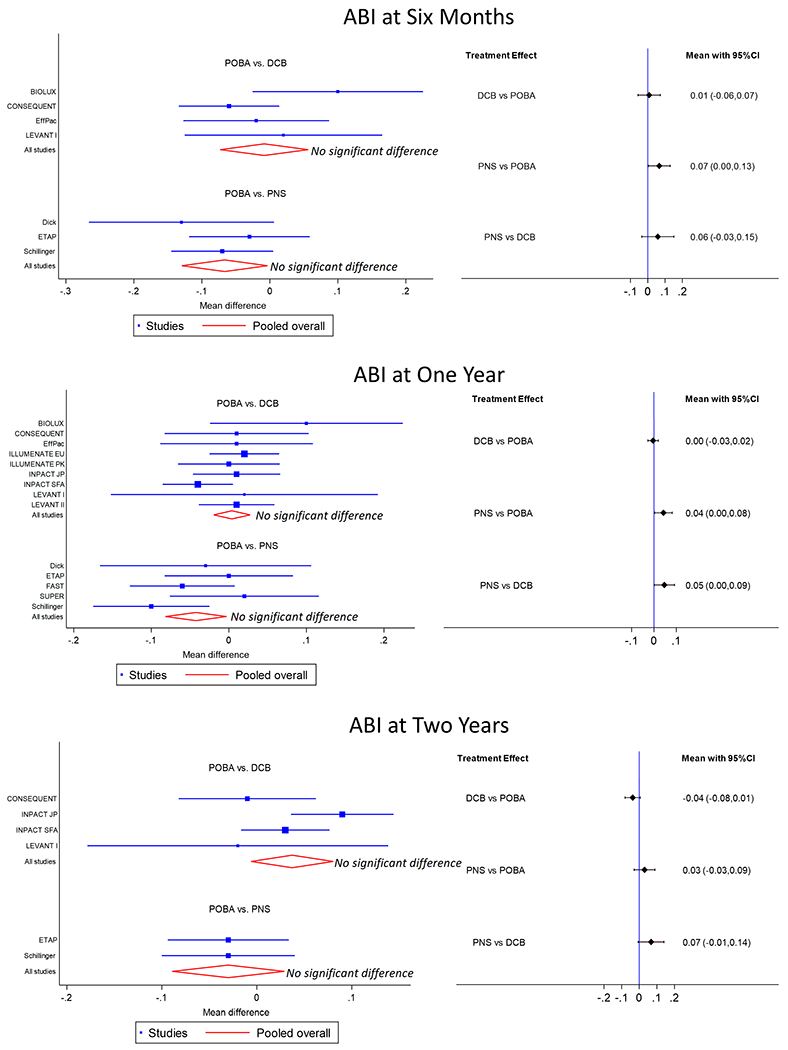
Results: Twenty-seven publications covering 19 trials were identified; 8 trials compared PNS with POBA and 11 trials compared DCB with POBA. The odds of freedom from binary restenosis for patients treated with DCB compared with PNS at 6 months was 1.19 (95% confidence interval [CI], 0.63-2.22), at 12 months was 1.67 (95% CI, 1.04-2.68), and at 24 months was 1.36 (95% CI, 0.78-2.37). The odds of freedom from TLR for patients treated with DCB compared with PNS at 6 months was 0.66 (95% CI, 0.12-3.80), at 12 months was 1.89 (95% CI, 1.04-3.45), and at 24 months was 1.68 (95% CI, 0.82-3.44). The mean increase in ABI for patients treated with PNS compared with DCB at 6 months was 0.06 higher (95% CI, -0.03 to 0.15), at 12 months was 0.05 higher (95% CI, 0.00-0.09), and at 24 months was 0.07 higher (95% CI, -0.01 to 0.14).
Conclusions: Both DCB and PNS demonstrated a lower rate of binary restenosis compared with POBA at the 6-, 12-, and 24-month timepoints. When comparing DCB with PNS through network meta-analysis, DCB had a statistically lower rate of a binary restenosis and TLR at the 12-month timepoint. This network meta-analysis demonstrates that both DCB and PNS are superior to POBA, and that PNS is a satisfactory substitute for DCB when paclitaxel is not desirable.
Keywords: Bare Metal stent; Drug-coated balloon; Network Meta-analysis; Nitinol stenting; Peripheral arterial disease.
Copyright © 2020 Society for Vascular Surgery. Published by Elsevier Inc. All rights reserved.
Conflict of interest statement
Disclosures: None
Figures
References
-
- Giacoppo D, Cassese S, Harada Y, Colleran R, Michel J, Fusaro M, Kastrati A, Byrne RA. Drug-coated balloon versus plain balloon angioplasty for the treatment of femoropopliteal artery disease: an updated systematic review and meta-analysis of randomized clinical trials. JACC: Cardiovascular Interventions. 2016. August 22;9(16):1731–42. - PubMed
-
- Conway AM, Qato K, Bottalico D, Lugo J, Giangola G, Carroccio A. Occluded superficial femoral and popliteal artery stents can have a negative impact on bypass target. Journal of Endovascular Therapy. 2015. December;22(6):868–73. - PubMed
