


COVID-CheXNet: hybrid deep learning framework for identifying COVID-19 virus in chest X-rays images
- PMID: 33250662
- PMCID: PMC7679792
- DOI: 10.1007/s00500-020-05424-3
COVID-CheXNet: hybrid deep learning framework for identifying COVID-19 virus in chest X-rays images
Retraction in
-
Retraction Note: COVID-CheXNet: hybrid deep learning framework for identifying COVID-19 virus in chest X-rays images.Soft comput. 2024;28(Suppl 1):65. doi: 10.1007/s00500-024-09992-6. Epub 2024 Jul 22. Soft comput. 2024. PMID: 39847664 Free PMC article.
Abstract
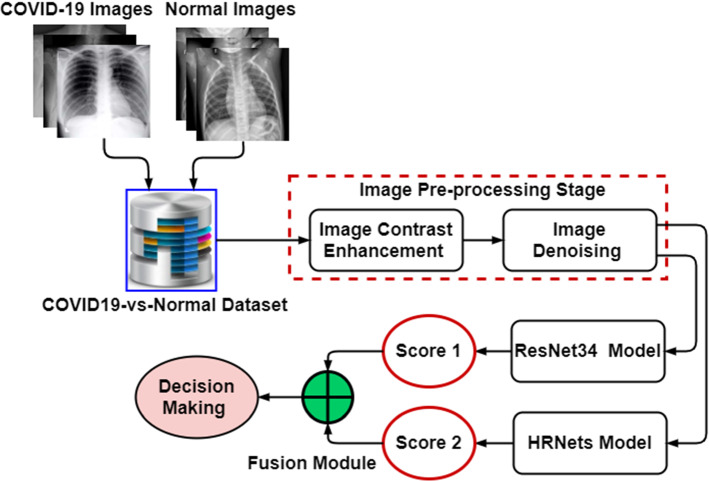
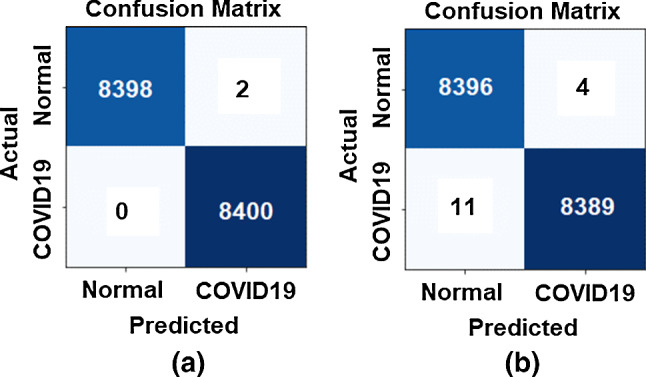
The outbreaks of Coronavirus (COVID-19) epidemic have increased the pressure on healthcare and medical systems worldwide. The timely diagnosis of infected patients is a critical step to limit the spread of the COVID-19 epidemic. The chest radiography imaging has shown to be an effective screening technique in diagnosing the COVID-19 epidemic. To reduce the pressure on radiologists and control of the epidemic, fast and accurate a hybrid deep learning framework for diagnosing COVID-19 virus in chest X-ray images is developed and termed as the COVID-CheXNet system. First, the contrast of the X-ray image was enhanced and the noise level was reduced using the contrast-limited adaptive histogram equalization and Butterworth bandpass filter, respectively. This was followed by fusing the results obtained from two different pre-trained deep learning models based on the incorporation of a ResNet34 and high-resolution network model trained using a large-scale dataset. Herein, the parallel architecture was considered, which provides radiologists with a high degree of confidence to discriminate between the healthy and COVID-19 infected people. The proposed COVID-CheXNet system has managed to correctly and accurately diagnose the COVID-19 patients with a detection accuracy rate of 99.99%, sensitivity of 99.98%, specificity of 100%, precision of 100%, F1-score of 99.99%, MSE of 0.011%, and RMSE of 0.012% using the weighted sum rule at the score-level. The efficiency and usefulness of the proposed COVID-CheXNet system are established along with the possibility of using it in real clinical centers for fast diagnosis and treatment supplement, with less than 2 s per image to get the prediction result.
Keywords: Chest X-ray images; Chest radiography imaging; Coronavirus COVID-19 epidemic; Deep learning; ResNet34 model; Transfer learning.
© Springer-Verlag GmbH Germany, part of Springer Nature 2020.
Conflict of interest statement
Conflict of interestThe authors declare that they have no conflict of interest.
Figures


References
-
- Al-Waisy AS et al (2017a) A multimodal deep learning framework using local feature representations for face recognition. Mach Vis Appl 29(1):35–54. 10.1007/s00138-017-0870-2
-
- Al-Waisy AS et al (2017b) A multimodal biometric system for personal identification based on deep learning approaches. In: 2017 Seventh international conference on emerging security technologies (EST). pp 163–168
-
- Al-Waisy AS et al (2018) A multi-biometric iris recognition system based on a deep learning approach. Pattern Anal Appl 21(3):783–802. 10.1007/s10044-017-0656-1
Publication types
LinkOut - more resources
Full Text Sources