


Cyberbullying Victimization and Non-suicidal Self-Injurious Behavior Among Chinese Adolescents: School Engagement as a Mediator and Sensation Seeking as a Moderator
- PMID: 33250816
- PMCID: PMC7674837
- DOI: 10.3389/fpsyg.2020.572521
Cyberbullying Victimization and Non-suicidal Self-Injurious Behavior Among Chinese Adolescents: School Engagement as a Mediator and Sensation Seeking as a Moderator
Abstract
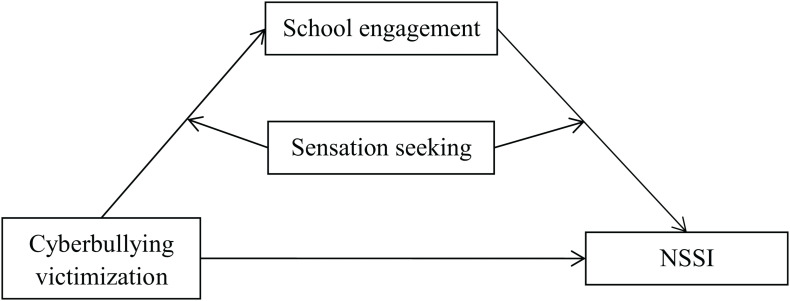
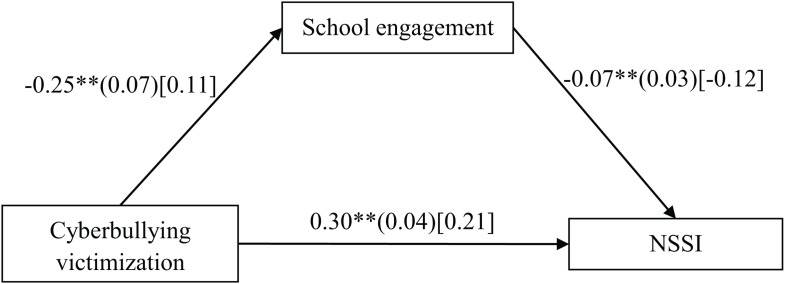
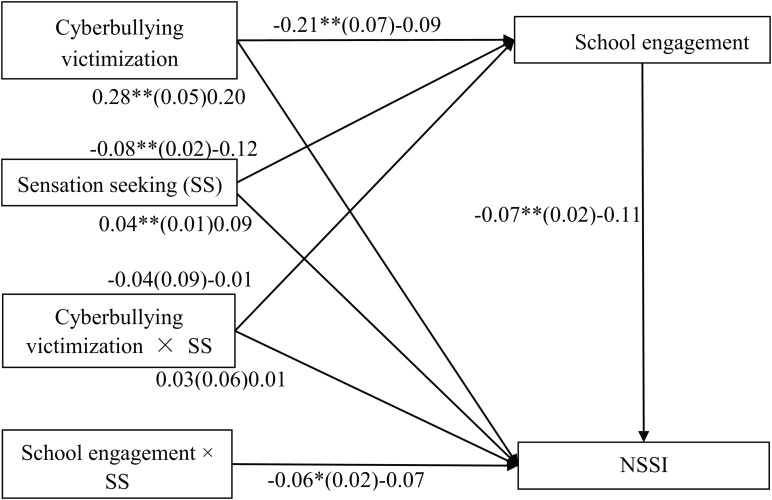
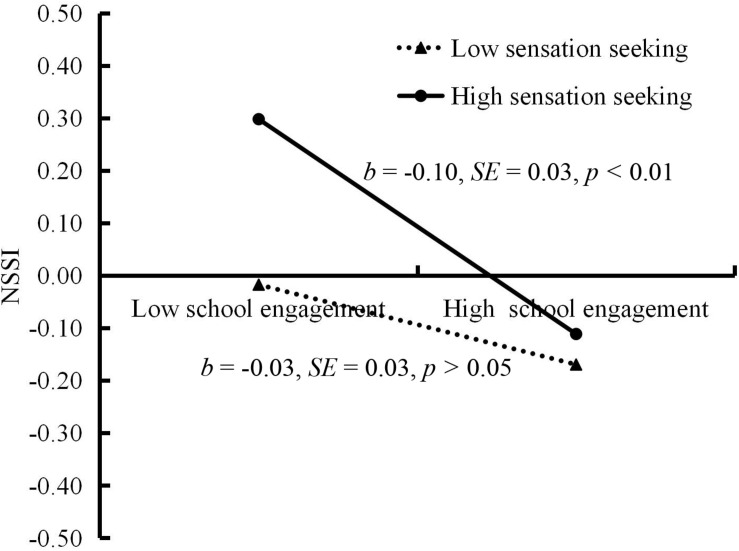
Although a large body of research has indicated that cyberbullying victimization is a crucial risk factor for adolescent non-suicidal self-injury (NSSI) behavior, the mediating and moderating mechanisms underlying this relationship remain unclear. To address this research gap, this study, based on the social control theory and the organism-environment interaction model, was designed to test whether school engagement mediated the relationship between cyberbullying victimization and adolescent NSSI and whether this mediating effect was moderated by sensation seeking. A sample of 1,102 adolescents (M age = 13.17; SD = 0.69) anonymously completed the questionnaires. The results showed that the positive association between cyberbullying victimization and adolescent NSSI was mediated by school engagement. Moreover, this indirect link was significant for adolescents with high-level sensation seeking but non-significant for adolescents with low-level sensation seeking. These findings highlight school engagement as a potential mechanism linking cyberbullying victimization to adolescent NSSI, and high sensation seeking was an important risk factor to amplify this indirect effect. Intervention programs aimed at reducing NSSI among adolescents may benefit from the current research.
Keywords: adolescent; cyberbullying; non-suicidal self-injury; school engagement; sensation seeking.
Copyright © 2020 Yu, Xie, Lin, Liang, Wang, Nie, Wang and Longobardi.
Figures
References
-
- Baiden P., Stewart S. L., Fallon B. (2017). The mediating effect of depressive symptoms on the relationship between bullying victimization and non-suicidal self-injury among adolescents: findings from community and inpatient mental health settings in Ontario, Canada. Psychiatry Res. 255 238–247. 10.1016/j.psychres.2017.05.018 - DOI - PubMed
-
- Buhs E. S., Ladd G. W., Herald S. L. (2006). Peer exclusion and victimization: processes that mediate the relation between peer group rejection and children’s classroom engagement and achievement? J. Educ. Psychol. 98 1–13. 10.1037/0022-0663.98.1.1 - DOI
-
- Chan H. C., Wong D. S. W. (2015). Traditional school bullying and cyberbullying in Chinese societies: prevalence and a review of the whole-school intervention approach. Aggress. Violent Behav. 23 98–108. 10.1016/j.avb.2015.05.010 - DOI
LinkOut - more resources
Full Text Sources
Miscellaneous
