


Vitamin D, Calcium, Magnesium, and Potassium Consumption and Markers of Glucose Metabolism in the Hispanic Community Health Study/Study of Latinos
- PMID: 33252321
- PMCID: PMC8667446
- DOI: 10.1080/07315724.2020.1833790
Vitamin D, Calcium, Magnesium, and Potassium Consumption and Markers of Glucose Metabolism in the Hispanic Community Health Study/Study of Latinos
Abstract
Objective: This was a cross-sectional study associating vitamin D, calcium, magnesium, and potassium intakes with markers of glucose metabolism in the Hispanic Community Health Study/Study of Latinos (HCHS/SOL).
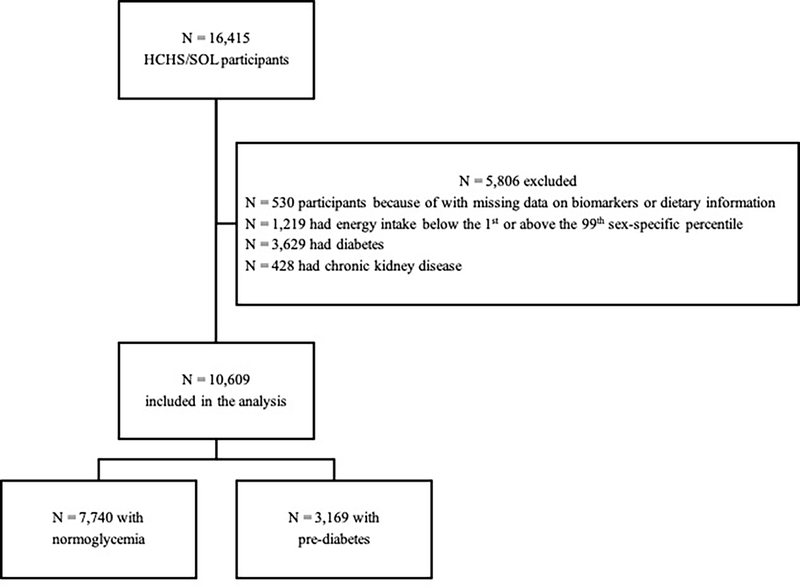
Methods: HCHS/SOL is a multicenter, prospective, population-based cohort study on Hispanics/Latinos aged 18-74 years in the US. For this analysis, we included 10,609 participants who were free of diabetes. Analysis of covariance was used to assess associations of a range of micronutrient intake on the Homeostatic Model Assessment of Insulin Resistance (HOMA-IR), Hemoglobin A1c (HbA1c), and 2-hour post-oral glucose tolerance test (2h-plasma glucose) separately for normoglycemic and with pre-diabetes, after controlling for important confounders. All analyses accounted for the complex sample design and sampling weights.
Results: HOMA-IR levels were significantly lower among adults with intakes in the highest quartile for vitamin D, magnesium, and potassium compared to the respective lowest quartiles, for those with normoglycemia and pre-diabetes, even after adjusting for confounders, such as diet quality (p < 0.05). For those with pre-diabetes, HOMA-IR levels were also significantly lower for those in the highest quartile of calcium intake. However, 2h-plasma glucose was significantly higher in those with intakes higher than quartile 1 for vitamin D and calcium among those with normoglycemia and significantly higher in quartile 3 of potassium intake for those with pre-diabetes, p < 0.05. No significant associations were found for HbA1c in either group.
Conclusions: Higher consumption of vitamin D, magnesium, and potassium are associated with optimal levels of HOMA-IR among participants with normoglycemia and pre-diabetes.
Keywords: 2-hour glucose levels; HOMA-IR; HbA1c; Hispanics/Latinos; Vitamin D; calcium; magnesium; potassium.
Conflict of interest statement
None of the authors had any financial or other conflicts of interest.
References
-
- Centers for Disease Control and Prevention. National Diabetes Statistics Report, 2017 Estimates of Diabetes and Its Burden in the United States Background. Atlanta, GA; 2017. Available at: http://www.diabetes.org/assets/pdfs/basics/cdc-statistics-report-2017.pdf. Accessed January 11, 2019.
-
- Menke A, Casagrande S, Geiss L, Cowie CC. Prevalence of and Trends in Diabetes Among Adults in the United States, 1988–2012. JAMA 2015;314(10):1021. - PubMed
-
- Schneiderman N, Llabre M, Cowie CC, Barnhart J, Carnethon M, Gallo LC, Giachello AL, Heiss G, Kaplan RC, LaVange LM, Teng Y, Villa-Caballero L, Avilés-Santa ML. Prevalence of Diabetes Among Hispanics/Latinos From Diverse Backgrounds: The Hispanic Community Health Study/Study of Latinos (HCHS/SOL). Diabetes Care 2014;37(8):2233–2239. - PMC - PubMed
-
- US Census Bureau. FFF: Hispanic Heritage Month 2016. Release Number CB16-FF.16 2016. Available at: https://www.census.gov/newsroom/facts-for-features/2016/cb16-ff16.html. Accessed July 17, 2017.
-
- Dong J-Y, Qin L-Q. Dietary calcium intake and risk of type 2 diabetes: possible confounding by magnesium. Eur. J. Clin. Nutr. 2012;66(3):408–410. - PubMed
Publication types
MeSH terms
Substances
Grants and funding
LinkOut - more resources
Full Text Sources
Medical
