


Direct Inpatient Medical Costs of Operative Treatment of Periprosthetic Hip and Knee Infections Are Twofold Higher Than Those of Aseptic Revisions
- PMID: 33252589
- PMCID: PMC8327701
- DOI: 10.2106/JBJS.20.00550
Direct Inpatient Medical Costs of Operative Treatment of Periprosthetic Hip and Knee Infections Are Twofold Higher Than Those of Aseptic Revisions
Abstract
Background: Periprosthetic joint infections (PJIs) following total hip arthroplasty (THA) and total knee arthroplasty (TKA) are associated with substantial morbidity. A better understanding of the costs of PJI treatment can inform prevention, treatment, and reimbursement strategies. The purpose of the present study was to describe direct inpatient medical costs associated with the treatment of hip and knee PJI.
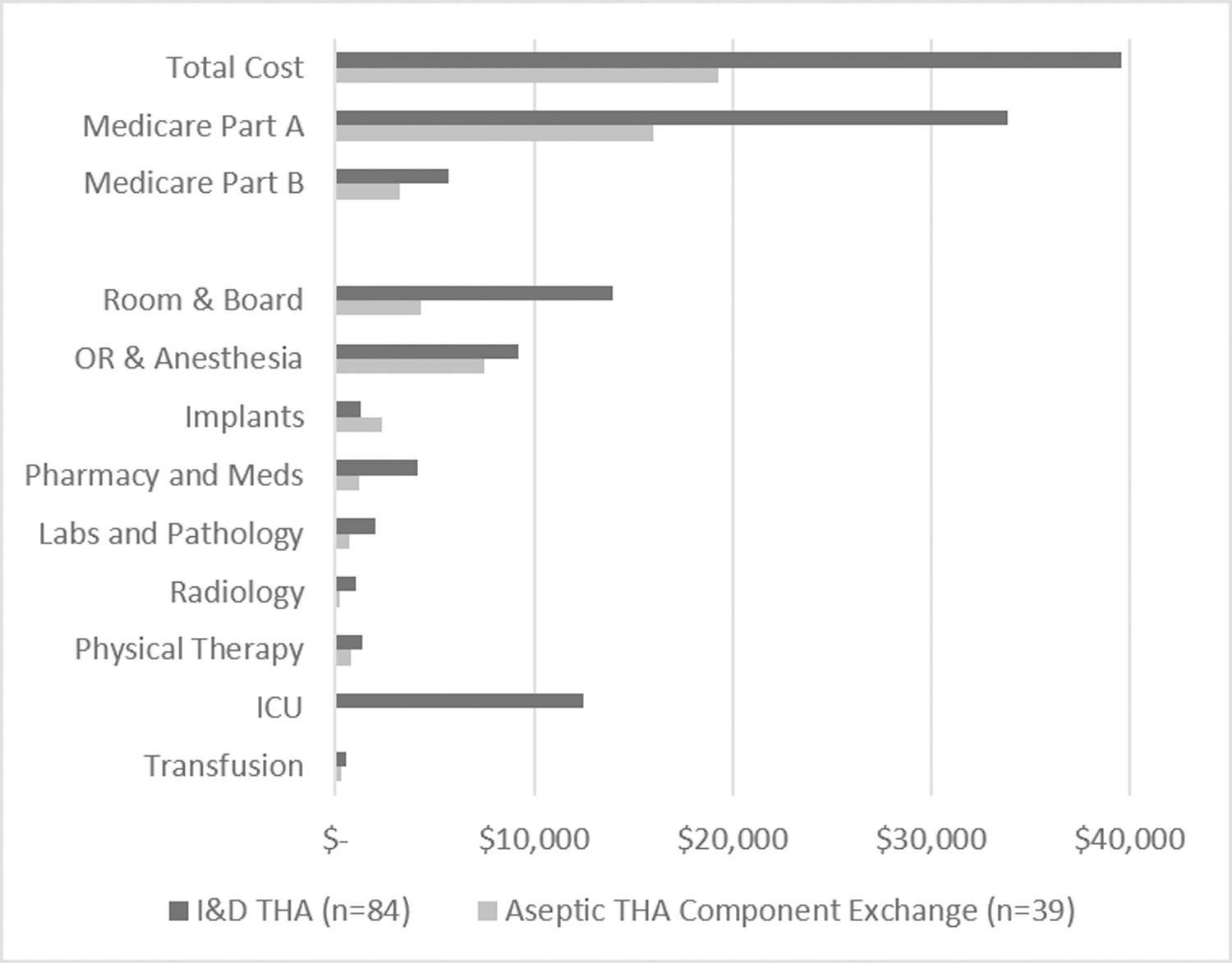
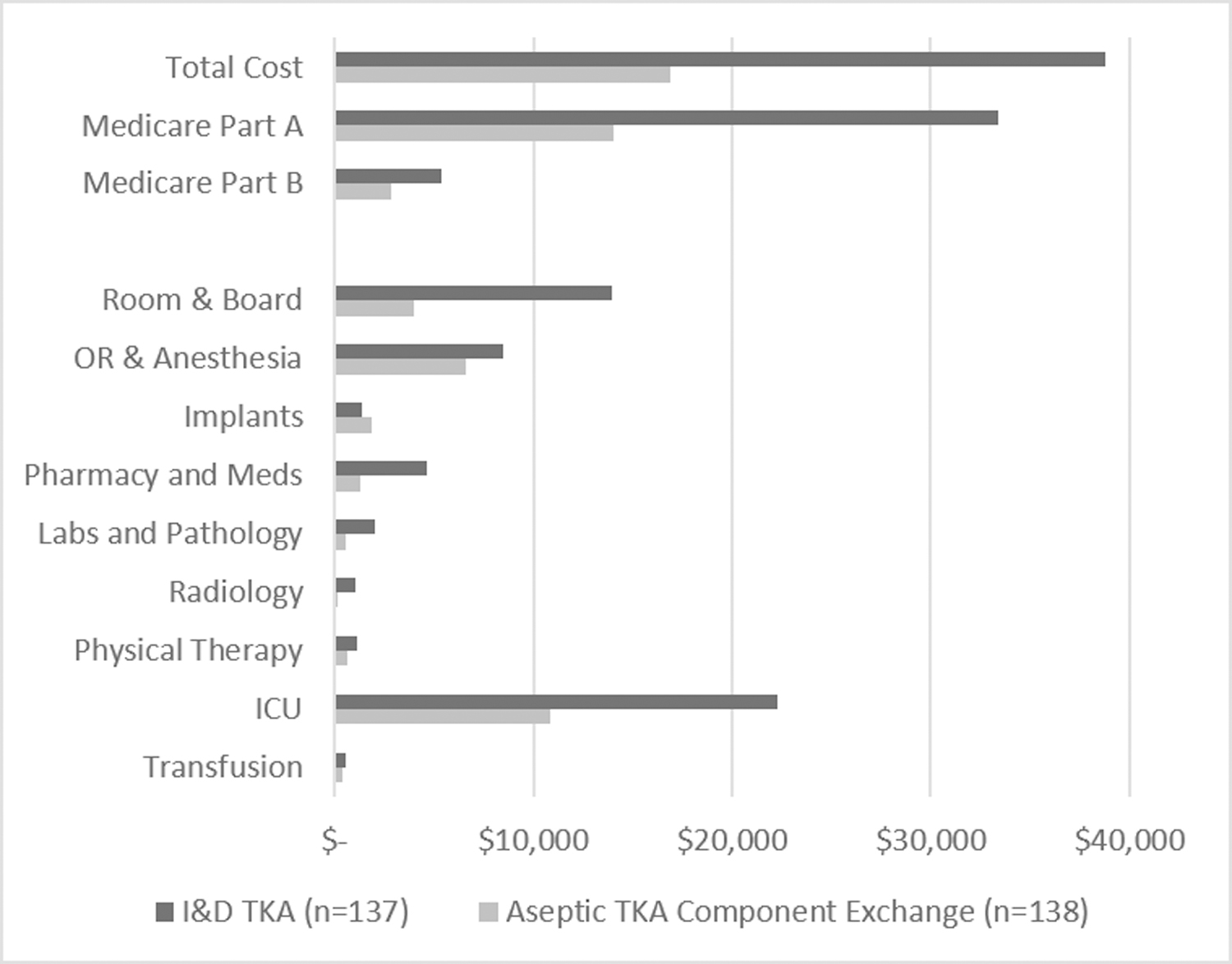
Methods: At a single tertiary care institution, 176 hips and 266 knees that underwent 2-stage revisions for the treatment of PJI from 2009 to 2015 were compared with 1,611 hips and 1,276 knees that underwent revisions for aseptic indications. In addition, 84 hips and 137 knees that underwent irrigation and debridement (I&D) with partial component exchange were compared with 39 hips and 138 knees that underwent partial component exchange for aseptic indications. Line-item details of services billed during hospitalization were retrieved, and standardized direct medical costs were calculated in 2018 inflation-adjusted dollars.
Results: The mean direct medical cost of 2-stage revision THA performed for the treatment of PJI was significantly higher than that of aseptic revision THA ($58,369 compared with $22,846, p < 0.001). Similarly, the cost of 2-stage revision TKA performed for the treatment of PJI was significantly higher than that of aseptic revision TKA ($56,900 compared with $24,630, p < 0.001). Even when the total costs of aseptic revisions were doubled for a representative comparison with 2-stage procedures, the costs of PJI procedures were 15% to 28% higher than those of the doubled costs of aseptic revisions (p < 0.001). The mean direct medical cost of I&D procedures for PJI was about twofold higher than of partial component exchange for aseptic indications.
Conclusions: The direct medical costs of operative treatment of PJI following THA and TKA are twofold higher than the costs of similar aseptic revisions. The high economic burden of PJI warrants efforts to reduce the incidence of PJI. Reimbursement schemes should account for the high costs of treating PJI in order to ensure sustainable patient care.
Level of evidence: Economic Level IV. See Instructions for Authors for a complete description of levels of evidence.
Copyright © 2020 by The Journal of Bone and Joint Surgery, Incorporated.
Conflict of interest statement
Disclosure: This research was supported by the National Institutes of Health (NIH) under grant P30AR76312. On the Disclosure of Potential Conflicts of Interest forms, which are provided with the online version of the article, one or more of the authors checked “yes” to indicate that the author had a relevant financial relationship in the biomedical arena outside the submitted work and “yes” to indicate that the author had a patent and/or copyright, planned, pending, or issued, broadly relevant to this work (http://links.lww.com/JBJS/G210).
Figures
References
-
- Hebert CK, et al., Cost of treating an infected total knee replacement. Clin Orthop Relat Res, 1996(331): p. 140–5. - PubMed
-
- Lavernia C, Lee DJ, and Hernandez VH, The increasing financial burden of knee revision surgery in the United States. Clin Orthop Relat Res, 2006. 446: p. 221–6. - PubMed
-
- Lavernia CJ, et al., Revision and primary hip and knee arthroplasty. A cost analysis. Clin Orthop Relat Res, 1995(311): p. 136–41. - PubMed
MeSH terms
Grants and funding
LinkOut - more resources
Full Text Sources
Medical
Research Materials
