


Alternative Tobacco Product Use in Critically Ill Patients
- PMID: 33255164
- PMCID: PMC7727672
- DOI: 10.3390/ijerph17238707
Alternative Tobacco Product Use in Critically Ill Patients
Abstract
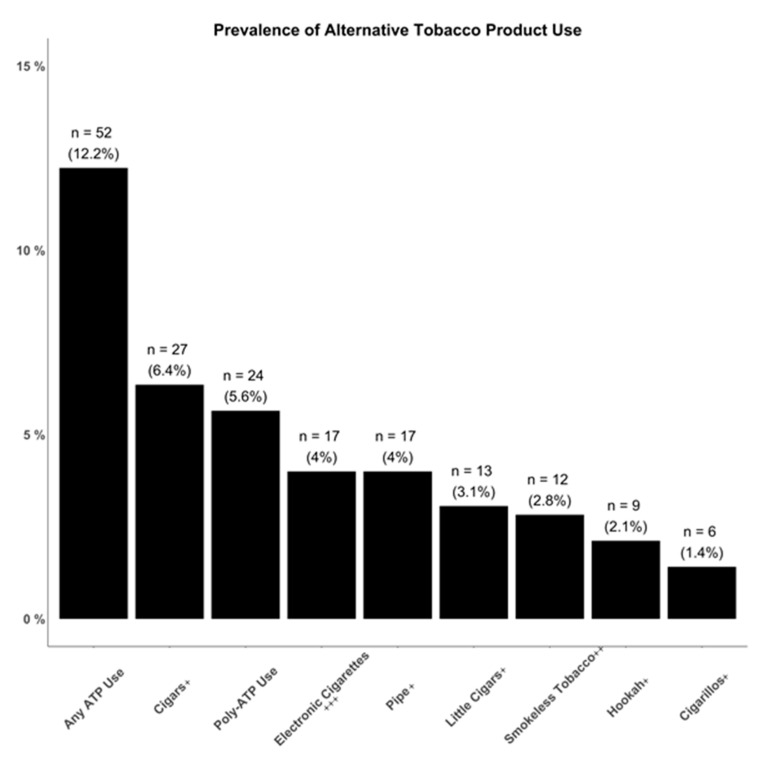
Background: Alternative tobacco product (ATP) use has bee linked to critical illness, however, few studies have examined the use of these substances in critically ill populations. We sought to examine ATP use within critically ill patients and to define barriers in accurately assessing use within this population. Methods: We prospectively studied 533 consecutive patients from the Early Assessment of Renal and Lung Injury study, enrolled between 2013 and 2016 at a tertiary referral center and a safety-net hospital. ATP use information (electronic cigarettes, cigars, pipes, hookahs/waterpipes, and snus/chewing tobacco) was obtained from the patient or surrogate using a detailed survey. Reasons for non-completion of the survey were recorded, and differences between survey responders vs. non-responders, self- vs. surrogate responders, and ATP users vs. non-users were explored. Results: Overall, 80% (n = 425) of subjects (56% male) completed a tobacco product use survey. Of these, 12.2% (n = 52) reported current ATP use, while 5.6% reported using multiple ATP products. When restricted to subjects who were self-responders, 17% reported ATP use, while 10% reported current cigarette smoking alone. The mean age of ATP users was 57 ± 17 years. Those who did not complete a survey were sicker and more likely to have died during admission. Subjects who completed the survey as self-responders reported higher levels of ATP use than ones with surrogate responders (p < 0.0001). Conclusion: ATP use is common among critically ill patients despite them being generally older than traditional users. Survey self-responders were more likely than surrogate responders to report use. These findings highlight the importance of improving our current methods of surveillance of ATP use in older adults in the outpatient setting.
Keywords: alternative tobacco products; critical illness; electronic nicotine delivery devices; non-cigarette tobacco products; smoking-caused disease; surveillance and monitoring; survey research.
Conflict of interest statement
The authors declare no conflict of interest.
Figures
References
-
- Schier J.G., Meiman J.G., Layden J., Mikosz C.A., VanFrank B., King B.A., Salvatore P.P., Weissman D.N., Thomas J., Melstrom P.C., et al. states investigating severe pulmonary disease among people who use e-cigarettes [press release]. Centers for Disease Control and Prevention. Morb. Mortal. Wkly. Rep. 2019;68:787. doi: 10.15585/mmwr.mm6836e2. - DOI - PMC - PubMed
