


Self-Selection of Agricultural By-Products and Food Ingredients by Tenebrio molitor (Coleoptera: Tenebrionidae) and Impact on Food Utilization and Nutrient Intake
- PMID: 33255246
- PMCID: PMC7760134
- DOI: 10.3390/insects11120827
Self-Selection of Agricultural By-Products and Food Ingredients by Tenebrio molitor (Coleoptera: Tenebrionidae) and Impact on Food Utilization and Nutrient Intake
Abstract
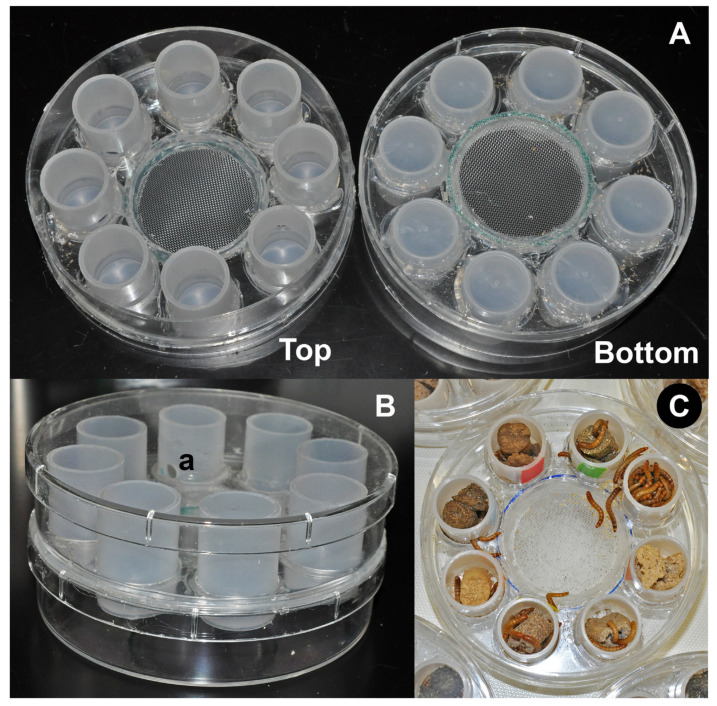
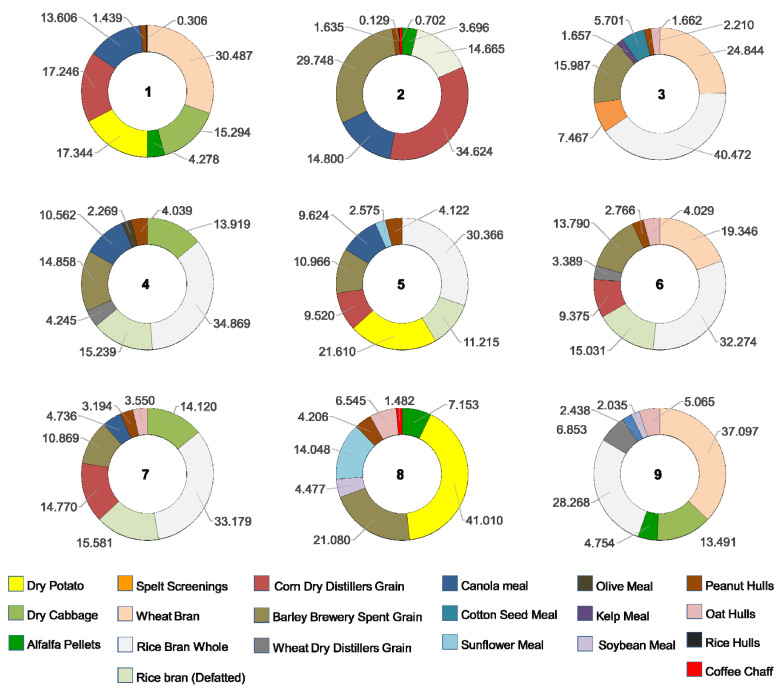
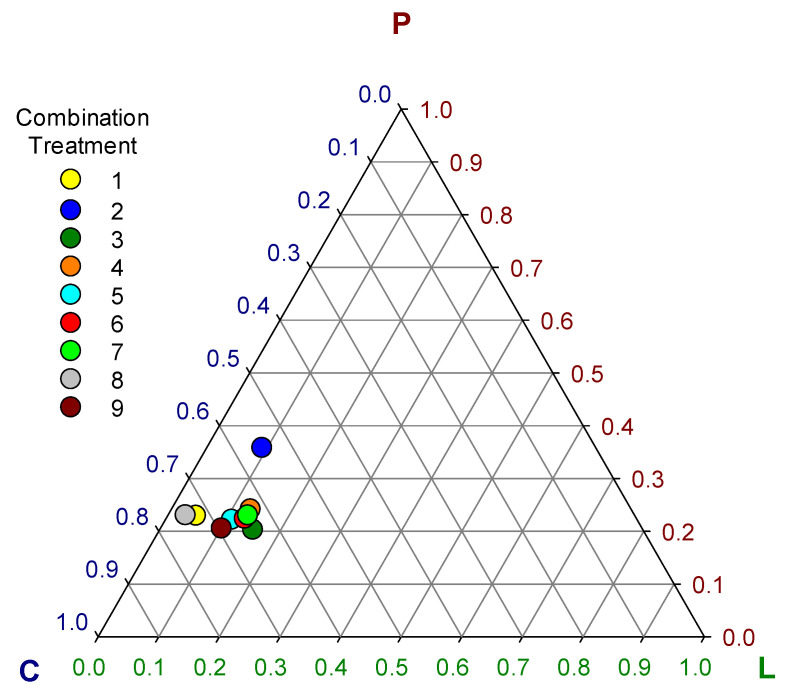
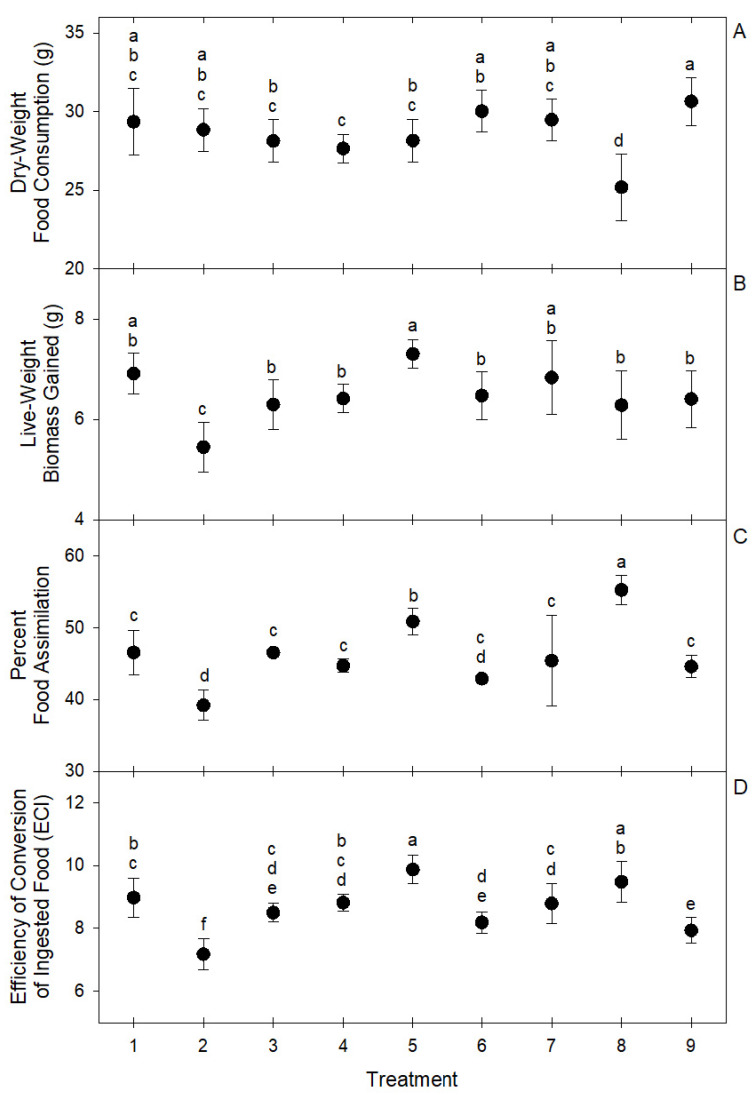
Nutrient self-selection was used to determine optimal intake ratios of macro-nutrients by Tenebrio molitor L. larvae. Self-selection experiments consisted of 9 combinations (treatments) of 8 ingredients, from a total of 20 choices, radially distributed in a multiple-choice arena presented to groups of 100 T. molitor larvae (12th-13th instar). Larvae freely selected and feed on the pelletized ingredients for a period of 21 days at 27 °C, 75% RH, and dark conditions. Consumption (g) of each ingredient, larval live weight gained (mg), and frass production were recorded and used to calculate food assimilation and efficiency of conversion of ingested food. The macro-nutrient intake ratios were 0.06 ± 0.03, 0.23 ± 0.01, and 0.71 ± 0.03 for lipid, protein, and carbohydrate, respectively on the best performing treatments. The intake of neutral detergent fiber negatively impacted food assimilation, food conversion and biomass gain. Food assimilation, food conversion, and biomass gain were significantly impacted by the intake of carbohydrate in a positive way. Cabbage, potato, wheat bran, rice bran (whole and defatted), corn dry distillers' grain, spent brewery dry grain, canola meal and sunflower meal were considered suitable as T. molitor diets ingredients based on their relative consumption percentages (over 10%) within treatment.
Keywords: food assimilation; food conversion; insect dietetics; insect rearing; insects as feed and food; macro-nutrients; nutrition.
Conflict of interest statement
The authors declare no conflict of interest. The funders had no role in the design of the study; in the collection, analyses, or interpretation of data; in the writing of the manuscript, or in the decision to publish the results.
Figures
References
-
- Ng W.-K., Liew F.-L., Ang L.-P., Wong K.-W. Potential of mealworm (Tenebrio molitor) as an alternative protein source in practical diets for African catfish, Clarias gariepinus. Aquac. Res. 2001;32:272–280. doi: 10.1046/j.1355-557x.2001.00024.x. - DOI
-
- Barroso F.G., de Haro C., Sánchez-Muros M.J., Venegas E., Martínez-Sánchez A., Pérez-Bañon C. The potential of various insect species for use as food for fish. Aquaculture. 2014;422–423:193–201. doi: 10.1016/j.aquaculture.2013.12.024. - DOI
-
- Gasco L., Henry M., Piccolo G., Marono S., Gai F., Renna M., Lussiana C., Antonopoulou E., Mola P., Chatzifotis S. Tenebrio molitor meal in diets for European sea bass (Dicentrarchus labrax L.) juveniles: Growth performance, whole body composition and in vivo apparent digestibility. Anim. Feed Sci. Technol. 2016;220:34–45. doi: 10.1016/j.anifeedsci.2016.07.003. - DOI
-
- Gasco L., Gai F., Maricchiolo G., Genovese L., Ragonese S., Bottari T., Caruso G. Fishmeal alternative protein sources for aquaculture. In: Gasco L., Gai F., Maricchiolo G., Genovese L., Ragonese S., Bottari T., Caruso G., editors. Feeds for the Aquaculture Sector. Springer; Cham, Switzerland: 2018. pp. 1–28. Springer Briefs in Molecular Science.
-
- Lock E.J., Biancarosa I., Gasco L. Insects as raw materials in compound feed for aquaculture. In: Halloran A., Flore R., Vantomme P., Roos N., editors. Edible Insects in Sustainable Food Systems. Springer; Cham, Switzerland: 2018. pp. 263–276.
Grants and funding
LinkOut - more resources
Full Text Sources
Other Literature Sources
