


Pathogenetic Mechanisms Implicated in Sjögren's Syndrome Lymphomagenesis: A Review of the Literature
- PMID: 33255258
- PMCID: PMC7759999
- DOI: 10.3390/jcm9123794
Pathogenetic Mechanisms Implicated in Sjögren's Syndrome Lymphomagenesis: A Review of the Literature
Abstract
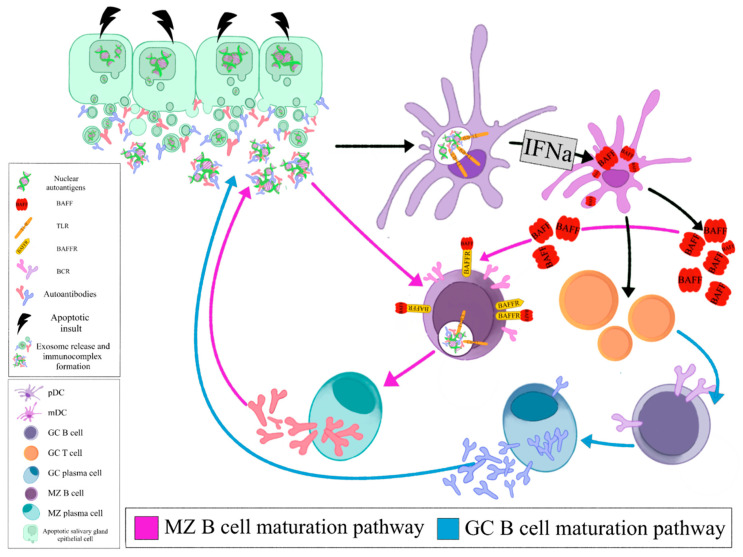
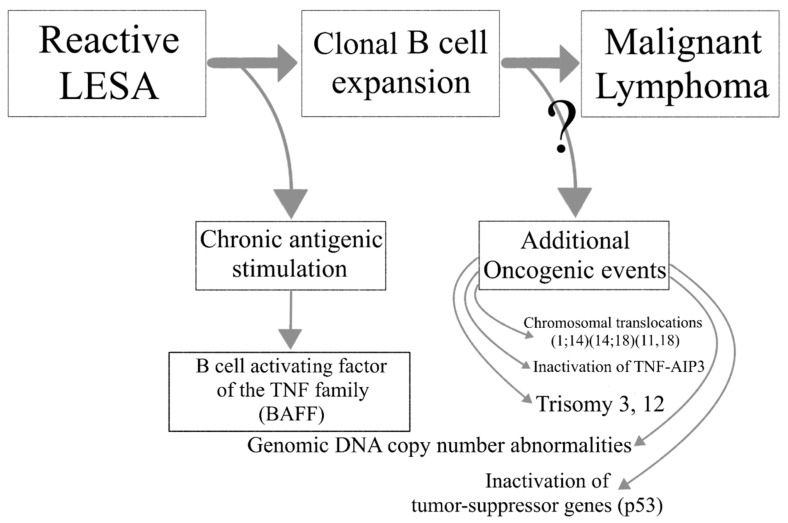
Sjögren's Syndrome (SS) is a chronic autoimmune disorder characterized by focal mononuclear cell infiltrates that surround the ducts of the exocrine glands, impairing the function of their secretory units. Compared to other autoimmune disorders, SS is associated with a notably high incidence of non-Hodgkin lymphoma (NHL) and more frequently mucosa associated lymphoid tissue (MALT) lymphoma, leading to increased morbidity and mortality rates. High risk features of lymphoma development include systemic extraepithelial manifestations, low serum levels of complement component C4 and mixed type II cryoglobulinemia. The discrimination between reactive and neoplastic lymphoepithelial lesion (LEL) is challenging, probably reflecting a continuum in the evolution from purely inflammatory lymphoid infiltration to the clonal neoplastic evolution. Early lesions display a predominance of activated T cells, while B cells prevail in severe histologic lesions. This strong B cell infiltration is not only a morphologic phenomenon, but it is also progressively associated with the presence of ectopic germinal centers (GCs). Ectopic formation of GCs in SS represents a complex process regulated by an array of cytokines, adhesion molecules and chemokines. Chronic antigenic stimulation is the major driver of specific B cell proliferation and increases the frequency of their transformation in the ectopic GCs and marginal zone (MZ) equivalents. B cells expressing cell surface rheumatoid factor (RF) are frequently detected in the salivary glands, suggesting that clonal expansion might arise from antigen selection of RF-expressing B cells. Abnormal stimulation and incomplete control mechanisms within ectopic lymphoid structures predispose RF MZ like cells to lymphoma development. Immunoglobulin recombination, somatic mutation and isotype switching during B cell development are events that may increase the translocation of oncogenes to immunoglobulin loci or tumor suppressor gene inactivation, leading to monoclonal B cell proliferation and lymphoma development. Concerning chronic antigenic stimulation, conclusive data is so far lacking. However immune complexes containing DNA or RNA are the most likely candidates. Whether additional molecular oncogenic events contribute to the malignant overgrowth remains to be proved.
Keywords: Sjögren’s Syndrome; autoimmunity; germinal centers; lymphoma pathogenesis; mucosa associated lymphoid tissue.
Conflict of interest statement
The authors declare no conflict of interest.
Figures
References
-
- Sikara M., Ziogas D., Argyropoulou O., Papageorgiou A., Tzioufas A., Voulgarelis M. SAT0208 Ten-year overall survival and standarized mortality ratio in the largest single center cohort of patients with primary sjogren’s associated lymphomas. Ann. Rheum. Dis. 2019;78:1179. doi: 10.1136/annrheumdis-2019-eular.5794. - DOI
-
- Ekström Smedby K., Vajdic C.M., Falster M., Engels E.A., Martínez-Maza O., Turner J., Hjalgrim H., Vineis P., Seniori Costantini A., Bracci P.M., et al. Autoimmune disorders and risk of non-Hodgkin lymphoma subtypes: A pooled analysis within the InterLymph Consortium. Blood. 2008;111:4029–4038. doi: 10.1182/blood-2007-10-119974. - DOI - PMC - PubMed
-
- Maeshima A.M., Taniguchi H., Toyoda K., Yamauchi N., Makita S., Fukuhara S., Munakata W., Maruyama D., Kobayashi Y., Tobinai K. Clinicopathological features of histological transformation from extranodal marginal zone B-cell lymphoma of mucosa-associated lymphoid tissue to diffuse large B-cell lymphoma: An analysis of 467 patients. Br. J. Haematol. 2016;174:923–931. doi: 10.1111/bjh.14153. - DOI - PubMed
Publication types
LinkOut - more resources
Full Text Sources
Miscellaneous
