. 2020 Nov 24;9(12):3804.
doi: 10.3390/jcm9123804.

Psychosocial Stress Hastens Disease Progression and Sudden Death in Mice with Arrhythmogenic Cardiomyopathy

Affiliations

Psychosocial Stress Hastens Disease Progression and Sudden Death in Mice with Arrhythmogenic Cardiomyopathy

Jacopo Agrimi et al. J Clin Med. .

Abstract

Physiological stressors, such as exercise, can precipitate sudden cardiac death or heart failure progression in patients with arrhythmogenic cardiomyopathy (ACM). Yet, whether and to what extent a highly prevalent and more elusive environmental factor, such as psychosocial stress (PSS), can also increase ACM disease progression is unexplored. Here, we first quantified perceived stress levels in patients with ACM and found these levels correlated with the extent of arrhythmias and cardiac dysfunction. To determine whether the observed correlation is due to causation, we inflicted PSS-via the resident-intruder (RI) paradigm-upon Desmoglein-2 mutant mice, a vigorously used mammalian model of ACM. We found that ACM mice succumbed to abnormally high in-trial, PSS mortality. Conversely, no sudden deaths occurred in wildtype (WT) counterparts. Desmoglein-2 mice that survived RI challenge manifested markedly worse cardiac dysfunction and remodeling, namely apoptosis and fibrosis. Furthermore, WT and ACM mice displayed similar behavior at baseline, but Desmoglein-2 mice exhibited heightened anxiety following RI-induced PSS. This outcome correlated with the worsening of cardiac phenotypes. Our mouse model demonstrates that in ACM-like subjects, PSS is incisive enough to deteriorate cardiac structure and function per se, i.e., in the absence of any pre-existing anxious behavior. Hence, PSS may represent a previously underappreciated risk factor in ACM disease penetrance.

Keywords: Desmoglein-2; anxiety; arrhythmia; corticosterone; desmosomal variants; psychosocial stress; resident-intruder.


Conflict of interest statement

There are no competing interest to be declared.

Figures
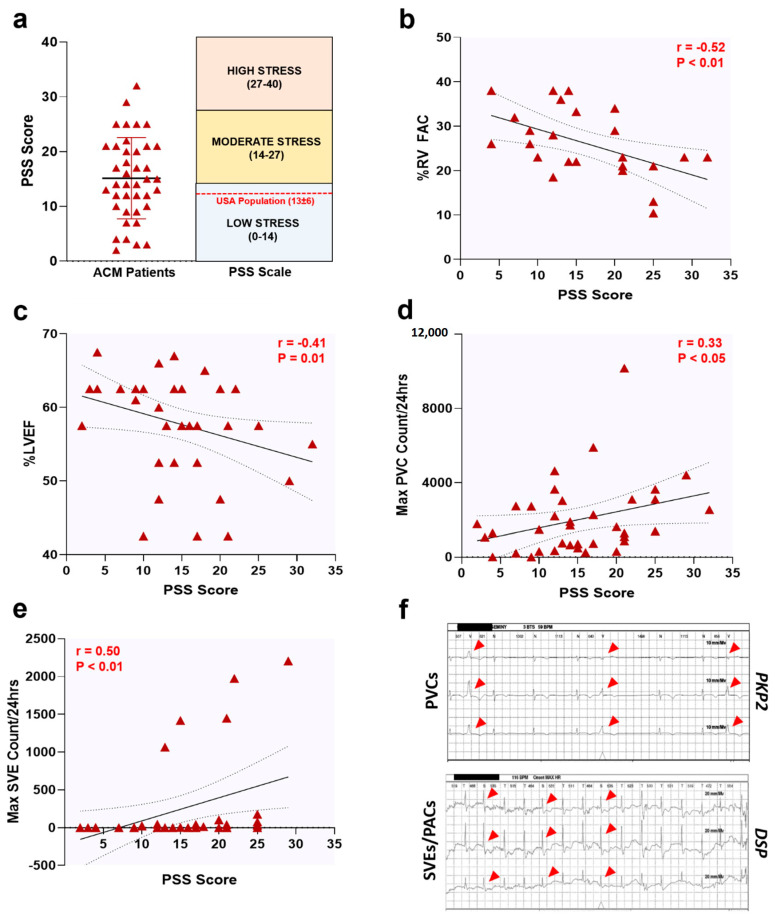
Figure 1
Figure 1
Perceived stress levels correlate with cardiac dysfunction in ACM patients. (a) PSS scores in n = 40 ACM patients. Data presented as Mean ± StDev. Upon further analysis, PSS scores correlated with ACM patient phenotypes; notably, (b) percent right ventricular fractional area change (%RV FAC), (c) percent left ventricular ejection fraction (%LVEF), (d) maximum premature ventricular contractions per 24 h (Max PVC Count/24 h), and (e) maximum supraventricular ectopics per 24 h (Max SVE Count/24 h). Data displayed in scatterplots; thick black line shows the best linear fit through the data; dotted lines represent two-tailed 95% confidence interval; text inset reports Spearman’s Rho value and associated p-value. For (ae), each maroon triangle is an individual data point from a single patient. (f) Representative Holter strips showing PVCs (top panel) and SVEs (lower panel) from ACM patients harboring a Plakophilin-2 (PKP2) and Desmoplakin (DSP) pathogenic variant, respectively. Red arrowheads, PVCs and SVEs.
Figure 2
Figure 2
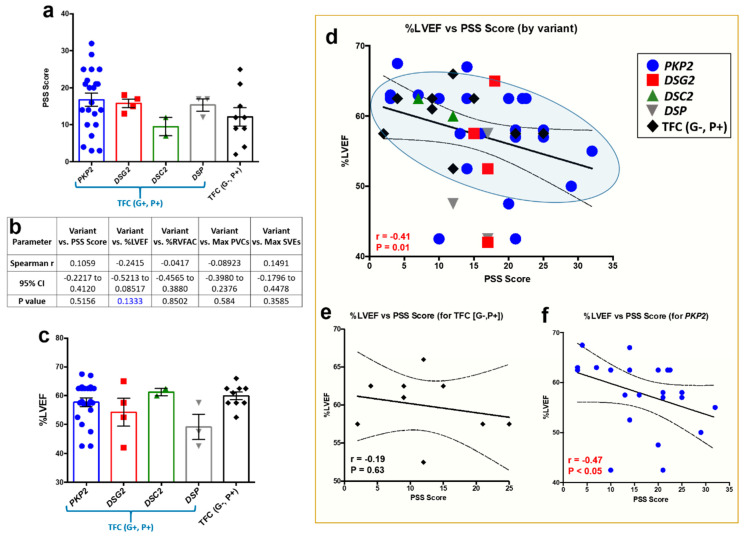
Multivariate analysis between perceived stress levels, pathogenic variant, and functional phenotypes in ACM patients. (a) PSS scores in n = 40 ACM patients, sorted by ACM patients with a pathogenic variant (i.e., TFC (G+, P+)) and gene-elusive patients (i.e., TFC (G−, P+)). No significance to note. (b) Multivariate analysis demonstrated a trend between presence of a pathogenic variant and %LVEF (noted in blue text). (c) Even though a trend was found between variant and %LVEF, no significant differences in %LVEF were found between cohorts. (d) However, color-coating each data point by variant or gene-elusive status indicated PKP2 patients (blue circles) and TFC (G−, P+) patients (black diamonds) abundantly fell within the 95% confidence interval between PSS scores and %LVEF correlation analysis. (e,f) Yet, only PKP2 patients showed a strong correlation between PSS scores and %LVEF. For (a,c), data presented as mean ± SEM. For (df), data displayed in scatterplots; thick black line shows the best linear fit through the data; dotted lines represent two-tailed 95% confidence interval; text inset reports Spearman’s Rho value and associated p-value.
Figure 3
Figure 3
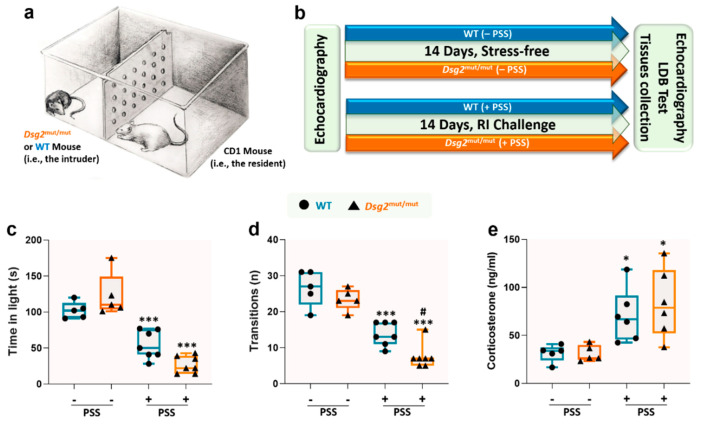
The resident-intruder paradigm induces anxiety behavior and a surge in corticosterone levels. Behavioral parameters assessed via the light-dark box (LDB) test and corticosterone levels from WT and Dsg2mut/mut mice in presence or absence of resident-intruder (RI) paradigm. (a) Illustrative schematic depicting the RI paradigm test. (b) Graphical timeline for the experimental protocol. (c) Time spent in the light chamber during the LDB test. (d) Number of transitions between the two chambers during the LDB test. (e) Circulating corticosterone levels. Data presented as box-whisker plots, n = 5–7 mice/parameter/cohort. PSS, psychosocial stress. * p < 0.05, *** p < 0.001 WT (+PSS) vs. WT (–PSS) or Dsg2mut/mut (+PSS) vs. Dsg2mut/mut (–PSS); # p < 0.05 Dsg2mut/mut (+PSS) vs. WT (+PSS) using One-Way ANOVA with Tukey’s post-hoc analysis.
Figure 4
Figure 4
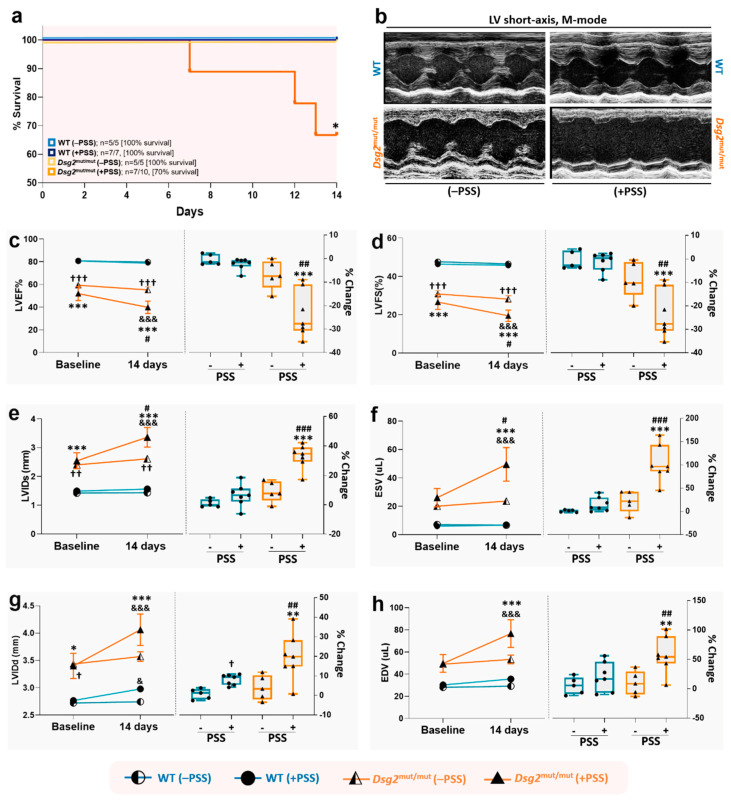
Psychosocial stress increases the risk of sudden death and worsens cardiac function in Dsg2mut/mut mice. (a) Percent (%) survival curve in non-stressed (–PSS) and stress-induced (+PSS) WT and Dsg2mut/mut mice. PSS, psychosocial stress. Data presented as % survival and n-values inset; * p < 0.05 for Dsg2mut/mut (+PSS) vs. all cohorts via Wilcoxon survival test. (b) Representative left ventricular (LV) short-axis, m-mode echocardiography. Images representative of n = 5–7 mice/cohort. For ch, the trend of echocardiographic parameters (y-axis) over time (x-axis) is shown on the left panels; and the percent changes (% Change) from baseline to the end of the protocol for each cohort, is shown on the right panels. (c) Percent Left Ventricular Ejection Fraction (LVEF%); (d) Percent Left Ventricular Fractional Shortening (LVFS%); (e) Left Ventricle Internal Diameter at systole (LVIDs; mm); (f) End Systolic Volume (ESV; µL); (g) Left Ventricle Internal Diameter at diastole (LVIDd; mm); and (h) End Diastolic Volume (EDV; µL). Data in left panels are presented as mean ± SEM; n = 5–7 mice/cohort/parameter; & p < 0.05; &&& p < 0.001 any cohort (at 14 days) vs. same cohort (at baseline) within cohort study, using two-way ANOVA with Sidak’s multiple comparisons post-hoc analysis; and * p < 0.01, *** p < 0.001 Dsg2mut/mut (+PSS) vs. WT (+PSS) and WT (−PSS); # p < 0.05 Dsg2mut/mut (+PSS) vs. Dsg2mut/mut (−PSS), p < 0.05, †† p < 0.01, ††† p < 0.001 Dsg2mut/mut (−PSS) vs. WT (+PSS) and WT (−PSS), between cohort study, using two-way ANOVA with Tukey’s posthoc analysis. Data in right panels presented as box-whisker plots, n = 5–7 mice/cohort/parameter; ** p < 0.01, *** p < 0.001 Dsg2mut/mut (+PSS) vs. WT (+PSS) and WT (−PSS); p < 0.05 WT (+PSS) vs. WT (−PSS); ## p < 0.01, ### p < 0.001 Dsg2mut/mut (+PSS) vs. Dsg2mut/mut (−PSS), using one-way ANOVA with Tukey’s post-hoc analysis.
Figure 5
Figure 5
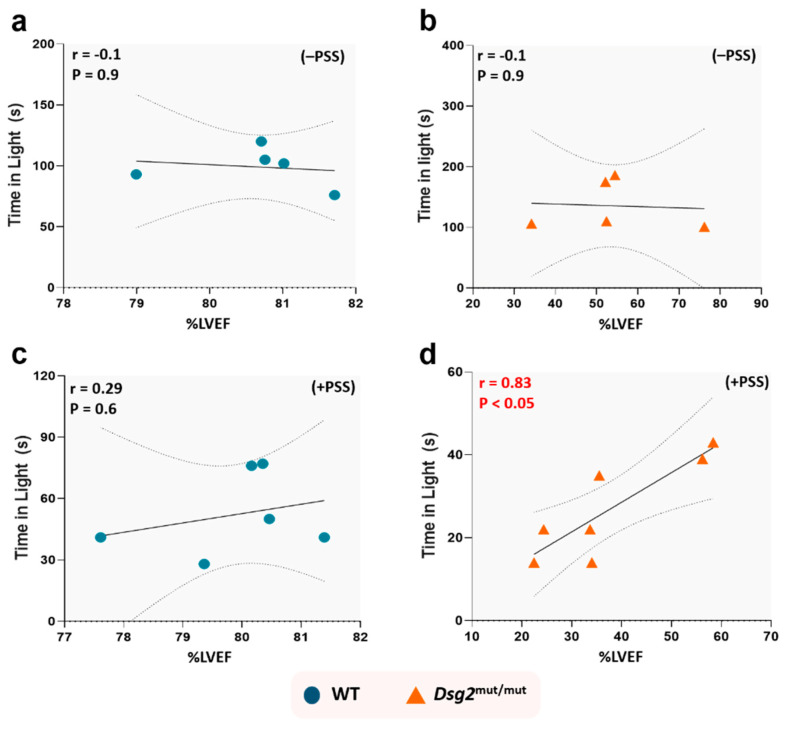
Anxiety levels induced by psychosocial stress correlate with cardiac dysfunction in Dsg2mut/mut mice. No correlation was found between time spent in light with %LVEF from (a) WT mice and (b) Dsg2mut/mut mice not subjected to RI (i.e., −PSS), or (c) WT mice after 14 days of RI challenge (i.e., +PSS). (d) Conversely, after 14 days of psychosocial stress, Dsg2mut/mut mice showed a significant correlation between time spent in light and %LVEF (r = 0.83, p < 0.05). Data displayed in scatterplots; thick black lines represent the best linear fit through data; dotted lines represent two-tailed 95% confidence interval; text inset reports Spearman’s Rho values and associated p-values.
Figure 6
Figure 6
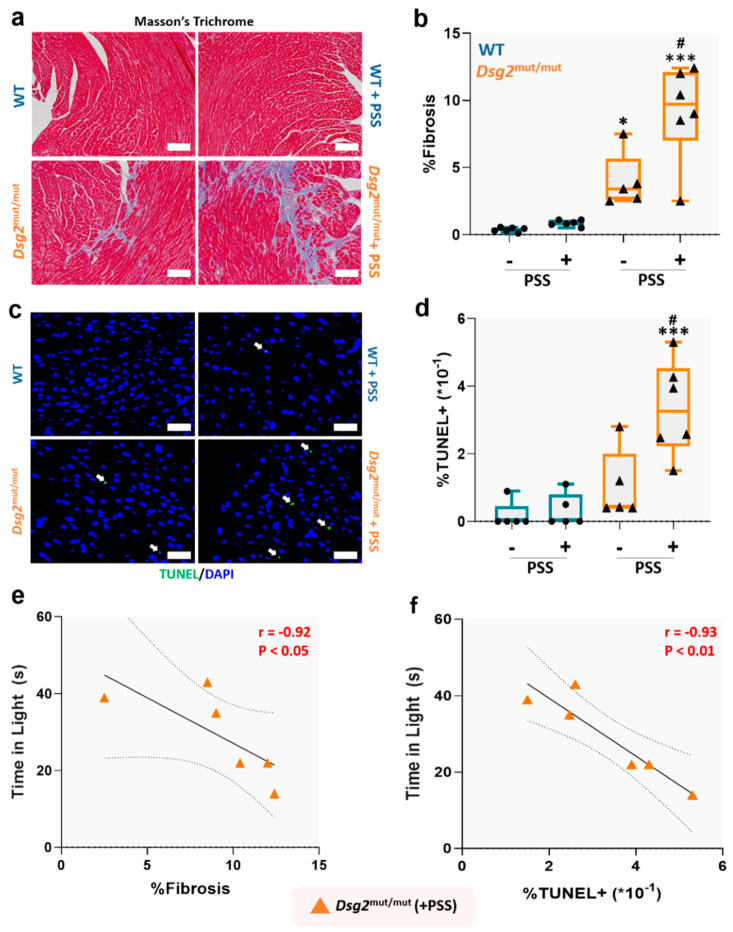
Psychosocial stress worsens pathological progression in Dsg2mut/mut mice. (a) Representative images of Masson’s Trichrome immunostained myocardium. White scale bars, 100 µm. Images are representative of n = 5–6 mice/cohort; (b) Percent (%) myocardial fibrosis; (c) Representative images of myocardium immunostained for TUNEL and DAPI. Images are representative of n = 5–6 mice/cohort. White arrows, TUNEL positive (+) nuclei; white scale bars, 25 µm. (d) Percent (%) TUNEL+ nuclei in 5 microscopic fields from each mouse/cohort. For (b,c) data presented as box-whisker plots, n = 5–6 mice/cohort. PSS, psychosocial stress. * p < 0.05, *** p < 0.001 vs. WT (+PSS) and WT (−PSS); # p < 0.01 Dsg2mut/mut (+PSS) vs. Dsg2mut/mut (−PSS); using One-Way ANOVA and Tukey’s post-hoc analysis. For (b,d), black dots are WT mice (with or without PSS) and black triangles are Dsg2mut/mut mice (with or without PSS). (e,f) Anxiety levels induced by PSS correlates with cardiac remodeling in Dsg2mut/mut mice. Correlation between time spent in light and (e) percent (%) fibrosis and (f) percent (%) TUNEL+ nuclei in Dsg2mut/mut (+PSS) mice. Data displayed as scatterplots; thick black lines show the best linear fit through data; dotted lines represent two-tailed 95% confidence interval; text inset reports Spearman’s Rho values and associated p-values.

References

    1. Anderson E., Shivakumar G. Effects of exercise and physical activity on anxiety. Front. Psychiatry. 2013;4:27. doi: 10.3389/fpsyt.2013.00027. - DOI - PMC - PubMed
    1. Agrimi J., Spalletti C., Baroni C., Keceli G., Zhu G., Caragnano A., Matteucci M., Chelko S., Ramirez-Correa G.A., Bedja D., et al. Obese mice exposed to psychosocial stress display cardiac and hippocampal dysfunction associated with local brain-derived neurotrophic factor depletion. EBioMedicine. 2019;47:384–401. doi: 10.1016/j.ebiom.2019.08.042. - DOI - PMC - PubMed
    1. Schneiderman N., Ironson G., Siegel S.D. Stress and health: Psychological, behavioral, and biological determinants. Annu. Rev. Clin. Psychol. 2005;1:607–628. doi: 10.1146/annurev.clinpsy.1.102803.144141. - DOI - PMC - PubMed
    1. Saberniak J., Hasselberg N.E., Borgquist R., Platonov P.G., Sarvari S.I., Smith H.J., Ribe M., Holst A.G., Edvardsen T., Haugaa K.H. Vigorous physical activity impairs myocardial function in patients with arrhythmogenic right ventricular cardiomyopathy and in mutation positive family members. Eur. J. Heart Fail. 2014;16:1337–1344. doi: 10.1002/ejhf.181. - DOI - PMC - PubMed
    1. James C.A., Bhonsale A., Tichnell C., Murray B., Russell S.D., Tandri H., Tedford R.J., Judge D.P., Calkins H. Exercise increases age-related penetrance and arrhythmic risk in arrhythmogenic right ventricular dysplasia/cardiomyopathy-associated desmosomal mutation carriers. J. Am. Coll. Cardiol. 2013;62:1290–1297. doi: 10.1016/j.jacc.2013.06.033. - DOI - PMC - PubMed

LinkOut - more resources