


Valproic Acid and Its Amidic Derivatives as New Antivirals against Alphaherpesviruses
- PMID: 33256172
- PMCID: PMC7760627
- DOI: 10.3390/v12121356
Valproic Acid and Its Amidic Derivatives as New Antivirals against Alphaherpesviruses
Abstract
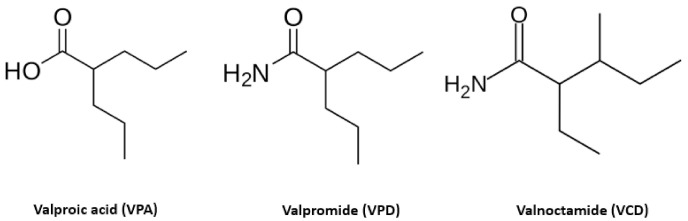
Herpes simplex viruses (HSVs) are neurotropic viruses with broad host range whose infections cause considerable health problems in both animals and humans. In fact, 67% of the global population under the age of 50 are infected with HSV-1 and 13% have clinically recurrent HSV-2 infections. The most prescribed antiherpetics are nucleoside analogues such as acyclovir, but the emergence of mutants resistant to these drugs and the lack of available vaccines against human HSVs has led to an imminent need for new antivirals. Valproic acid (VPA) is a branched short-chain fatty acid clinically used as a broad-spectrum antiepileptic drug in the treatment of neurological disorders, which has shown promising antiviral activity against some herpesviruses. Moreover, its amidic derivatives valpromide and valnoctamide also share this antiherpetic activity. This review summarizes the current research on the use of VPA and its amidic derivatives as alternatives to traditional antiherpetics in the fight against HSV infections.
Keywords: alphaherpesvirus; valnoctamide; valproic acid; valpromide.
Conflict of interest statement
The authors declare no conflict of interest. The funders had no role in the design of the study; in the collection, analyses, or interpretation of data; in the writing of the manuscript, or in the decision to publish the results.
Figures
References
-
- Carrasco L., Almendral J.M. Virus Patógenos. Editorial Hélice, Fundación BBVA; Madrid, Spain: 2006.
-
- Smith T.T., Whitley R.J. Infectious Diseases. Elsevier; Amsterdam, The Netherlands: 2017. Herpesviruses; pp. 1426–1438.e1. - DOI
Publication types
MeSH terms
Substances
LinkOut - more resources
Full Text Sources
Other Literature Sources
