


Fruiting body form, not nutritional mode, is the major driver of diversification in mushroom-forming fungi
- PMID: 33257574
- PMCID: PMC7768725
- DOI: 10.1073/pnas.1922539117
Fruiting body form, not nutritional mode, is the major driver of diversification in mushroom-forming fungi
Abstract
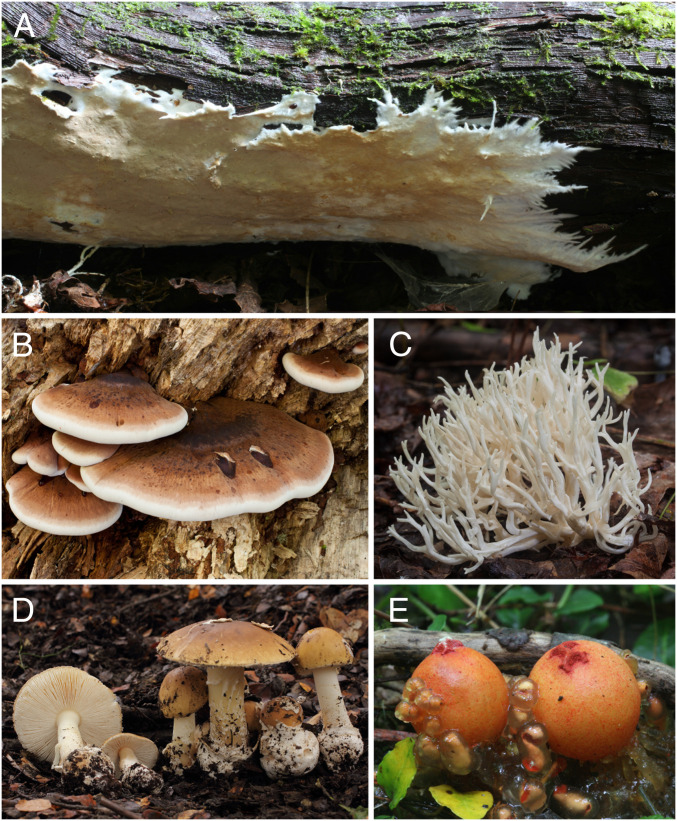
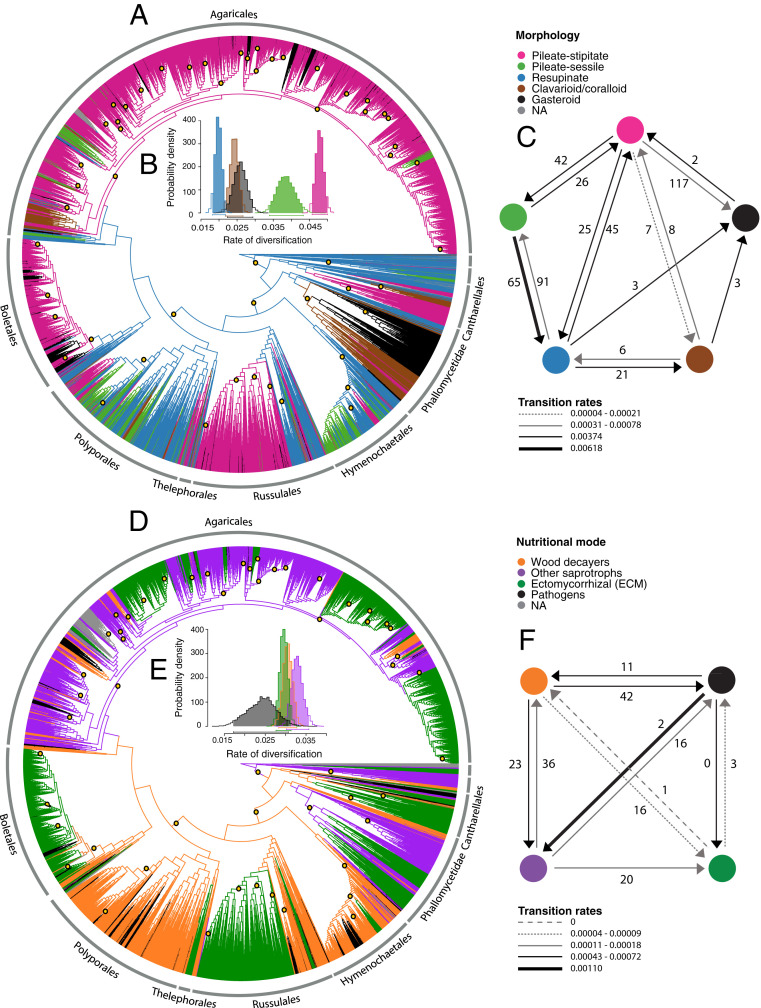
With ∼36,000 described species, Agaricomycetes are among the most successful groups of Fungi. Agaricomycetes display great diversity in fruiting body forms and nutritional modes. Most have pileate-stipitate fruiting bodies (with a cap and stalk), but the group also contains crust-like resupinate fungi, polypores, coral fungi, and gasteroid forms (e.g., puffballs and stinkhorns). Some Agaricomycetes enter into ectomycorrhizal symbioses with plants, while others are decayers (saprotrophs) or pathogens. We constructed a megaphylogeny of 8,400 species and used it to test the following five hypotheses regarding the evolution of morphological and ecological traits in Agaricomycetes and their impact on diversification: 1) resupinate forms are plesiomorphic, 2) pileate-stipitate forms promote diversification, 3) the evolution of gasteroid forms is irreversible, 4) the ectomycorrhizal (ECM) symbiosis promotes diversification, and 5) the evolution of ECM symbiosis is irreversible. The ancestor of Agaricomycetes was a saprotroph with a resupinate fruiting body. There have been 462 transitions in the examined morphologies, including 123 origins of gasteroid forms. Reversals of gasteroid forms are highly unlikely but cannot be rejected. Pileate-stipitate forms are correlated with elevated diversification rates, suggesting that this morphological trait is a key to the success of Agaricomycetes. ECM symbioses have evolved 36 times in Agaricomycetes, with several transformations to parasitism. Across the entire 8,400-species phylogeny, diversification rates of ectomycorrhizal lineages are no greater than those of saprotrophic lineages. However, some ECM lineages have elevated diversification rates compared to their non-ECM sister clades, suggesting that the evolution of symbioses may act as a key innovation at local phylogenetic scales.
Keywords: Agaricomycetes; diversification; ectomycorrhizal fungi; gasteroid forms; megaphylogeny.
Copyright © 2020 the Author(s). Published by PNAS.
Conflict of interest statement
The authors declare no competing interest.
Figures
References
-
- Index Fungorum. Index Fungorum Partnership; Kew R. B. G., Mycology, landcare research-NZ: Mycology and chinese academy or science: Institute of microbiology. www.indexfungorum.org. Accessed 12 December 2017.
-
- Birkebak J. M., Adamčík S., Looney B. P., Matheny P. B., Multilocus phylogenetic reconstruction of the Clavariaceae (Agaricales) reveals polyphyly of agaricoid members. Mycologia 108, 860–868 (2016). - PubMed
-
- Binder M., Larsson K.-H., Matheny P. B., Hibbett D. S., Amylocorticiales ord. nov. and Jaapiales ord. nov.: Early diverging clades of agaricomycetidae dominated by corticioid forms. Mycologia 102, 865–880 (2010). - PubMed
-
- Hosaka K., et al. , Molecular phylogenetics of the gomphoid-phalloid fungi with an establishment of the new subclass Phallomycetidae and two new orders. Mycologia 98, 949–959 (2006). - PubMed
-
- Binder M., Hibbett D. S., Molecular systematics and biological diversification of Boletales. Mycologia 98, 971–981 (2006). - PubMed
Publication types
MeSH terms
LinkOut - more resources
Full Text Sources
Miscellaneous
