. 2021 Mar;34(1):47-60.
doi: 10.1007/s00497-020-00399-5. Epub 2020 Nov 30.

Comparative analyses of angiosperm secretomes identify apoplastic pollen tube functions and novel secreted peptides

Affiliations

Comparative analyses of angiosperm secretomes identify apoplastic pollen tube functions and novel secreted peptides

María Flores-Tornero et al. Plant Reprod. 2021 Mar.

Abstract

Analyses of secretomes of in vitro grown pollen tubes from Amborella, maize and tobacco identified many components of processes associated with the cell wall, signaling and metabolism as well as novel small secreted peptides. Flowering plants (angiosperms) generate pollen grains that germinate on the stigma and produce tubes to transport their sperm cells cargo deep into the maternal reproductive tissues toward the ovules for a double fertilization process. During their journey, pollen tubes secrete many proteins (secreted proteome or secretome) required, for example, for communication with the maternal reproductive tissues, to build a solid own cell wall that withstands their high turgor pressure while softening simultaneously maternal cell wall tissue. The composition and species specificity or family specificity of the pollen tube secretome is poorly understood. Here, we provide a suitable method to obtain the pollen tube secretome from in vitro grown pollen tubes of the basal angiosperm Amborella trichopoda (Amborella) and the Poaceae model maize. The previously published secretome of tobacco pollen tubes was used as an example of eudicotyledonous plants in this comparative study. The secretome of the three species is each strongly different compared to the respective protein composition of pollen grains and tubes. In Amborella and maize, about 40% proteins are secreted by the conventional "classic" pathway and 30% by unconventional pathways. The latter pathway is expanded in tobacco. Proteins enriched in the secretome are especially involved in functions associated with the cell wall, cell surface, energy and lipid metabolism, proteolysis and redox processes. Expansins, pectin methylesterase inhibitors and RALFs are enriched in maize, while tobacco secretes many proteins involved, for example, in proteolysis and signaling. While the majority of proteins detected in the secretome occur also in pollen grains and pollen tubes, and correlate in the number of mapped peptides with relative gene expression levels, some novel secreted small proteins were identified. Moreover, the identification of secreted proteins containing pro-peptides indicates that these are processed in the apoplast. In conclusion, we provide a proteome resource from three distinct angiosperm clades that can be utilized among others to study the localization, abundance and processing of known secreted proteins and help to identify novel pollen tube secreted proteins for functional studies.

Keywords: Amborella; CRP; Cell wall; Maize; Pollen tube; Proteomics; Secretome; Signaling; Tobacco.


Conflict of interest statement

There is no conflict of interests.

Figures
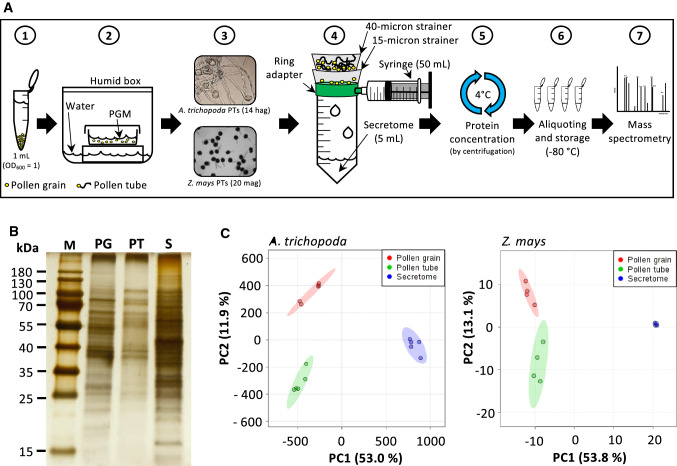
Fig. 1
Fig. 1
Procedure to obtain the pollen secretome from Amborella trichopoda and Zea mays and data quality analysis. a Schematic diagram describing the process of secretome obtainment in seven steps as indicated (see text for details). b Representative silver stained SDS-PAGEs showing differences in protein profiles of pollen grains (PG), pollen tubes (PT) and secretome (S) from A. trichopoda. c Principal component analysis (PCA) of the proteomic profile of A. trichopoda and Z. mays. Abbreviations: hag, hours after germination; mag, minutes after germination; PC, principal component; PGM, pollen germination medium
Fig. 2
Fig. 2
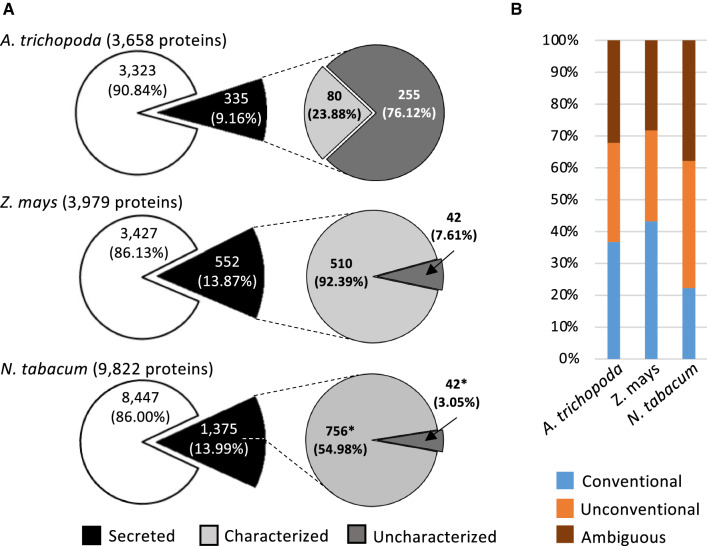
Statistical analysis of proteomic data obtained from pollen grains, pollen tubes and their secretome of A. trichopoda, Z. mays and Nicotiana tabacum. a Total number of proteins classified as “secreted” (detected in at least two biological replicates in the secretome data), “characterized” (described in the proteomic report) or “uncharacterized” (without description in the proteomic report). (*) Number of N. tabacum proteins with available UniProt ID (see text for details). b Predicted relative number of secreted proteins for conventional and unconventional secretory pathways, respectively
Fig. 3
Fig. 3
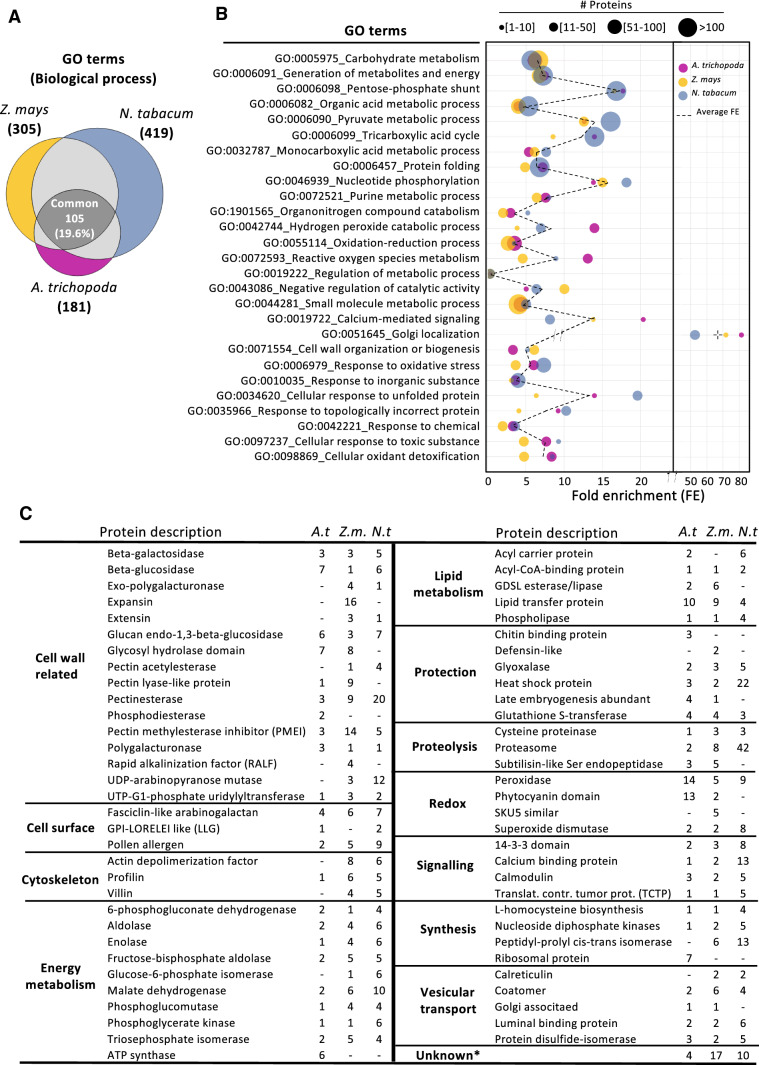
GO term analysis of secreted proteins from A. trichopoda, Z. mays and N. tabacum. a Venn diagram representing in brackets the total number of significantly enriched GO terms for biological processes in each species and the overlapping number. b Overlapping GO terms of all three species, number of detected proteins in each category, their fold enrichment (FE) and mean value indicated by a dashed line. c Most relevant secreted proteins when comparing A. trichopoda (A.t.), Z. mays (Z.m.) and N. tabacum (N.t.) pollen secretomes. (*) No available information (see Supplemental Table S3)
Fig. 4
Fig. 4
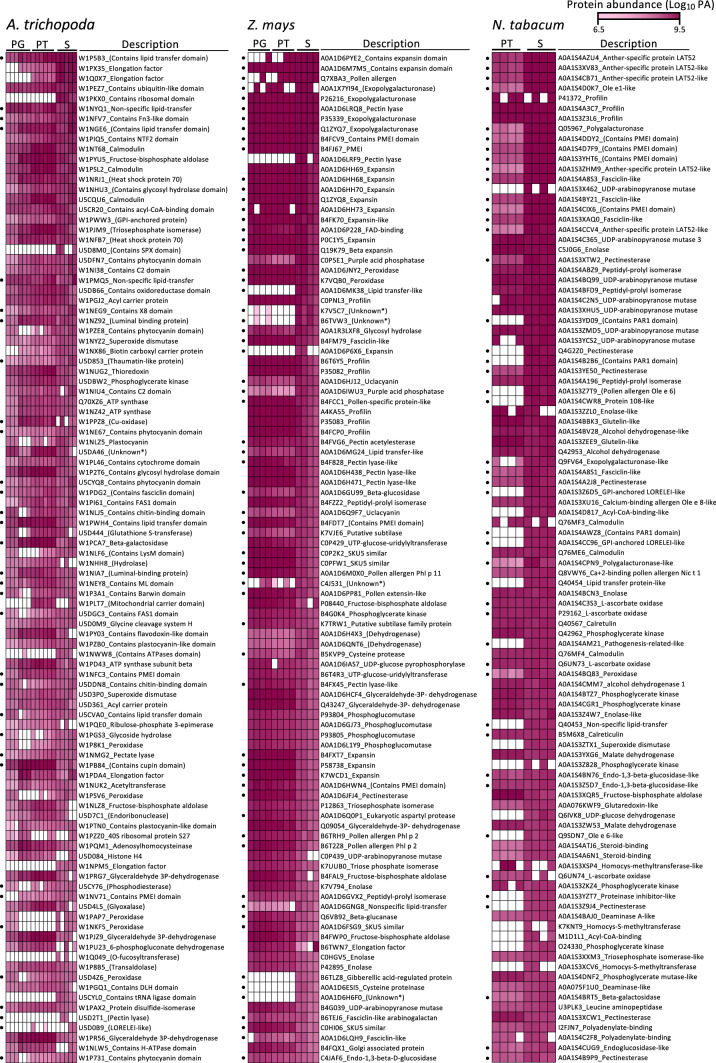
Identity of top 100 most abundant pollen tube secreted proteins from A. trichopoda, Z. mays and N. tabacum. Each cell represents the log10-transformed protein area of a given protein accession in parts per million (ppm). White cells represent the absence of protein. Proteins were sorted according to the highest number in the secretome data on top. Features from uncharacterized proteins are given in brackets. (●) Proteins with predicted signal peptide. *Proteins without any available information. PG pollen grain, PT pollen tube, S secretome
Fig. 5
Fig. 5
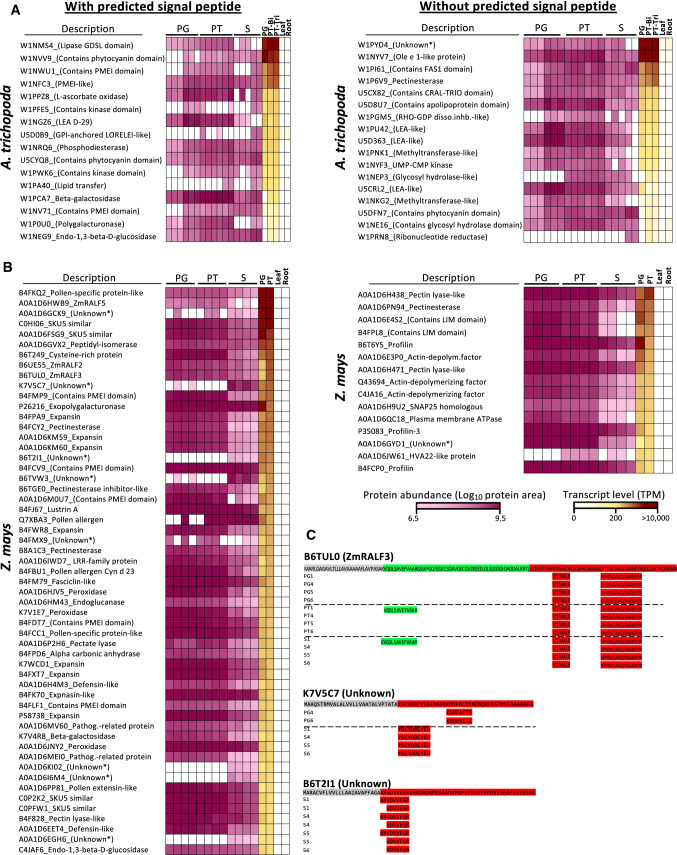
Comparison of proteomic and transcriptomic heatmaps of top expressed genes in pollen grains and pollen tubes of A. trichopoda and Z. mays as well as examples of mapped peptides. Genes and corresponding proteins were sorted with those showing the highest transcript levels on top. Two vegetative tissues are also included. a and b Proteins whose genes display at least 100 TPM expression levels in pollen tubes at the tricellular stage of A. trichopoda and 1000 TPM in pollen tubes of Z. mays are shown. Left blocks display proteins with predicted signal peptides and right blocks those lacking a predicted signal peptide. Color code for protein abundance and transcript level is indicated. Each biological protein sample is indicated. Average transcript levels were taken from Flores-Tornero et al. (2020). White cells represent the absence of protein or transcript. Features from uncharacterized proteins are given in brackets, and asterisks mark proteins without any available information. c Three examples showing mapping of identified peptides to small secreted proteins. PG pollen grain, PT pollen tube, S secretome

References

    1. Agrawal GK, Jwa NS, Lebrun MH, Job D, Rakwal R. Plant secretome: unlocking secrets of the secreted proteins. Proteomics. 2010;10:799–827. doi: 10.1002/pmic.200900514. - DOI - PubMed
    1. Alché JdD, M’rani-Alaoui M, Castro AJ, Rodríguez-García MI. Ole e 1, the major allergen from olive (Olea europaea L.) pollen, increases its expression and is released to the culture medium during in vitro germination. Plant Cell Physiol. 2004;45:1149–1157. doi: 10.1093/pcp/pch127. - DOI - PubMed
    1. Bircheneder S, Dresselhaus T. Why cellular communication during plant reproduction is particularly mediated by CRP signalling. J Exp Bot. 2016;67:4849–4861. doi: 10.1093/jxb/erw271. - DOI - PubMed
    1. Bokvaj P, Hafidh S, Honys D. Transcriptome profiling of male gametophyte development in Nicotiana tabacum. Genom Data. 2015;3:106–111. doi: 10.1016/j.gdata.2014.12.002. - DOI - PMC - PubMed
    1. Campbell L, Turner SR. A comprehensive analysis of RALF proteins in green plants suggests there are two distinct functional groups. Front Plant Sci. 2017;8:37. doi: 10.3389/fpls.2017.00037. - DOI - PMC - PubMed

Publication types