Review
. 2021 Apr;10(4):522-533.
doi: 10.1002/sctm.20-0351. Epub 2020 Dec 1.

Reemergence of neural crest stem cell-like states in melanoma during disease progression and treatment

Affiliations
Review

Reemergence of neural crest stem cell-like states in melanoma during disease progression and treatment

Johanna Diener et al. Stem Cells Transl Med. 2021 Apr.

Abstract

Melanoma is the deadliest of all skin cancers due to its high metastatic potential. In recent years, advances in targeted therapy and immunotherapy have contributed to a remarkable progress in the treatment of metastatic disease. However, intrinsic or acquired resistance to such therapies remains a major obstacle in melanoma treatment. Melanoma disease progression, beginning from tumor initiation and growth to acquisition of invasive phenotypes and metastatic spread and acquisition of treatment resistance, has been associated with cellular dedifferentiation and the hijacking of gene regulatory networks reminiscent of the neural crest (NC)-the developmental structure which gives rise to melanocytes and hence melanoma. This review summarizes the experimental evidence for the involvement of NC stem cell (NCSC)-like cell states during melanoma progression and addresses novel approaches to combat the emergence of stemness characteristics that have shown to be linked with aggressive disease outcome and drug resistance.

Keywords: cancer; development; drug resistance; invasion; melanoma; neural crest stem cells (NCSCs); tumor initiation.


Conflict of interest statement

The authors declared no potential conflicts of interest.

Figures
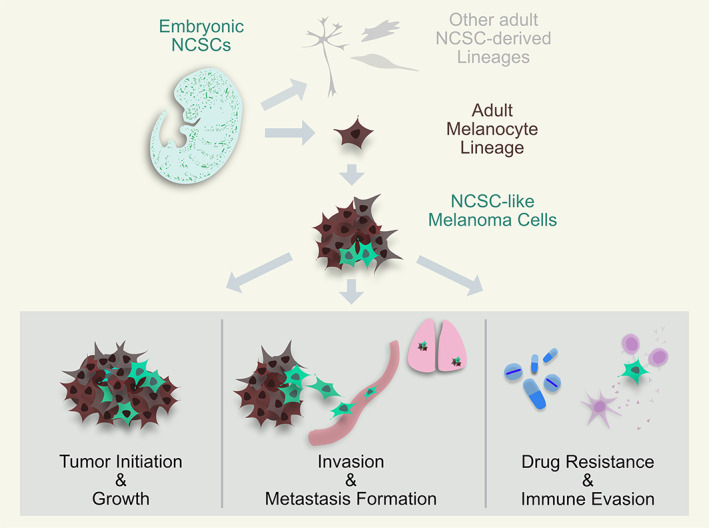
FIGURE 1
FIGURE 1
Reacquisition of neural crest stem cell (NCSC)‐like characteristics in melanoma and its implications. Embryonic NCSCs (dark green) arise at the developing dorsal neural tube and migrate into the whole embryo to form different tissues such as craniofacial bone and cartilage, enteric and peripheral nervous system cells (light grey) and, amongst many others, also cells of the melanocyte lineage, specifically melanocyte stem cells (MeSCs), melanoblasts and melanocytes (brown). Due to malignant transformations, those cells can progress into melanoma. Different studies have shown that some melanoma cells (light green) can hijack embryonic NCSC programs, bestowing them with different advantageous characteristics. Melanoma cells with reacquired NCSC features have been associated with the ability to form novel tumors and sustain growth, increased cell invasiveness and metastasis formation, as well as the ability to resist different melanoma therapies and evade immune surveillance
FIGURE 2
FIGURE 2
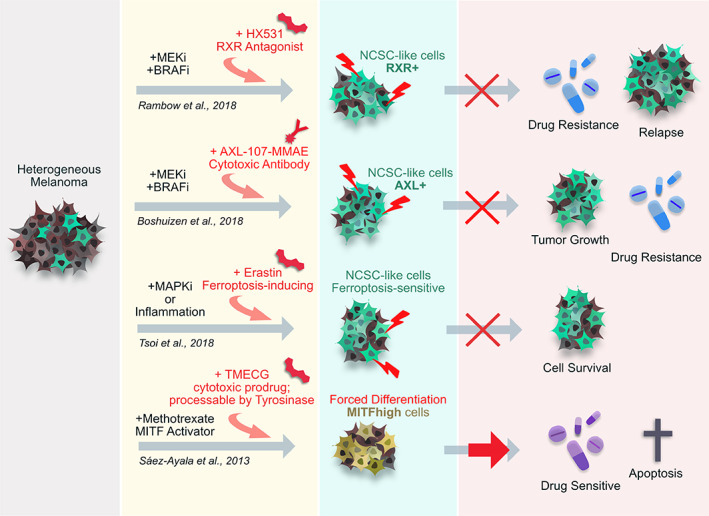
Interfering with dedifferentiated, neural crest stem cell (NCSC)‐like melanoma cells to combat drug resistance. Different preclinical studies successfully managed to circumvent therapy resistance of melanoma cells or patient‐derived grafts in mice by targeting the reemergence of NCSC‐like melanoma states. Rambow et al 28 were able to attenuate the accumulation of NCSC‐like cells after BRAF/MEK inhibition by treating patient‐derived melanoma with an antagonist toward RXRG, a NCSC‐associated gene strongly upregulated within their drug resistant melanoma subpopulation. Similarly, Boshuizen et al 107 successfully targeted tumor growth by combining MAPK inhibition with a cytotoxic antibody against AXLhigh cells emerging as resistant cells after BRAF/MEK inhibition. AXL is associated with invasiveness and drug resistance in melanoma 60 but has also been associated with reemergence of NCSC states in melanoma. 106 Also, Tsoi et al 106 could show that MAPK inhibition as well as pro‐inflammatory signaling from immunotherapies promoted drug resistant, dedifferentiated melanoma cells, which were characterized by increased sensitivity to ferroptosis. The authors subsequently co‐treated melanoma cells with targeted therapy and the ferroptosis‐inducing drug Erastin, which led to decreased melanoma cell survival. Sáez‐Ayala et al 111 achieved to circumvent drug resistance by forced differentiation of melanoma cells due to treatment with methotrexate (MTX), which induced the expression of the melanocyte differentiation marker MITF and inhibited invasiveness. This drug was further combined with the cytotoxic prodrug TMECG, activated by tyrosinase (a target of MITF), which is expressed in differentiated melanocytes

References

    1. Baggiolini A, Varum S, Mateos JM, et al. Premigratory and migratory neural crest cells are multipotent in vivo. Cell Stem Cell. 2015;16(3):314‐322. 10.1016/j.stem.2015.02.017. - DOI - PubMed
    1. Bronner‐Fraser M, Fraser SE. Cell lineage analysis reveals multipotency of some avian neural crest cells. Nature. 1988;335:161–164. 10.1038/335161a0. - DOI - PubMed
    1. Le Douarin, N. , & Kalcheim, C. (1999). The Neural Crest. Cambridge, England: Cambridge University Press. 10.1017/CBO9780511897948 - DOI
    1. Szabó A, Mayor R. Mechanisms of neural crest migration. Annu Rev Genet. 2018;52(1):43‐63. 10.1146/annurev-genet-120417-031559. - DOI - PubMed
    1. Etchevers HC, Dupin E, Le Douarin NM. The diverse neural crest: from embryology to human pathology. Development (Cambridge). 2019;146:dev169821. 10.1242/dev.169821. - DOI - PubMed