


Digital and Mobile Technologies to Promote Physical Health Behavior Change and Provide Psychological Support for Patients Undergoing Elective Surgery: Meta-Ethnography and Systematic Review
- PMID: 33258787
- PMCID: PMC7738263
- DOI: 10.2196/19237
Digital and Mobile Technologies to Promote Physical Health Behavior Change and Provide Psychological Support for Patients Undergoing Elective Surgery: Meta-Ethnography and Systematic Review
Abstract
Background: Digital technology has influenced many aspects of modern living, including health care. In the context of elective surgeries, there is a strong association between preoperative physical and psychological preparedness, and improved postoperative outcomes. Health behavior changes made in the pre- and postoperative periods can be fundamental in determining the outcomes and success of elective surgeries. Understanding the potential unmet needs of patients undergoing elective surgery is central to motivating health behavior change. Integrating digital and mobile health technologies within the elective surgical pathway could be a strategy to remotely deliver this support to patients.
Objective: This meta-ethnographic systematic review explores digital interventions supporting patients undergoing elective surgery with health behavior changes, specifically physical activity, weight loss, dietary intake, and psychological support.
Methods: A literature search was conducted in October 2019 across 6 electronic databases (International Prospective Register of Systematic Reviews [PROSPERO]: CRD42020157813). Qualitative studies were included if they evaluated the use of digital technologies supporting behavior change in adult patients undergoing elective surgery during the pre- or postoperative period. Study quality was assessed using the Critical Appraisal Skills Programme tool. A meta-ethnographic approach was used to synthesize existing qualitative data, using the 7 phases of meta-ethnography by Noblit and Hare. Using this approach, along with reciprocal translation, enabled the development of 4 themes from the data.
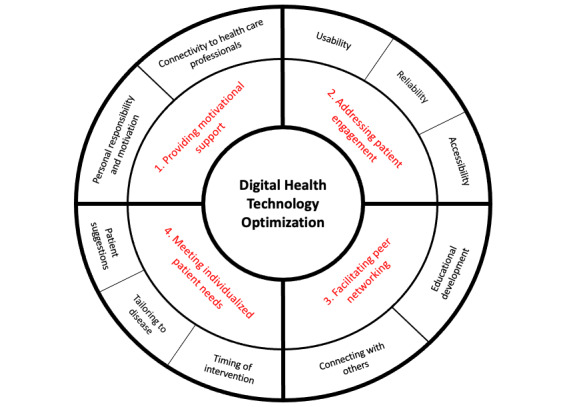
Results: A total of 18 studies were included covering bariatric (n=2, 11%), cancer (n=13, 72%), and orthopedic (n=3, 17%) surgeries. The 4 overarching themes appear to be key in understanding and determining the effectiveness of digital and mobile interventions to support surgical patients. To successfully motivate health behavior change, technologies should provide motivation and support, enable patient engagement, facilitate peer networking, and meet individualized patient needs. Self-regulatory features such as goal setting heightened patient motivation. The personalization of difficulty levels in virtual reality-based rehabilitation was positively received. Internet-based cognitive behavioral therapy reduced depression and distress in patients undergoing cancer surgery. Peer networking provided emotional support beyond that of patient-provider relationships, improving quality of life and care satisfaction. Patients expressed the desire for digital interventions to be individually tailored according to their physical and psychological needs, before and after surgery.
Conclusions: These findings have the potential to influence the future design of patient-centered digital and mobile health technologies and demonstrate a multipurpose role for digital technologies in the elective surgical pathway by motivating health behavior change and offering psychological support. Through the synthesis of patient suggestions, we highlight areas for digital technology optimization and emphasize the importance of content tailored to suit individual patients and surgical procedures. There is a significant rationale for involving patients in the cocreation of digital health technologies to enhance engagement, better support behavior change, and improve surgical outcomes.
Keywords: bariatric surgery; cancer; healthy lifestyle; mHealth; mobile health; mobile phone; orthopedic procedures; qualitative research; systematic review; telemedicine.
©Anna Robinson, Umay Oksuz, Robert Slight, Sarah Slight, Andrew Husband. Originally published in JMIR mHealth and uHealth (http://mhealth.jmir.org), 01.12.2020.
Conflict of interest statement
Conflicts of Interest: None declared.
Figures

References
-
- Becker S, Miron-Shatz T, Schumacher N, Krocza J, Diamantidis C, Albrecht U. Mhealth 2.0: experiences, possibilities, and perspectives. JMIR Mhealth Uhealth. 2014 May 16;2(2):e24. doi: 10.2196/mhealth.3328. https://mhealth.jmir.org/2014/2/e24/ - DOI - PMC - PubMed
-
- Bhavnani SP, Narula J, Sengupta PP. Mobile technology and the digitization of healthcare. Eur Heart J. 2016 May 7;37(18):1428–38. doi: 10.1093/eurheartj/ehv770. http://europepmc.org/abstract/MED/26873093 - DOI - PMC - PubMed
-
- - Correction to lancet infectious diseases 2020; published online april 29. Https://doi.Org/10.1016/ s1473-3099(20)30064-5. Lancet Infect Dis. 2020 Jul;20(7):e148. doi: 10.1016/S1473-3099(20)30370-4. https://linkinghub.elsevier.com/retrieve/pii/S1473-3099(20)30370-4 - DOI - PubMed
Publication types
MeSH terms
LinkOut - more resources
Full Text Sources
Medical
Miscellaneous
