


Altered nutrition behavior during COVID-19 pandemic lockdown in young adults
- PMID: 33258996
- PMCID: PMC7705857
- DOI: 10.1007/s00394-020-02435-6
Altered nutrition behavior during COVID-19 pandemic lockdown in young adults
Abstract
Purpose: The COVID-19 pandemic and the implemented lockdown strongly impact on everyone's daily life. Stressful situations are known to alter eating habits and increase the risk for obesity. In our study, we aimed to investigate the effect of the lockdown measures on nutrition behavior among young adults.
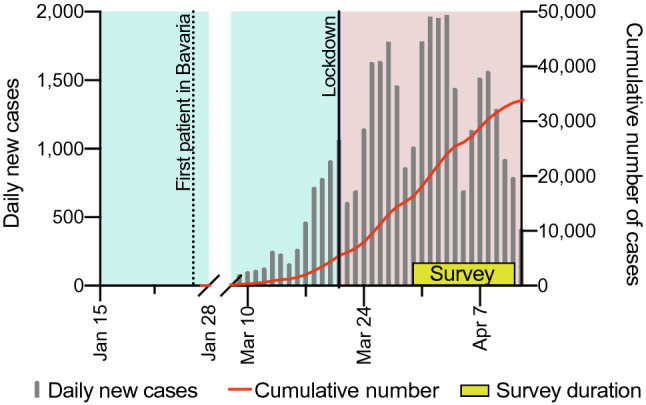
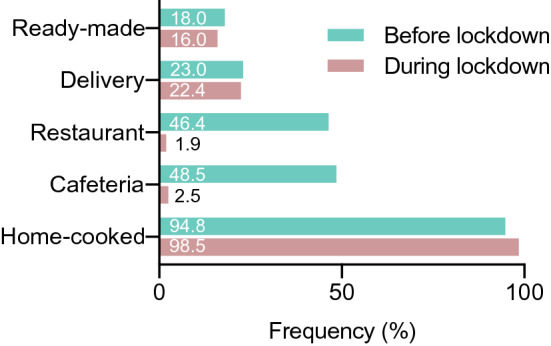
Methods: In this cross-sectional study, we enrolled 1964 voluntary participants from Bavarian universities. All participants were asked to complete an online questionnaire, semi-quantitatively evaluating the amount and type of food before and during pandemic lockdown. Study subjects were inquired to give information about acquisition and food procurement. The primary outcome was the change in food amount, secondary outcomes included alterations of food composition and procurement.
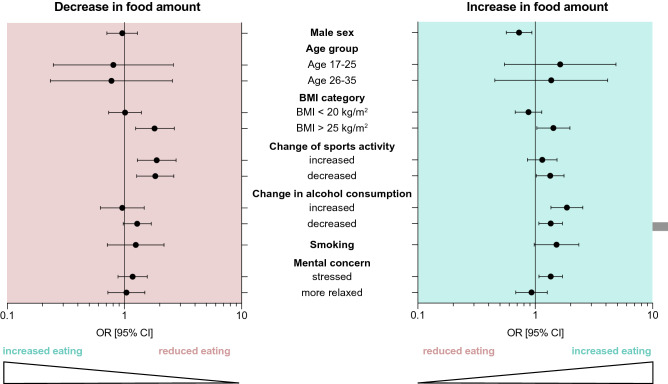
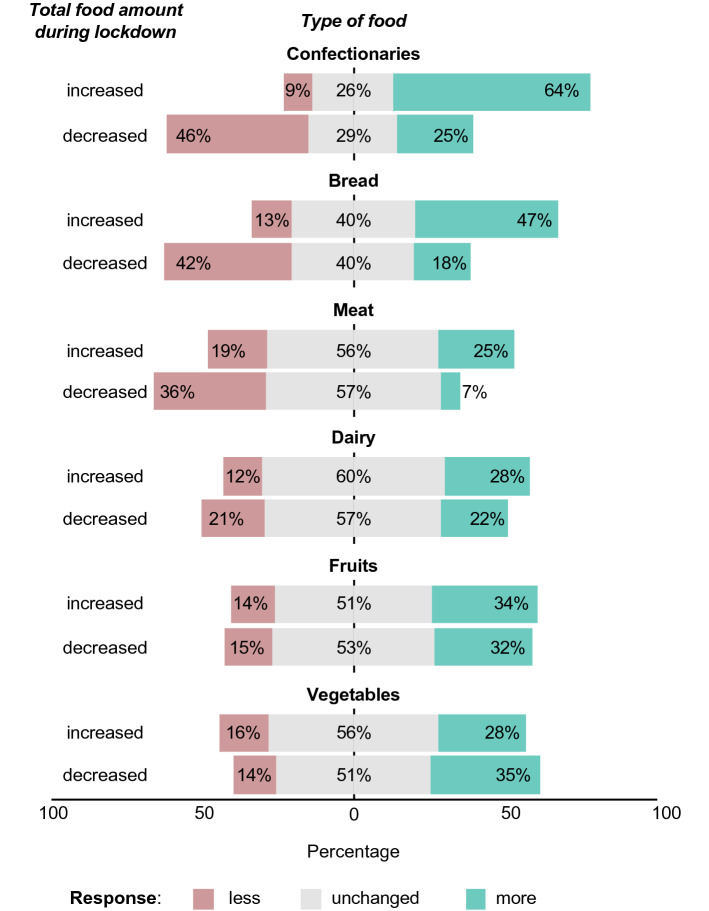
Results: Our study cohort (mean age 23.3 ± 4.0 years, 28.5% male) had a mean body mass index of 22.1 ± 4.5 kg/m2. The overall food amount increased in 31.2% of participants (n = 610) during lockdown and decreased in 16.8% (n = 328). A multinominal regression model revealed that an increased food intake was less likely in male participants (OR, 0.7 [CI 0.6-0.9]) and more likely with increasing BMI (OR, 1.4 [CI 1.3-2.0]), increased sports activity (OR, 1.3 [CI 1.2-1.8]), augmented mental stress (OR 1.4 [1.1-1.7]), and an alteration of alcohol consumption (reduced alcohol amount, OR, 1.4 [CI 1.1-1.7], increased alcohol, OR, 1.9 [CI 1.4-2.5]). Increase in food intake was mainly triggered by consumption of bread (increased in 46.8%, n = 284) and confectionary (increased in 64.4%, n = 389).
Conclusion: The COVID-19 pandemic lockdown significantly affected eating habits in young adults. Further investigation to evaluate long-term effects on weight change and comorbidities are warranted.
Trial registration: ClinicalTrials.gov NCT04361877.
Keywords: COVID-19 pandemic lockdown; Cardiovascular prevention; Dietary habits; Eating behavior; SARS-CoV-2; Students.
© 2020. The Author(s).
Conflict of interest statement
The authors declare that they have no conflict of interest.
All persons gave their informed consent prior to their inclusion in the study.
Figures


Comment in
-
Im Lockdown wurden Kalorien geschaufelt.MMW Fortschr Med. 2022 Oct;164(17):30. doi: 10.1007/s15006-022-1969-6. MMW Fortschr Med. 2022. PMID: 36198953 Free PMC article. German. No abstract available.
References
-
- Li Q, Guan X, Wu P, Wang X, Zhou L, Tong Y, Ren R, Leung KSM, Lau EHY, Wong JY, Xing X, Xiang N, Wu Y, Li C, Chen Q, Li D, Liu T, Zhao J, Liu M, Tu W, Chen C, Jin L, Yang R, Wang Q, Zhou S, Wang R, Liu H, Luo Y, Liu Y, Shao G, Li H, Tao Z, Yang Y, Deng Z, Liu B, Ma Z, Zhang Y, Shi G, Lam TTY, Wu JT, Gao GF, Cowling BJ, Yang B, Leung GM, Feng Z. Early transmission dynamics in Wuhan, China, of novel coronavirus-infected pneumonia. N Engl J Med. 2020;382(13):1199–1207. doi: 10.1056/NEJMoa2001316. - DOI - PMC - PubMed
-
- Piepoli MF, Hoes AW, Agewall S, Albus C, Brotons C, Catapano AL, Cooney MT, Corra U, Cosyns B, Deaton C, Graham I, Hall MS, Hobbs FDR, Lochen ML, Lollgen H, Marques-Vidal P, Perk J, Prescott E, Redon J, Richter DJ, Sattar N, Smulders Y, Tiberi M, van der Worp HB, van Dis I, Verschuren WMM, Binno S, Group ESCSD 2016 European guidelines on cardiovascular disease prevention in clinical practice: the sixth joint task force of the European Society of Cardiology and other societies on cardiovascular disease prevention in clinical practice (constituted by representatives of 10 societies and by invited experts) developed with the special contribution of the European Association for Cardiovascular Prevention & Rehabilitation (EACPR) Eur Heart J. 2016;37(29):2315–2381. doi: 10.1093/eurheartj/ehw106. - DOI - PMC - PubMed
MeSH terms
Associated data
LinkOut - more resources
Full Text Sources
Medical
Miscellaneous
