. 2020 Nov 29;21(23):9080.
doi: 10.3390/ijms21239080.

Zinc Binds to RRM2 Peptide of TDP-43

Affiliations

Zinc Binds to RRM2 Peptide of TDP-43

Andrey V Golovin et al. Int J Mol Sci. .

Abstract

Transactive response DNA and RNA binding protein 43 kDa (TDP-43) is a highly conserved heterogeneous nuclear ribonucleoprotein (hnRNP), which is involved in several steps of protein production including transcription and splicing. Its aggregates are frequently observed in motor neurons from amyotrophic lateral sclerosis patients and in the most common variant of frontotemporal lobar degeneration. Recently it was shown that TDP-43 is able to bind Zn2+ by its RRM domain. In this work, we have investigated Zn2+ binding to a short peptide 256-264 from C-terminus of RRM2 domain using isothermal titration calorimetry, electrospray ionization mass spectrometry, QM/MM simulations, and NMR spectroscopy. We have found that this peptide is able to bind zinc ions with a Ka equal to 1.6 × 10⁵ M-1. Our findings suggest the existence of a zinc binding site in the C-terminal region of RRM2 domain. Together with the existing structure of the RRM2 domain of TDP-43 we propose a model of its complex with Zn2+ which illustrates how zinc might regulate DNA/RNA binding.

Keywords: QM/MM; TDP-43; zinc.


Conflict of interest statement

The authors declare no conflict of interest.

Figures
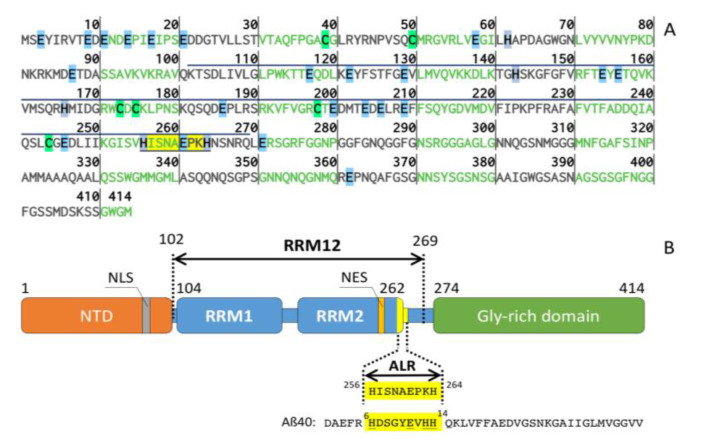
Figure 1
Figure 1
(A) Primary sequence of TAR DNA-binding protein 43 (TDP-43). The fragments of 102–269 (RRMs) and 256–264 (ALR) discussed in this study overlined and underlined respectively. The amino acids, which are able to chelate Zn2+ ions are highlighted: in clear blue—Glu, in green—Cys and in grey—His. (B) Domain organization of TDP-43: NTD—N-terminal domain; NLS—nuclear localization sequence; RRM1 and RRM2—RNA-recognition domains; NES—nuclear export signal. ALR in TDP-43 and Aβ40 sequence highlighted in yellow, amino acids that chelate Zn2+ in Aβ40 are underlined.
Figure 2
Figure 2
The 450–1200 m/z range of the positive ion mass spectra obtained for 10 µM ALR peptide in 100 mM ammonium acetate buffer in the absence (A) in the presence (B) of 50 mM ZnCl2, pH 7.3. Major signals at m/z 516.8, and 1032.5 correspond to the single and double charged molecular ion of the ALR peptide (marked as P). In the presence of zinc signal at 547.8 and 578.7 m/z were detected, which correspond to ALR complexes with one and two zinc ions. (C) Typical ITC titration curve (upper panel) and binding isotherm (lower panel) for zinc interactions with ALR peptide at 25 °C in 50 mM Tris buffer, pH 7.3.
Figure 3
Figure 3
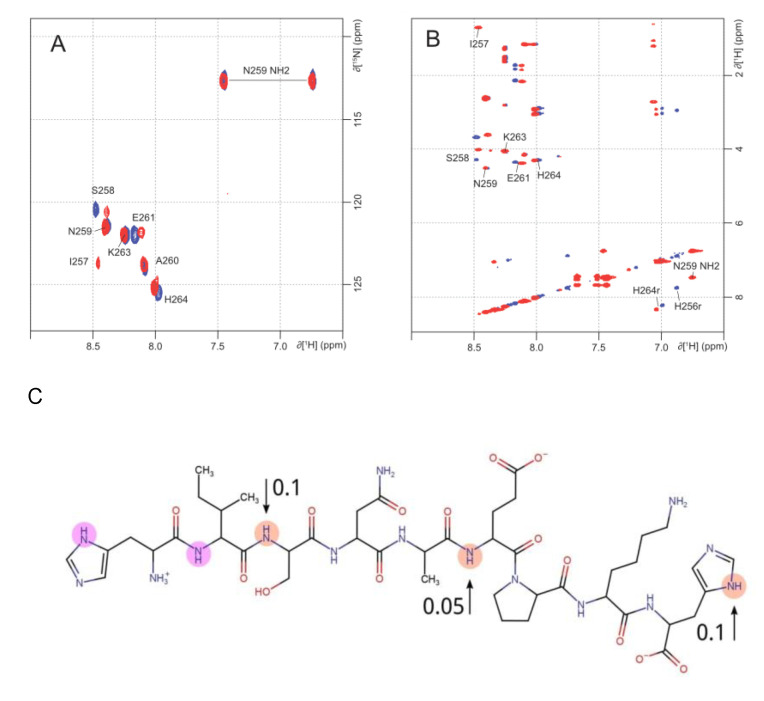
(A) 1H-15N HSQC spectra of ALR peptide (in blue) recorded at natural abundance for a sample at 0.8 mM concentration, 290 K and in phosphate buffer pH 6.8. For Zn2+/ALR complex (in red) the same conditions were used with a ratio of 10/1. NH group and Asn259 side chain NH2 assignments are indicated. (B) Zoom in on the homonuclear TOCSY spectra of free (in blue) and Zn2+ bound (in red) ALR peptides. (C) Chemical structure of ALR peptide. Atoms highlighted with red circles correspond to atoms with chemical shift upon zinc binding greater than 0.05. Atoms highlighted with pink circles correspond to atoms with new peaks upon zinc binding. The NMR spectra were recorded on a Bruker 600 MHz (Billerica, MA, USA) equipped with a TCI cryoprobe at 290 K. ALR peptide was at 0.8 mM concentration in a 10 mM phosphate buffer at pH 6.8. The spectra of Zn2+/ALR complex were obtained at a ratio 10:1. Sequential assignments of NH groups and side-chain protons of the peptide are indicated using protein numbering.
Figure 4
Figure 4
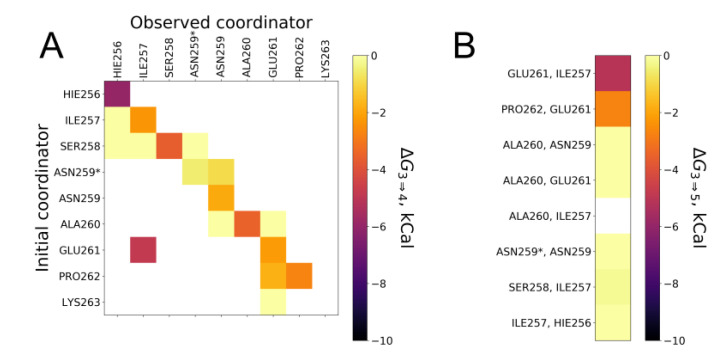
Screening for fourth and fifth chelators for Zn2+ in ALR peptide while other chelators are: Nδ His256, Nδ His264, and Oδ Glu261. All chelators’ names correspond to the backbone oxygen atom, except ASN259* is Oδ. ΔG values were estimated from simulations of systems initially built according to the abscissa names, while the axis represents observed coordination and corresponding energy values. (A) Matrix of ΔG values between four and three-coordinate state of Zn2+, (B) Column of ΔG values where the five-coordination sphere of Zn2+ was observed in simulation.
Figure 5
Figure 5
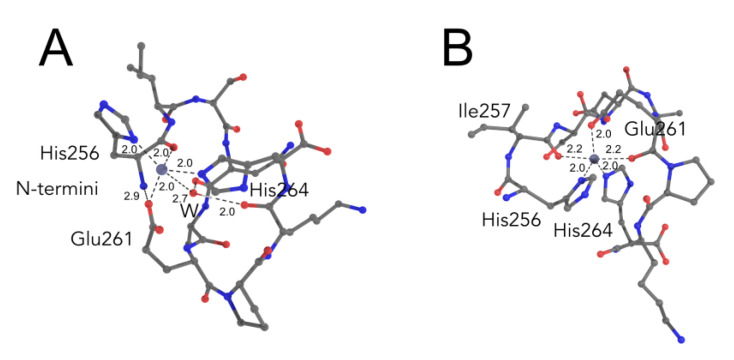
ALR peptide models from QM/MM simulations in which the zinc ion is coordinated (A) by four chelators: Nδ His256, Nδ His264, and Oδ Glu261 and backbone O from His256. (B) by five chelators: Nδ His256, Nδ His264, Oδ Glu261, backbone O from Glu261, and backbone O from Ile257. Oxygen atoms colored in red, nitrogen atoms in blue, carbon atoms in grey, and zinc cation in slate blue. Dashed lines present distances in the coordination sphere. Atom names are given according to the IUPAC-IUB convention.

References

    1. Cassandri M., Smirnov A., Novelli F., Pitolli C., Agostini M., Malewicz M., Melino G., Raschellà G. Zinc-finger proteins in health and disease. Cell Death Discov. 2017;3:17071. doi: 10.1038/cddiscovery.2017.71. - DOI - PMC - PubMed
    1. Tsvetkov P.O., Kulikova A.A., Golovin A.V., Tkachev Y.V., Archakov A.I., Kozin S.A., Makarov A.A. Minimal Zn(2+) binding site of amyloid-β. Biophys. J. 2010;99:L84–L86. doi: 10.1016/j.bpj.2010.09.015. - DOI - PMC - PubMed
    1. Tsvetkov P.O., Roman A.Y., Baksheeva V.E., Nazipova A.A., Shevelyova M.P., Vladimirov V.I., Buyanova M.F., Zinchenko D.V., Zamyatnin A.A.J., Devred F., et al. Functional Status of Neuronal Calcium Sensor-1 Is Modulated by Zinc Binding. Front. Mol. Neurosci. 2018;11:459. doi: 10.3389/fnmol.2018.00459. - DOI - PMC - PubMed
    1. Tsvetkov P.O., Devred F., Makarov A.A. Thermodynamics of zinc binding to human S100A2. Mol. Biol. 2010;44:832–835. doi: 10.1134/S0026893310050213. - DOI - PubMed
    1. Eide D.J. Zinc transporters and the cellular trafficking of zinc. Biochim. Biophys. Acta (BBA) Mol. Cell Res. 2006;1763:711–722. doi: 10.1016/j.bbamcr.2006.03.005. - DOI - PubMed

LinkOut - more resources