Review
. 2020 Nov 28;21(23):9067.
doi: 10.3390/ijms21239067.

Effects of Biological Therapies on Molecular Features of Rheumatoid Arthritis

Affiliations
Review

Effects of Biological Therapies on Molecular Features of Rheumatoid Arthritis

Chary Lopez-Pedrera et al. Int J Mol Sci. .

Abstract

Rheumatoid arthritis (RA) is an autoimmune and chronic inflammatory disease primarily affecting the joints, and closely related to specific autoantibodies that mostly target modified self-epitopes. Relevant findings in the field of RA pathogenesis have been described. In particular, new insights come from studies on synovial fibroblasts and cells belonging to the innate and adaptive immune system, which documented the aberrant production of inflammatory mediators, oxidative stress and NETosis, along with relevant alterations of the genome and on the regulatory epigenetic mechanisms. In recent years, the advances in the understanding of RA pathogenesis by identifying key cells and cytokines allowed the development of new targeted disease-modifying antirheumatic drugs (DMARDs). These drugs considerably improved treatment outcomes for the majority of patients. Moreover, numerous studies demonstrated that the pharmacological therapy with biologic DMARDs (bDMARDs) promotes, in parallel to their clinical efficacy, significant improvement in all these altered molecular mechanisms. Thus, continuous updating of the knowledge of molecular processes associated with the pathogenesis of RA, and on the specific effects of bDMARDs in the correction of their dysregulation, are essential in the early and correct approach to the treatment of this complex autoimmune disorder. The present review details basic mechanisms related to the physiopathology of RA, along with the core mechanisms of response to bDMARDs.

Keywords: NETosis; autoimmunity; bDMARDs; epigenetic and pos-transcriptional mechanisms; genome; inflammation; oxidative stress; rheumatoid arthritis.


Conflict of interest statement

The authors declare no conflict of interest.

Figures
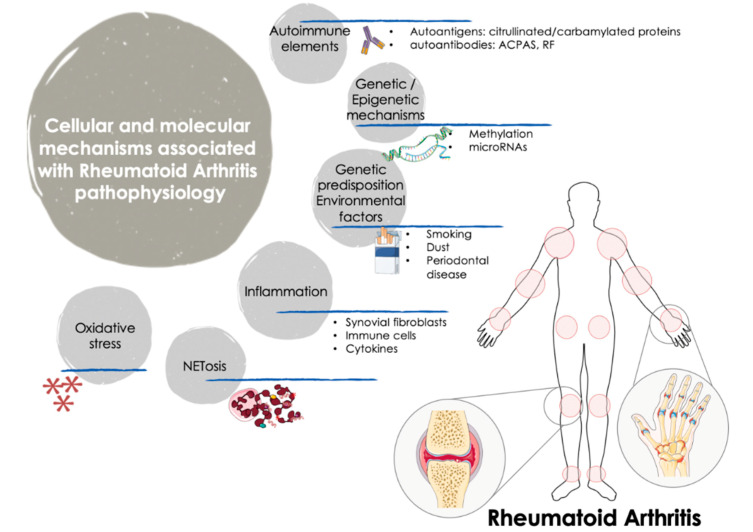
Figure 1
Figure 1
Cellular and molecular mechanisms involved in the pathogenesis of RA. The onset and progression of RA is orchestrated by several cellular and molecular pathologic mechanisms that participate in an integrated and coordinated way. The interaction between multiple genetic and environmental factors increase the risk of RA development. Autoimmune factors such as autoantigens and autoantibodies along with inflammatory mediators released by activated immune cells -including several cytokines and chemokines- are well recognized molecular features that influence the clinical manifestations of RA, characterized by tender and swollen joints and other related comorbidities. In recent years, novel mechanisms have been further associated with the pathogenesis of RA, including oxidative stress and NETosis and the interplay among gene expression and epigenetic and post-transcriptional mechanisms such as methylation and microRNAs. ACPAS, Anti-citrullinated peptide antibodies; RF, Rheumatoid Factor.
Figure 2
Figure 2
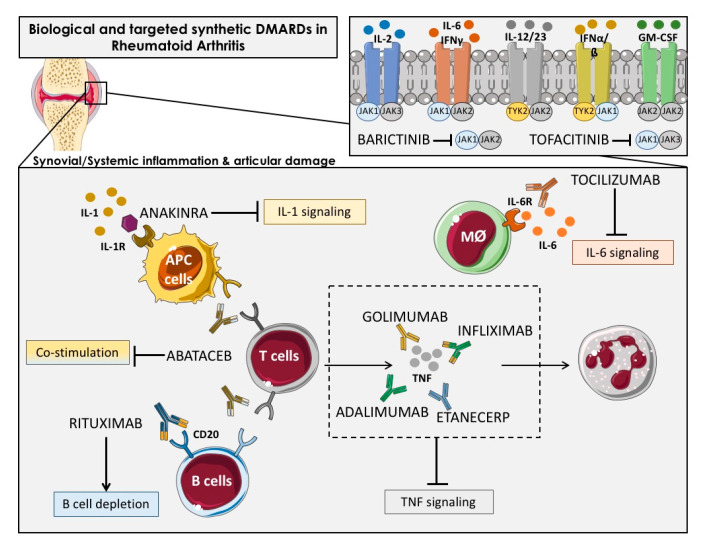
Overview of the main immunologic pathways targeted by the biological and targeted synthetic therapies in rheumatoid arthritis. Simplified description of cytokines and receptors that are targeted by available biologic DMARDs such as: TNF inhibitors (adalimumab, golimumab, infliximab and etanercept), IL-1R antagonist (anakinra), antibody against IL-6R (tocilizumab) and anti-CD20 (rituximab), and targeted synthetic DMARDs, such as Janus kinase inhibitors (anti-JAKs): tofacitinib (JAK1-JAK3 inhibitor) and baricitinib (JAK1–JAK2 inhibitor). APC: Antigen-presenting cells; Mφ: Macrophage.
Figure 3
Figure 3
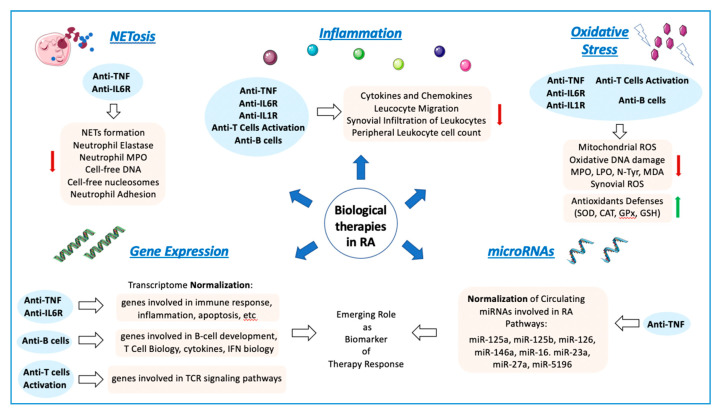
Molecular Effects of Biological therapies in RA patients. Biological therapies in RA have shown a wide range of beneficial molecular effects, by controlling numerous mechanisms altered in the disease. Hence, several therapies reduced the protein levels of circulating inflammatory mediators as well as the migration rate of activated immune cells to joints. Oxidative stress and NETosis have been also ameliorated after biological therapies including the reduction of ROS and oxidative markers, and the increase of the antioxidant defenses as well as the decrease of the NETs formation by neutrophils and related derived products. The altered transcriptome profile in peripheral blood and synovium of RA patients has been found normalized after biologics drugs, on which genes involved in key molecular pathways associated with the disease were modulated. Levels of microRNAs controlling the expression of central inflammatory genes have been found modulated in peripheral blood, plasma, and synovial fluid after anti-TNF therapy and some of, them along with mRNAs, are emerging as potential biomarkers predictors of therapy response.

References

    1. Smolen J.S., Aletaha D., Barton A., Burmester G.R., Emery P., Firestein G.S., Kavanaugh A., McInnes I.B., Solomon D.H., Strand V., et al. Rheumatoid arthritis. Nat. Rev. Dis. Primers. 2018;4:18001. doi: 10.1038/nrdp.2018.1. - DOI - PubMed
    1. Rooney C.M., Mankia K., Emery P. The role of the microbiome in driving RA-related autoimmunity. Front. Cell Dev. Biol. 2020;8:1013. doi: 10.3389/fcell.2020.538130. - DOI - PMC - PubMed
    1. Silverman G.J., Carson D.A. Roles of B cells in rheumatoid arthritis. Arthritis Res. Ther. 2003;5:1–6. doi: 10.1186/ar1010. - DOI - PMC - PubMed
    1. Smallwood M.J., Nissim A., Knight A.R., Whiteman M., Haigh R., Winyard P.G. Oxidative stress in autoimmune rheumatic diseases. Free Radic. Biol. Med. 2018;125:3–14. doi: 10.1016/j.freeradbiomed.2018.05.086. - DOI - PubMed
    1. Grayson P.C., Kaplan M.J. At the bench: Neutrophil extracellular traps (NETs) highlight novel aspects of innate immune system involvement in autoimmune diseases. J. Leukoc. Biol. 2016;99:253–264. doi: 10.1189/jlb.5BT0615-247R. - DOI - PMC - PubMed