Review
. 2020 Dec;35(4):696-715.
doi: 10.3803/EnM.2020.807. Epub 2020 Dec 2.

Updates in the Pathologic Classification of Thyroid Neoplasms: A Review of the World Health Organization Classification

Affiliations
Review

Updates in the Pathologic Classification of Thyroid Neoplasms: A Review of the World Health Organization Classification

Yanhua Bai et al. Endocrinol Metab (Seoul). 2020 Dec.

Abstract

Advances in medical sciences and evidence-based medicine have led to momentous changes in classification and management of thyroid neoplasms. Much progress has been made toward avoiding overdiagnosis and overtreatment of thyroid cancers. The new 2017 World Health Organization (WHO) classification of thyroid neoplasms updated the diagnostic criteria and molecular and genetic characteristics reflecting the biology and behavior of the tumors, and newly introduced the category of borderline malignancy or uncertain malignant potential. Some neoplasms were subclassified, renamed, or redefined as a specific entity. This review introduces changes in the fourth edition WHO classification of thyroid tumors and updates the contemporary diagnosis and classification of thyroid tumors. We also discuss several challenges with the proposal of new diagnostic entities, since they have unique histopathologic and molecular features and clinical relevance.

Keywords: Classification; Clinical decision-making; Diagnosis; Mutation; Prognosis; Thyroid neoplasms.


Conflict of interest statement

CONFLICTS OF INTEREST

No potential conflict of interest relevant to this article was reported.

Figures
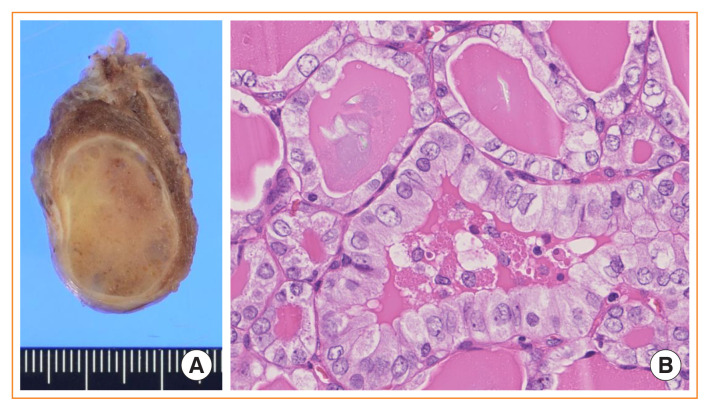
Fig. 1
Fig. 1
Noninvasive follicular thyroid neoplasm with papillary-like nuclear features. (A) Gross photo showing an encapsulated solid nodule confined to the thyroid gland. (B) Microscopically, the tumor shows a follicular growth pattern. Some follicular cells reveal mild nuclear enlargement, nuclear membrane irregularity, and a pale chromatin pattern which correspond to a nuclear score of 3 (H&E stain, ×400).
Fig. 2
Fig. 2
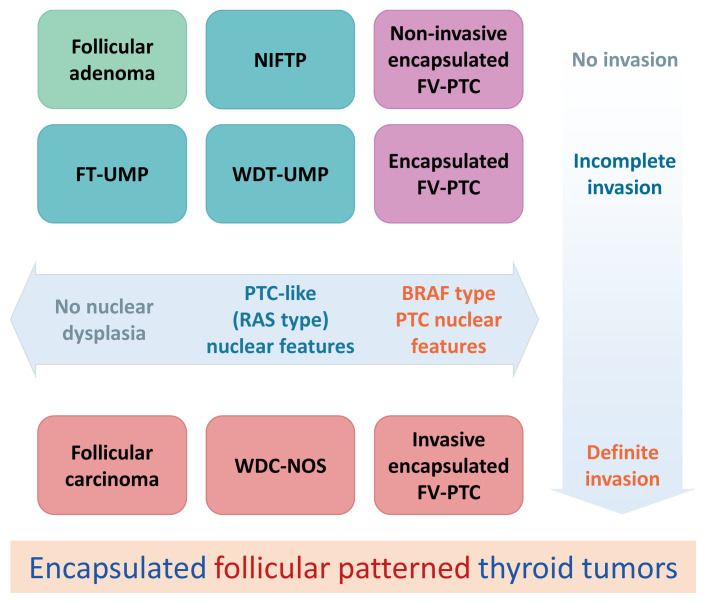
Schematic explanation of encapsulated follicular patterned thyroid tumors. NIFTP, noninvasive follicular thyroid neoplasm with papillary-like nuclear features; FV-PTC, follicular variant papillary thyroid carcinoma; FT-UMP, follicular tumor of uncertain malignant potential; WDT-UMP, well-differentiated tumor of uncertain malignant potential; WDC-NOS, well differentiated carcinoma not otherwise specified.
Fig. 3
Fig. 3
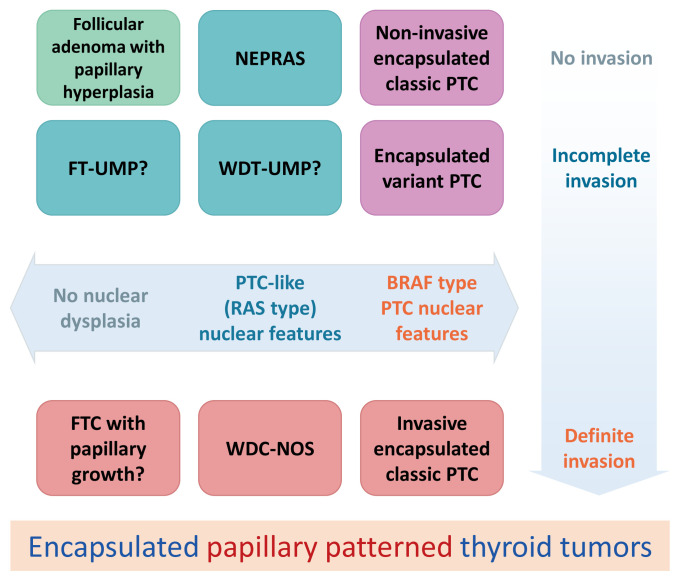
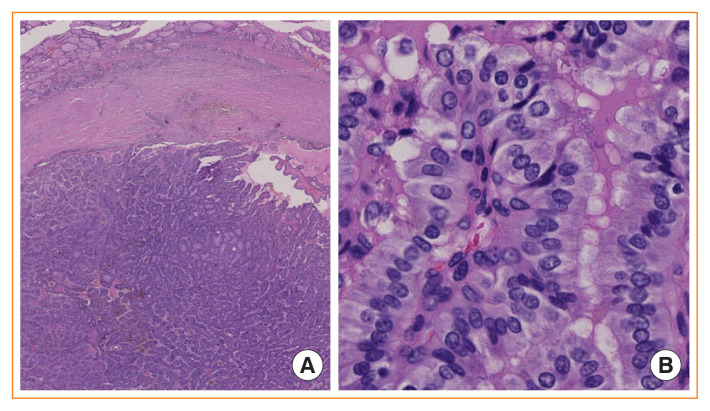
Schematic explanation of encapsulated papillary patterned thyroid tumors. Noninvasive encapsulated papillary patterned thyroid tumors with papillary thyroid carcinoma (PTC)-like nuclear features were not defined in the fourth edition World Health Organization classification of tumors of endocrine organs [2]. Ohba et al. [27] proposed to name it noninvasive encapsulated papillary RAS-like thyroid tumor (NEPRAS). FT-UMP, follicular tumor of uncertain malignant potential; WDT-UMP, well-differentiated tumor of uncertain malignant potential; WDC-NOS, well-differentiated carcinoma not otherwise specified.
Fig. 4
Fig. 4
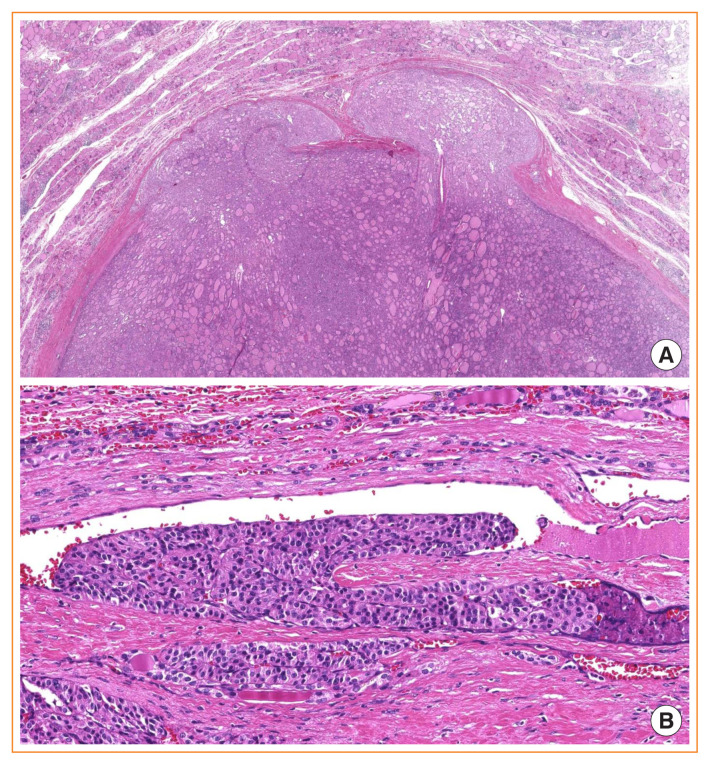
Noninvasive encapsulated papillary RAS-like thyroid tumor (NEPRAS). (A) Low-power view of an encapsulated papillary patterned thyroid without capsular or vascular invasion (H&E stain, ×40). (B) Higher magnification reveals mild nuclear enlargement and nuclear membrane irregularity which correspond to a nuclear score of 2 (H&E stain, ×400). Ohba et al. [27] proposed to name this tumor NEPRAS.
Fig. 5
Fig. 5
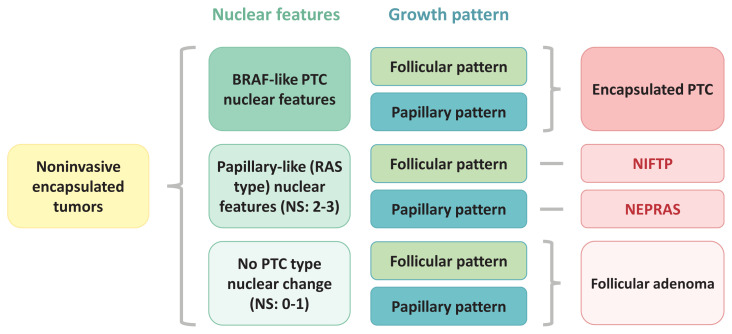
Schematic explanation of how to classify four different noninvasive encapsulated thyroid tumors including encapsulated papillary thyroid carcinoma (PTC), noninvasive follicular thyroid neoplasm with papillary-like nuclear features (NIFTP), noninvasive encapsulated papillary RAS-like thyroid tumor (NEPRAS), and follicular adenoma. NS, nuclear score.
Fig. 6
Fig. 6
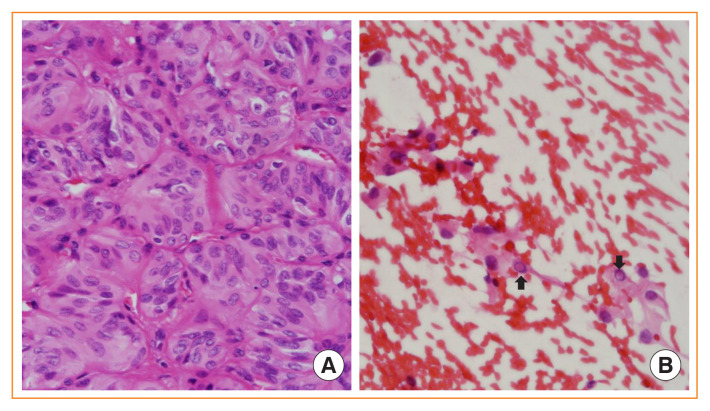
Hyalinizing trabecular tumor. (A) Tumor cells are arranged in a trabecular pattern and show a spindle shape, abundant cytoplasm, and papillary thyroid carcinoma-like nuclear features (H&E stain, ×400). (B) Fine needle aspiration cytology shows intranuclear pseudoinclusions (arrows) (H&E stain, ×400).
Fig. 7
Fig. 7
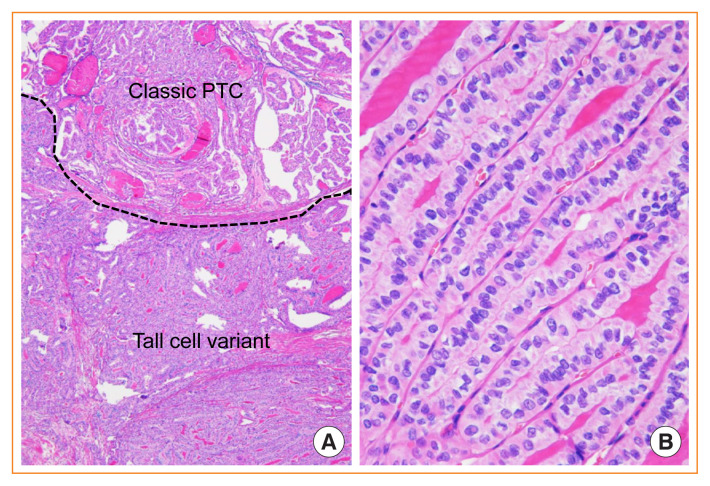
Tall cell variant of papillary thyroid carcinoma (PTC) mixed with classic papillary PTC. (A) The region of tall cells comprises more than 30% of the tumor (H&E stain, ×40). (B) Tall cells are arranged in a “tram-track” parallel pattern and are more than twice as tall as they are wide (H&E stain, ×400).
Fig. 8
Fig. 8
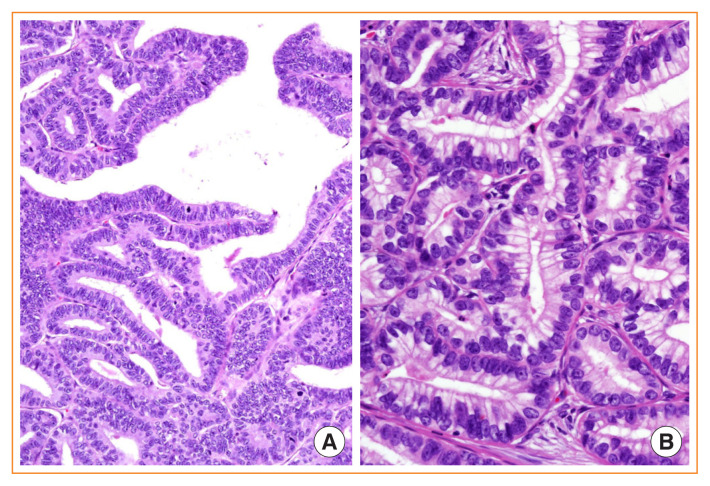
Columnar cell variant of papillary thyroid carcinoma (PTC). (A) Papillary and glandular architecture lined by columnar cells showing nuclear stratification and lacking characteristic nuclear features of PTC (H&E stain, ×400). (B) Columnar cells resemble secretory-type endometrium having supranuclear cytoplasmic vacuoles (H&E stain, ×400).
Fig. 9
Fig. 9
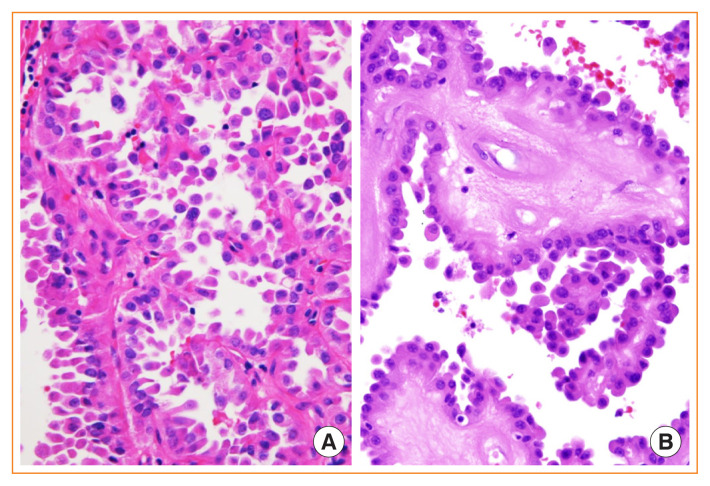
Hobnail variant of papillary thyroid carcinoma (PTC) and mimicker. (A) True hobnail variant (H&E stain, ×400). (B) Hobnail-like morphology is often seen in classic PTC with cystic changes (H&E stain, ×400).
Fig. 10
Fig. 10
Follicular thyroid carcinoma (FTC). (A) Minimally invasive FTC showing capsular invasion only (H&E stain, ×16). (B) A focus of vascular invasion found in an encapsulated angioinvasive FTC (H&E stain, ×253).
Fig. 11
Fig. 11
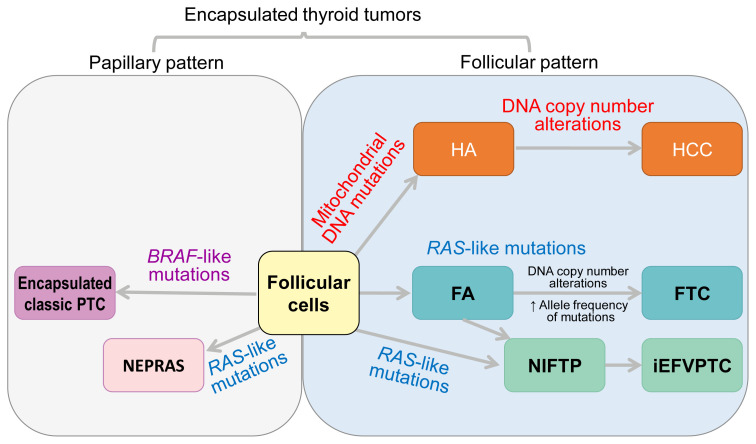
Classification of encapsulated thyroid tumors of follicular cell origin according to growth pattern and molecular profiles. Noninvasive encapsulated papillary RAS-like thyroid tumor (NEPRAS) is not currently included as a distinct entity of World Health Organization classification. PTC, papillary thyroid carcinoma; HA, Hürthle cell adenoma; HCC, Hürthle cell carcinoma; FA, follicular adenoma; FTC, follicular thyroid carcinoma; NIFTP, noninvasive follicular thyroid neoplasm with papillary-like nuclear features; iEFVPTC, invasive encapsulated follicular variant of papillary thyroid carcinoma.
Fig. 12
Fig. 12
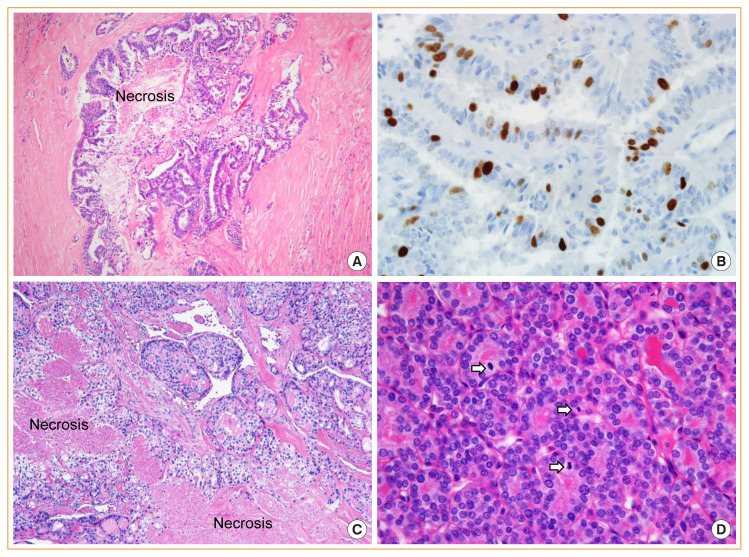
Well-differentiated thyroid carcinoma with high-grade features. Papillary thyroid carcinoma showing necrosis (A, H&E stain, ×100) and high proliferative activity with a Ki-67 rate of 18% (B, H&E stain, ×400). Follicular thyroid carcinoma with necrosis (C, H&E stain, ×100) and high mitotic figure (D, H&E stain, ×400). Three mitotic figures (arrows) are noted in one high-power field.
Fig. 13
Fig. 13
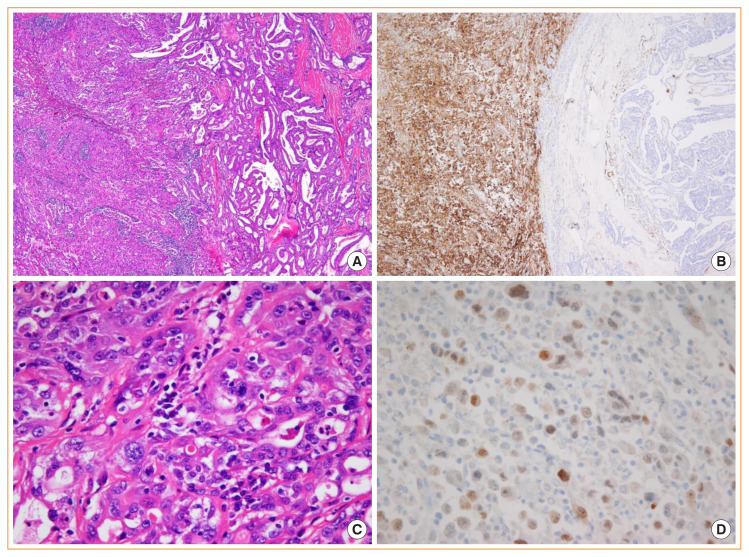
Anaplastic thyroid carcinoma (ATC) associated with papillary thyroid carcinoma (PTC). (A) Left area is ATC and right is PTC (H&E stain, ×100). (B) CD10 immunostain shows a diffuse and strong positivity in ATC (left) and is negative in PTC (right) (×100). (C) High-power view image shows pleomorphic tumor cells (H&E stain, ×400). (D) PAX8 immunostain shows a focal positivity (×400).

References

    1. Delellis RA, Lloyd RV, Heitz PU, Eng C. World Health Organization classification of tumours of endocrine organs. 3rd ed. Lyon: International Agency for Research on Cancer (IARC); 2004. pp. 49–123.
    1. Lloyd RV, Osamura RY, Kloppel G, Rosai J. WHO classification of tumours of endocrine organs. 4th ed. Lyon: International Agency for Research on Cancer (IARC); 2017. pp. 65–143.
    1. Williams ED. Guest editorial: two proposals regarding the terminology of thyroid tumors. Int J Surg Pathol. 2000;8:181–3. - PubMed
    1. Carney JA, Hirokawa M, Lloyd RV, Papotti M, Sebo TJ. Hyalinizing trabecular tumors of the thyroid gland are almost all benign. Am J Surg Pathol. 2008;32:1877–89. - PubMed
    1. Kakudo K, Bai Y, Liu Z, Li Y, Ito Y, Ozaki T. Classification of thyroid follicular cell tumors: with special reference to borderline lesions. Endocr J. 2012;59:1–12. - PubMed

Publication types