. 2021 Jun;66(6):569-578.
doi: 10.1038/s10038-020-00880-z. Epub 2020 Dec 2.

Comparative characterization of PCDH19 missense and truncating variants in PCDH19-related epilepsy

Affiliations

Comparative characterization of PCDH19 missense and truncating variants in PCDH19-related epilepsy

Mami Shibata et al. J Hum Genet. 2021 Jun.

Abstract

Missense and truncating variants in protocadherin 19 (PCDH19) cause PCDH19-related epilepsy. In this study, we aimed to investigate variations in distributional characteristics and the clinical implications of variant type in PCDH19-related epilepsy. We comprehensively collected PCDH19 missense and truncating variants from the literature and by sequencing six exons and intron-exon boundaries of PCDH19 in our cohort. We investigated the distribution of each type of variant using the cumulative distribution function and tested for associations between variant types and phenotypes. The distribution of missense variants in patients was clearly different from that of healthy individuals and was uniform throughout the extracellular cadherin (EC) domain, which consisted of six highly conserved domains. Truncating variants showed two types of distributions: (1) located from EC domain 1 to EC domain 4, and (2) located from EC domain 5 to the cytoplasmic domain. Furthermore, we also found that later onset seizures and milder intellectual disability occurred in patients with truncating variants located from EC domain 5 to the cytoplasmic domain compared with those of patients with other variants. Our findings provide the first evidence of two types of truncating variants in the PCDH19 gene with regard to distribution and the resulting clinical phenotype.


Conflict of interest statement

The authors declare that they have no conflict of interest.

Figures
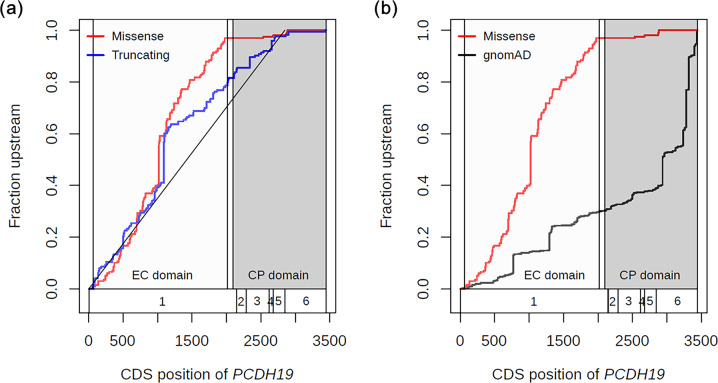
Fig. 1
Fig. 1
CDFs of PCDH19 missense and truncating variants. a CDFs of missense (red line) and truncating variants (blue line). b CDFs of variants from the gnomAD database (black line) and missense variants (red line). The white boxes and numbers at the bottom of the graphs indicate exon regions and exon numbers for the PCDH19 gene. The light and dark gray regions indicate extracellular cadherin (EC) and cytoplasmic (CP) domains, respectively
Fig. 2
Fig. 2
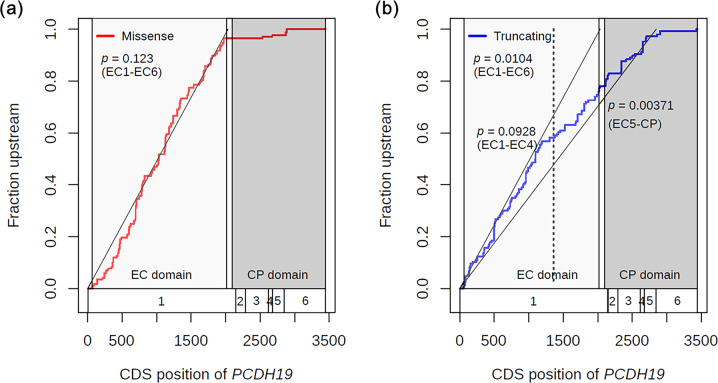
CDFs of PCDH19 missense and truncating variants without hotspots. a CDFs of missense variants without hotspots (red line). b CDFs of truncating variants without hotspots (blue line). The white boxes and numbers at the bottom of the graphs indicate exon regions and exon numbers for the PCDH19 gene. The light and dark gray regions indicate extracellular cadherin (EC) and cytoplasmic (CP) domains, respectively. The dashed line indicates the boundary between EC domains 4 and 5
Fig. 3
Fig. 3
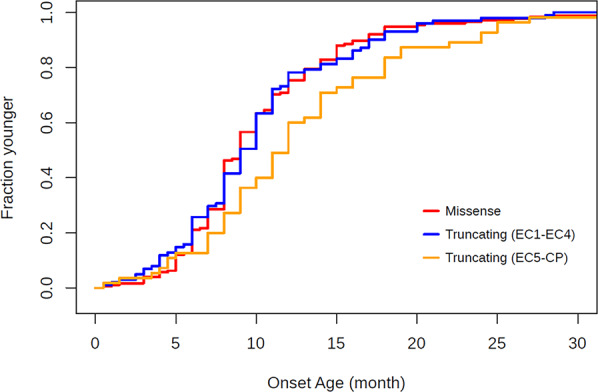
CDFs of seizure onset age. CDFs of the onset age of patients with missense variants, truncating variants located from EC1 to EC4, and truncating variants located from EC5 to the cytoplasmic domain are indicated in red, blue, and orange, respectively
Fig. 4
Fig. 4
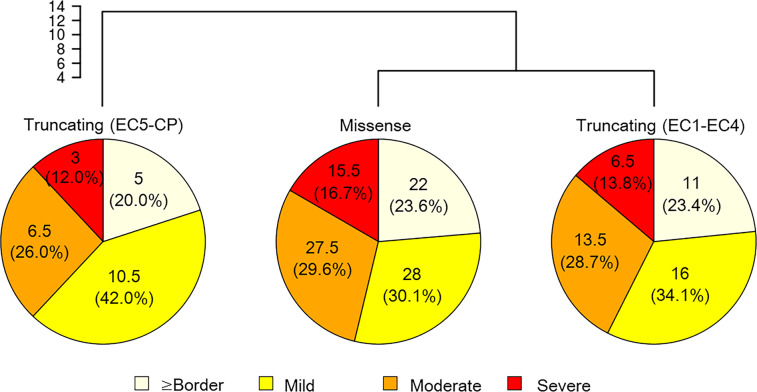
Comparison of the level of intellectual disability of in patients with PCDH19-related epilepsy. Hierarchical clustering dendrogram (top) showing similarities in the rates of patients with each intellectual disability level. For clustering, Ward’s method and Euclidean distance were utilized. The pie charts (bottom) show the percentages of patients with each level of intellectual disability. Cases with two levels in the literature were counted as 0.5 cases. For example, one case with a “moderate/severe” level was counted as 0.5 cases of moderate level and 0.5 cases of severe level

References

    1. Scheffer IE, Turner SJ, Dibbens LM, Bayly MA, Friend K, Hodgson B, et al. Epilepsy and mental retardation limited to females: an under-recognized disorder. Brain. 2008;131:918–27.. doi: 10.1093/brain/awm338. - DOI - PubMed
    1. Marini C, Mei D, Parmeggiani L, Norci V, Calado E, Ferrari A, et al. Protocadherin 19 mutations in girls with infantile-onset epilepsy. Neurology. 2010;75:646–53.. doi: 10.1212/WNL.0b013e3181ed9e67. - DOI - PubMed
    1. Marini C, Darra F, Specchio N, Mei D, Terracciano A, Parmeggiani L, et al. Focal seizures with affective symptoms are a major feature of PCDH19 gene-related epilepsy. Epilepsia. 2012;53:2111–9. doi: 10.1111/j.1528-1167.2012.03649.x. - DOI - PubMed
    1. Higurashi N, Nakamura M, Sugai M, Ohfu M, Sakauchi M, Sugawara Y, et al. PCDH19-related female-limited epilepsy: further details regarding early clinical features and therapeutic efficacy. Epilepsy Res. 2013;106:191–9. doi: 10.1016/j.eplepsyres.2013.04.005. - DOI - PubMed
    1. Terracciano A, Specchio N, Darra F, Sferra A, Bernardina BD, Vigevano F, et al. Somatic mosaicism of PCDH19 mutation in a family with low-penetrance EFMR. Neurogenetics. 2012;13:341–5. doi: 10.1007/s10048-012-0342-9. - DOI - PubMed