Review
. 2021 Jan;124(1):37-48.
doi: 10.1038/s41416-020-01160-5. Epub 2020 Dec 2.

Emerging immunotherapies for metastasis

Affiliations
Review

Emerging immunotherapies for metastasis

Sarah C Edwards et al. Br J Cancer. 2021 Jan.

Abstract

Major advances in cancer immunotherapy have dramatically expanded the potential to manipulate immune cells in cancer patients with metastatic disease to counteract cancer spread and extend patient lifespan. One of the most successful types of immunotherapy is the immune checkpoint inhibitors, such as anti-CTLA-4 and anti-PD-1, that keep anti-tumour T cells active. However, not every patient with metastatic disease benefits from this class of drugs and patients often develop resistance to these therapies over time. Tremendous research effort is now underway to uncover new immunotherapeutic targets that can be used in patients who are refractory to anti-CTLA-4 or anti-PD-1 treatment. Here, we discuss results from experimental model systems demonstrating that modulating the immune response can negatively affect metastasis formation. We focus on molecules that boost anti-tumour immune cells and opportunities to block immunosuppression, as well as cell-based therapies with enhanced tumour recognition properties for solid tumours. We also present a list of challenges in treating metastatic disease with immunotherapy that must be considered in order to move laboratory observations into clinical practice and maximise patient benefit.


Conflict of interest statement

The authors declare no competing interests.

Figures
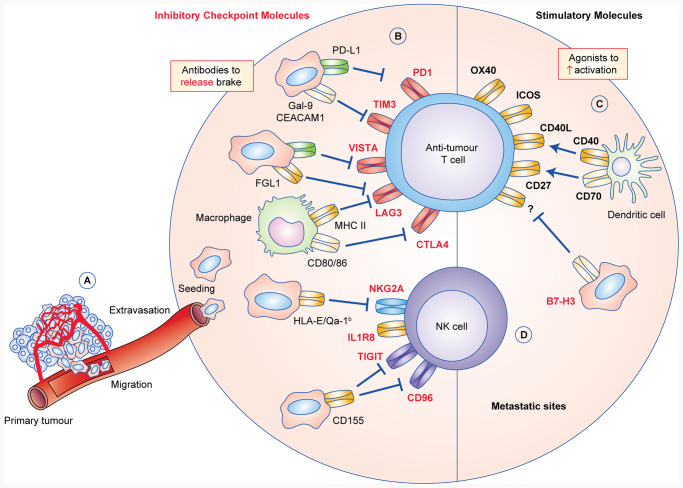
Fig. 1
Fig. 1. Inhibitory and stimulatory immune checkpoint molecules regulate the anti-tumour response at metastatic sites.
a In metastatic progression, cancer cells detach from the primary tumour, intravasate into the blood or lymphatic system and migrate to distant sites where they extravasate from the blood or lymph vessels to seed secondary tumour sites. b Cancer cells, metastasis-associated macrophages and other cells at metastatic sites can express a plethora of immunomodulatory proteins to inhibit and activate anti-tumour T cells. The binding of these ligands to their cognate checkpoint receptors, such as programmed death-ligand 1 (PD-L1) with programmed cell death protein 1 (PD-1) and galectin-9 or carcinoembryonic antigen-related cell adhesion molecule 1 (CEACAM1) with TIM-3, dampens T-cell activation and effector anti-tumour T-cell responses. Checkpoint molecules, such as VISTA, LAG-3 and CTLA-4 are inhibitory receptors that deliver negative stimulation signals upon binding to MHC-II, FGL1 and the co-stimulation molecules CD80 and CD86. c Engagement of stimulatory receptors such as OX40, ICOS, CD40, B7-H3 and CD27 with their cognate ligand, or agonists that artificially provide these signals, drives T-cell activation, differentiation and effector responses (R? = unknown receptor). Dendritic cells can be activated through CD40 and CD70 to induce their maturation and antigen-presenting properties. d Natural killer (NK) cells can be manipulated by cancer cells and myeloid cells that express inhibitory ligands to dampen their cytotoxic effector responses. The inhibitory receptors T-cell immunoreceptor with Ig and ITIM domains (TIGIT) and CD96 both have affinity for CD155, which is expressed on many types of cancer cell. NKG2A binds HLA-E on human cells or Qa-1b on mouse cells to block NK-cell-mediated killing. These inhibitory and activatory checkpoint pathways can be selectively modulated by blocking or agonist antibodies to release the brake on anti-tumour immunity in order to treat or prevent metastatic disease.
Fig. 2
Fig. 2. Exploiting pro-metastatic immune cell recruitment, survival and re-programming to counteract metastasis.
Recruitment, survival and re-programming of immune cells to a pro-tumorigenic phenotype at distant sites are key processes in the metastatic cascade. a Primary and secondary tumours release chemokines that attract aiding and abetting immune cells to encourage metastasis. In many cancers, CCR2+ bone-marrow-derived monocytes are recruited to primary and secondary tumours by the chemokine ligand CCL2, where these monocytes differentiate into tumour-associated macrophages (TAM). Pro-metastatic CXCR2+ neutrophils are recruited by CXCL1, CXCL2 or CXCL5, while pro-tumour CCR4+ regulatory T (TREG) cells require CCL17 or CCL22. Targeting these chemokine pathways can prevent the accumulation of these cell types and reduce metastasis in the liver or lung of colorectal, pancreatic and breast cancer mouse models. b Targeting colony stimulating factor (CSF)-1, granulocyte-macrophage (GM)-CSF and granulocyte (G)-CSF affects the pro-metastatic cascade. TAMs secrete interleukin (IL)-1β to activate IL-17-producing γδ T cells, which induce immunosuppressive neutrophils through G-CSF. Metastasis-associated macrophages (MAM) provide growth factors, survival signals and angiogenic factors at secondary sites to support outgrowth of cancer cells. c The cytokine IL-2 is essential for the survival of pro-tumour TREG cells as well as the activation of anti-tumour natural killer (NK) cells. Targeting selective IL-2 receptors on TREG cells might prevent their accumulation while enabling anti-tumour NK cells to remain active. d Tumour-derived factors such IL-4, vascular endothelial growth factor (VEGF) and angiopoietin 2 (ANGPT2) can induce pro-tumorigenic macrophages, while transforming growth factor (TGF)-β can enhance pro-metastatic neutrophils. CD47 functions as a ‘don’t eat me’ signal and can be upregulated on metastatic cancer cells to evade immune surveillance and phagocytosis by macrophages. Tumour-derived WNT ligands induce macrophages to secrete IL-1β, which activates IL-17-producing γδ T cells to drive pro-metastatic neutrophils. Blocking or interfering with the cytokine cascade or receptors on these pro-metastatic immune cells could reprogramme them away from a pro-tumorigenic phenotype in order to prevent metastatic disease.
Fig. 3
Fig. 3. Challenges for targeting metastatic tumours.
Metastatic tumours differ from primary tumours in various ways. Metastases occurring in various locations must adapt to the new tissue-specific environment (coloured circles). Metastatic tumours can acquire new (epi)genetic mutations, but antigens arising from these mutations are not always presented on the surface of cancer cells, thereby preventing T-cell recognition. The immune landscape can also be very different between primary and secondary tumours, due to varying abundance of specific immune cell populations between organs. Finally, immune responses to metastatic lesions might evolve significantly over the course of time due to acquired resistance to anti-cancer therapy (chemotherapy, radiotherapy, targeted therapy, etc) by secondary tumours.

References

    1. Miller KD, Nogueira L, Mariotto AB, Rowland JH, Yabroff KR, Alfano CM, et al. Cancer treatment and survivorship statistics, 2019. CA Cancer J. Clin. 2019;69:363–385. - PubMed
    1. Topalian SL, Drake CG, Pardoll DM. Immune checkpoint blockade: a common denominator approach to cancer therapy. Cancer Cell. 2015;27:450–461. - PMC - PubMed
    1. Syn NL, Teng MWL, Mok TSK, Soo RA. De-novo and acquired resistance to immune checkpoint targeting. Lancet Oncol. 2017;18:e731–e741. - PubMed
    1. Qin S, Xu L, Yi M, Yu S, Wu K, Luo S. Novel immune checkpoint targets: moving beyond PD-1 and CTLA-4. Mol. Cancer. 2019;18:155. - PMC - PubMed
    1. Souza-Fonseca-Guimaraes F, Cursons J, Huntington ND. The emergence of natural killer cells as a major target in cancer immunotherapy. Trends Immunol. 2019;40:142–158. - PubMed

Publication types