


Ultrasound as a Learning Tool in Bachelor-Level Anatomy Education
- PMID: 33262901
- PMCID: PMC7688295
- DOI: 10.1007/s40670-020-01170-1
Ultrasound as a Learning Tool in Bachelor-Level Anatomy Education
Abstract
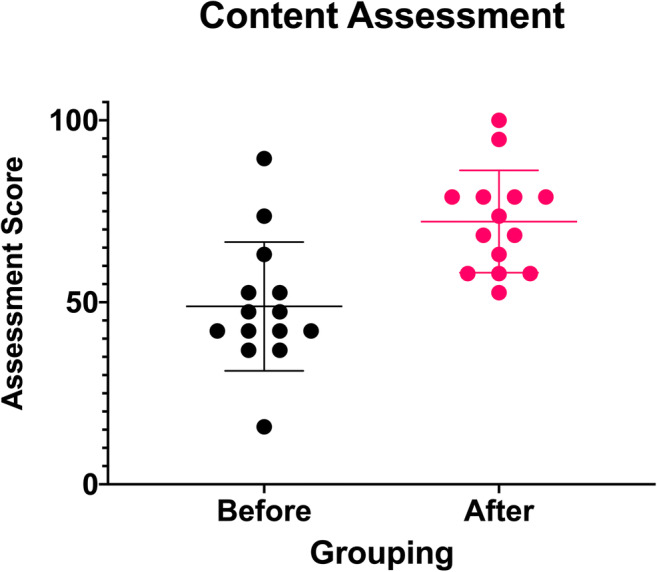
Point of care ultrasound (POCUS) has become an increasingly common diagnostic tool in the clinical environment. As a result, it is being used earlier for medical students in Undergraduate Medical Education (UME) as a learning tool for the basic sciences including gross anatomy. There is little literature, however, to support its utility for basic science education in students currently seeking a bachelor's degree. This study consisted of fourteen currently enrolled bachelor students with previous instruction in human anatomy and physiology. Students participated in an ultrasound didactic and an interactive ultrasound experience with volunteers. Before and after this session, students were asked to complete an assessment measuring their spatial understanding of the human anatomy and their ability to locate structures using ultrasound. Wilcoxon's signed-rank tests comparing assessment scores showed significant improvement on both portions of the assessment. Based on this improvement, we suggest that ultrasound is a valid educational tool which can be used at the bachelor-level to effectively enhance students' learning of anatomy and provide hands on experience with modern technology. Further research with larger samples will be necessary to determine whether it would supplement or replace more traditional teaching modalities.
Keywords: Anatomic imaging; Anatomy education; Anatomy teaching; Human gross anatomy; Ultrasound.
© International Association of Medical Science Educators 2020.
Conflict of interest statement
Conflict of InterestNot applicable.
Figures

References
LinkOut - more resources
Full Text Sources
Research Materials