


Incidence and outcomes of chronic total occlusion percutaneous coronary intervention in the Netherlands: data from a nationwide registry
- PMID: 33263890
- PMCID: PMC7782624
- DOI: 10.1007/s12471-020-01521-y
Incidence and outcomes of chronic total occlusion percutaneous coronary intervention in the Netherlands: data from a nationwide registry
Abstract
Background: Patients with chronic total coronary occlusions (CTO) are at increased risk for poor clinical outcomes. We aimed to determine the incidence of CTO percutaneous coronary intervention (PCI) and to identify CTO patients at risk for cardiac events in the nationwide Netherlands Heart Registration (NHR).
Methods: We included all PCI procedures with ≥1 CTO registered in the NHR from January 2015 to December 2018, excluding acute interventions. We used multivariable logistic regression of baseline characteristics to calculate the risk for events as odds ratios (OR) with 95% confidence intervals (CI).
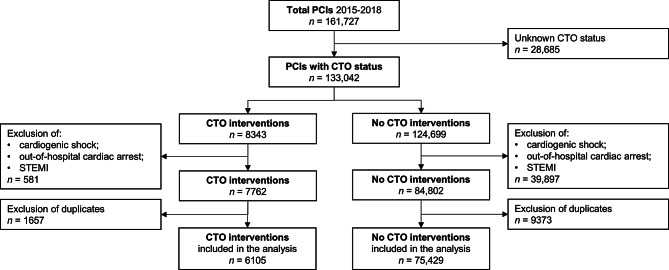
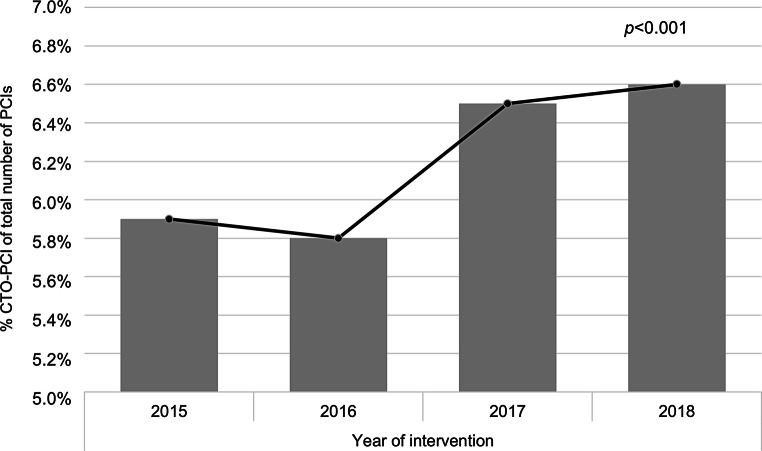
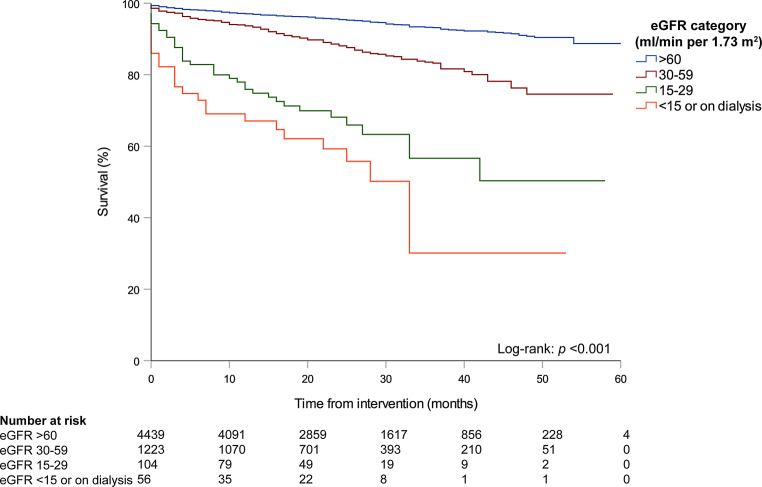
Results: Of the PCIs performed during the study period, 6.3% (8,343/133,042) were for CTOs, with the percentage increasing significantly over time from 5.9% in 2015 to 6.6% in 2018 (p < 0.001). Coronary artery bypass grafting <24 h was carried out in 0.3%, and the only significant predictor was diabetes mellitus (OR 2.97, 95% CI 1.04-8.49, p = 0.042). Myocardial infarction (MI) <30 days occurred in 0.5%, and renal insufficiency (i.e. estimated glomerular filtration rate <30 ml/min per 1.73 m2) was identified as an independent predictor (OR 4.70, 95% CI 1.07-20.61, p = 0.040). Among patients undergoing CTO-PCI, 1‑year mortality was 3.7%, and independent predictors included renal insufficiency (OR 5.59, 95% CI 3.25-9.59, p < 0.001), left ventricular ejection fraction <30% (OR 3.43, 95% CI 2.00-5.90, p < 0.001), previous MI (OR 1.62, 95% CI 1.14-2.31, p = 0.007) and age (OR 1.06 per year increment, 95% CI 1.04-1.07, p < 0.001). Target-vessel revascularisation <1 year occurred in 11.3%.
Conclusion: CTO-PCI is still infrequently performed in the Netherlands. The most important predictor of mortality after CTO-PCI was renal insufficiency. Identification of patients at risk may help improve the prognosis of CTO patients in the future.
Keywords: Chronic total occlusion; Mortality; Percutaneous coronary intervention; Renal insufficiency.
Conflict of interest statement
A. van Veelen, B.E.P.M. Claessen, S. Houterman, L.P.C. Hoebers, J. Elias, J.P.S. Henriques and P. Knaapen declare that they have no competing interests.
Figures
References
-
- Tsai TT, Stanislawski MA, Shunk KA, et al. Contemporary incidence, management, and long-term outcomes of percutaneous coronary interventions for chronic coronary artery total occlusions: insights from the VA CART program. JACC Cardiovasc Interv. 2017;10:866–875. doi: 10.1016/j.jcin.2017.02.044. - DOI - PubMed
LinkOut - more resources
Full Text Sources
Miscellaneous
