Review
. 2020 Nov 30;21(23):9106.
doi: 10.3390/ijms21239106.

The Role of Exosomal Epigenetic Modifiers in Cell Communication and Fertility of Dairy Cows

Affiliations
Review

The Role of Exosomal Epigenetic Modifiers in Cell Communication and Fertility of Dairy Cows

Pevindu Abeysinghe et al. Int J Mol Sci. .

Abstract

Abnormal uterine function affects conception rate and embryo development, thereby leading to poor fertility and reproduction failure. Exosomes are a nanosized subclass of extracellular vesicles (EV) that have important functions as intercellular communicators. They contain and carry transferable bioactive substances including micro RNA (miRNA) for target cells. Elements of the cargo can provide epigenetic modifications of the recipient cells and may have crucial roles in mechanisms of reproduction. The dairy industry accounts for a substantial portion of the economy of many agricultural countries. Exosomes can enhance the expression of inflammatory mediators in the endometrium, which contribute to various inflammatory diseases in transition dairy cows. This results in reduced fertility which leads to reduced milk production and increased cow maintenance costs. Thus, gaining a clear knowledge of exosomal epigenetic modifiers is critical to improving the breeding success and profitability of dairy farms. This review provides a brief overview of how exosomal miRNA contributes to inflammatory diseases and hence to poor fertility, particularly in dairy cows.

Keywords: dairy cow; epigenetics; exosome; fertility; inflammation; miRNA.


Conflict of interest statement

The authors declare no conflict of interest.

Figures
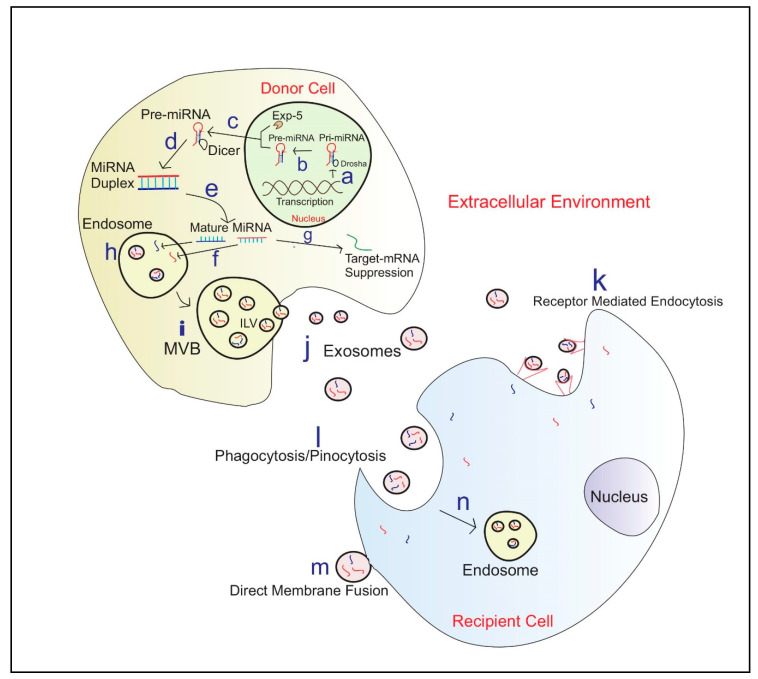
Figure 1
Figure 1
Exosome biosynthesis and miRNA Communication between cells a—Translation of primary miRNA (Pri-miRNA) from DNA; b—Cleavage of pri-miRNA to precursor miRNA(Pre-miRNA) by microprocessor complex including Drosha; c—Exportation of Pre-miRNA to the cytoplasm by Exportin 5(EXP-5); d—Pre-miRNA processing into miRNA duplexes using Dicer; e—Duplex unwinds to produce mature miRNA; f—miRNA engulf into endosomes; g—Few miRNA’s contribute to target mRNA silencing in the Donor cell; h—Endosomes engulfed miRNA; i—Micro-vesicular Bodies (MVB) release Intraluminal Vesicles (ILV) fuse with the plasma membrane j—Exosomes carrying miRNAs; k—Exosome entry to recipient cell via receptor-mediated endocytosis; l—Entrance of exosomes via Phagocytosis/Pinocytosis; m—Exosome entry via Direct membrane fusion; n—Formation of Endosome in the recipient cell and then exosomal miRNA release into the cytoplasm.
Figure 2
Figure 2
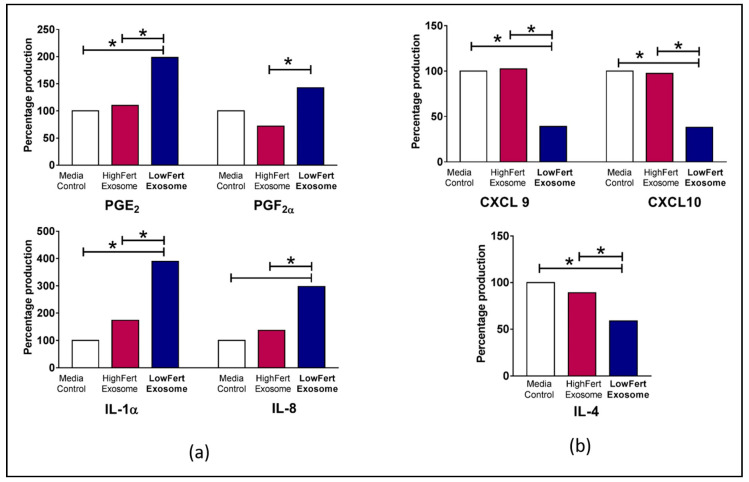
Differential expression of cytokines in bovine endometrial cells (a) Increased relative fold expression of prostaglandin E2 (PGE2), prostaglandin F2 alpha (PGF), interleukin 1 alpha (IL1α), (C-X-C motif) ligand 8/interleukin-8 (CXCL8/IL8) in low fertile exosome loaded cells. (b) Decreased relative fold expression of (C-X-C motif) ligand 9 (CXCL9), (C-X-C motif) ligand 10 (CXCL10) and interleukin 4 (IL-4). Differences of P < 0.05 are considered statistically significant between sample groups denoted by *. Adapted by experimental data published in Koh et al., 2020 [9].
Figure 3
Figure 3
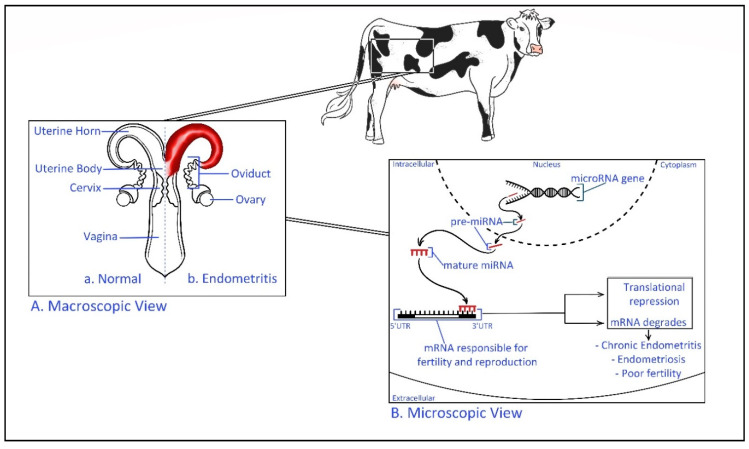
Epigenetic regulation of bovine uterine inflammatory diseases. (A). Macroscopic view—Comparison of a healthy and endometritis infected bovine reproductive system Endometritis is defined as a localized infection of the uterus lining [107]. (B). Microscopic view—Transcribed miRNA precursor (pre-miRNA) transfer to the cellular cytoplasm before mature miRNA targets the 3′ untranslated region (UTR) of specific mRNA. The inactive complex of (miRNA-mRNA) repress the translation process and the fate of mRNA is to be degraded. This may result in inflammatory diseases such as endometritis and poor fertility. For example, miR-218 has shown to be involved in the pathogenesis of bovine endometritis by inhibiting the activating mRNA of macrophage inflammatory protein (Mip-1) chemokine [108].

References

    1. Oltenacu P., Broom D. The impact of genetic selection for increased milk yield on the welfare of dairy cows. Anim. Welf. 2010;19:39–49.
    1. Garnsworthy P.C., Sinclair K.D., Webb R. Integration of physiological mechanisms that influence fertility in dairy cows. Animal. 2008;2:1144–1152. doi: 10.1017/S1751731108002358. - DOI - PubMed
    1. Formigoni A., Trevisi E. Transition cow: Interaction with fertility. Vet. Res. Commun. 2003;27(Suppl. S1):143–152. doi: 10.1023/B:VERC.0000014131.34839.4c. - DOI - PubMed
    1. McDougall S., Hussein H., Aberdein D., Buckle K., Roche J., Burke C., Mitchell M., Meier S. Relationships between cytology, bacteriology and vaginal discharge scores and reproductive performance in dairy cattle. Theriogenology. 2011;76:229–240. doi: 10.1016/j.theriogenology.2010.12.024. - DOI - PubMed
    1. Piccinini R., Binda E., Belotti M., Casirani G., Zecconi A. The evaluation of non-specific immune status of heifers in field conditions during the periparturient period. Vet. Res. 2004;35:539–550. doi: 10.1051/vetres:2004030. - DOI - PubMed

LinkOut - more resources