


Chemical Composition of Natural Hydrolates and Their Antimicrobial Activity on Arcobacter-Like Cells in Comparison with Other Microorganisms
- PMID: 33266263
- PMCID: PMC7730011
- DOI: 10.3390/molecules25235654
Chemical Composition of Natural Hydrolates and Their Antimicrobial Activity on Arcobacter-Like Cells in Comparison with Other Microorganisms
Abstract
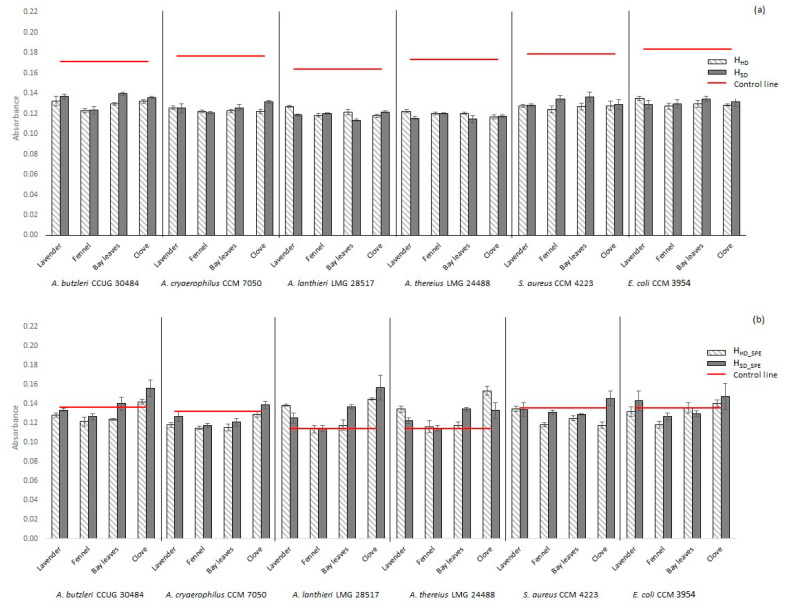
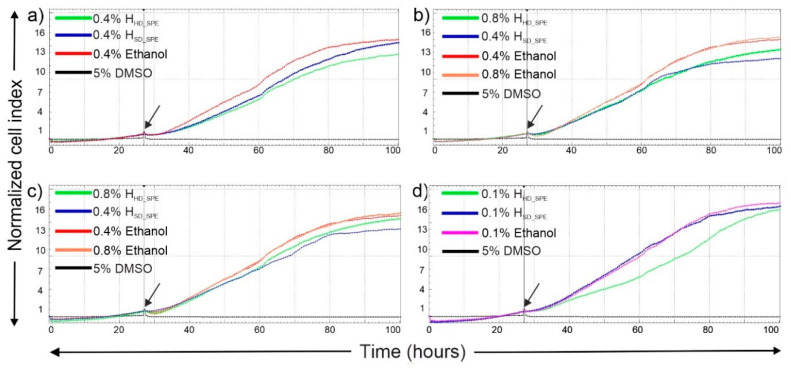
Hydrolates obtained via the hydrodistillation and steam distillation of Lavandulaangustifolia Mill., Syzygiumaromaticum L., Foeniculumvulgare Mill., and Laurusnobilis L. were analyzed by gas chromatography with flame ionization detector (GC-FID) and gas chromatography coupled to mass spectrometry (GC-MS). Additionally, the hydrolates were evaluated for antimicrobial activity (disk-diffusion and microdilution method), influence on biofilm formation (Christensen method) and cytotoxicity of concentrated hydrolates against human cell lines (A549) by xCELLigence system. Using chemical analysis, 48, 9, 13 and 33 different components were detected in lavender, clove, fennel and laurel hydrolates, respectively. Lavender hydrolate contained the largest proportion of 1,8-cineol, linalool furanoxide, and linalool. The main components of laurel hydrolate were 1,8-cineol, 4-terpineol and α-terpineol. Fenchone and estragole were the most abundant in fennel hydrolate, and eugenol and eugenyl acetate in clove hydrolate. Concentrated hydrolates showed significant antimicrobial activity. Clove hydrolate was among the most antimicrobially active agents, most preferably against C. albicans, with an inhibition zone up to 23.5 mm. Moreover, concentrated hydrolates did not show any cytotoxic effect again8 st human A549 cells. In the presence of the non-concentrated hydrolates, significantly reduced biofilm formation was observed; however, with concentrated clove hydrolate, there was an increase in biofilm formation, e.g., of A. thereius, A. lanthieri, and A. butzleri. Research shows new findings about hydrolates that may be important in natural medicine or for preservation purposes.
Keywords: Arcobacter-like bacteria; Foeniculum vulgare; Laurus nobilis; Lavandula angustifolia; Syzygium aromaticum; antimicrobial activity; biofilm formation; distillation; gas chromatography; hydrolates.
Conflict of interest statement
The authors declare no conflict of interest.
Figures
References
-
- Mohamed A., El-Sayed M.A., Hegazy M.E., Helaly S.E., Esmail A.M., Mohamed N.S. Chemical Constituents and Biological Activities of Artemisia herba-alba. Rec. Nat. Prod. 2010;4:1–25.
-
- Pejin B., Vujisic L., Sabovljevic M., Tesevic V., Vajs V. Preliminary data on essential oil composition of the moss Rhodobryum ontariense (Kindb.) Kindb. Cryptogam. Bryol. 2011;32:113–117. doi: 10.7872/cryb.v32.iss1.2011.113. - DOI
-
- Dadalioglu I., Evrendilek G.A. Chemical compositions and antibacterial effects of essential oils of Turkish oregano (Origanum minutiflorum), bay laurel (Laurus nobilis), Spanish lavender (Lavandula stoechas L.), and fennel (Foeniculum vulgare) on common foodborne pathogens. J. Agric. Food Chem. 2004;52:8255–8260. doi: 10.1021/jf049033e. - DOI - PubMed
-
- Diao W.R., Hu Q.P., Zhang H., Xu J.G. Chemical composition, antibacterial activity and mechanism of action of essential oil from seeds of fennel (Foeniculum vulgare Mill.) Food Control. 2014;35:109–116. doi: 10.1016/j.foodcont.2013.06.056. - DOI
MeSH terms
Substances
LinkOut - more resources
Full Text Sources
Other Literature Sources
Medical
Molecular Biology Databases
Miscellaneous
