. 2020 Nov 22;21(22):8832.
doi: 10.3390/ijms21228832.

Mechanistic Insights into the Allosteric Regulation of the Clr4 Protein Lysine Methyltransferase by Autoinhibition and Automethylation

Affiliations

Mechanistic Insights into the Allosteric Regulation of the Clr4 Protein Lysine Methyltransferase by Autoinhibition and Automethylation

Mina S Khella et al. Int J Mol Sci. .

Abstract

Clr4 is a histone H3 lysine 9 methyltransferase in Schizosaccharomyces pombe that is essential for heterochromatin formation. Previous biochemical and structural studies have shown that Clr4 is in an autoinhibited state in which an autoregulatory loop (ARL) blocks the active site. Automethylation of lysine residues in the ARL relieves autoinhibition. To investigate the mechanism of Clr4 regulation by autoinhibition and automethylation, we exchanged residues in the ARL by site-directed mutagenesis leading to stimulation or inhibition of automethylation and corresponding changes in Clr4 catalytic activity. Furthermore, we demonstrate that Clr4 prefers monomethylated (H3K9me1) over unmodified (H3K9me0) histone peptide substrates, similar to related human enzymes and, accordingly, H3K9me1 is more efficient in overcoming autoinhibition. Due to enzyme activation by automethylation, we observed a sigmoidal dependence of Clr4 activity on the AdoMet concentration, with stimulation at high AdoMet levels. In contrast, an automethylation-deficient mutant showed a hyperbolic Michaelis-Menten type relationship. These data suggest that automethylation of the ARL could act as a sensor for AdoMet levels in cells and regulate the generation and maintenance of heterochromatin accordingly. This process could connect epigenome modifications with the metabolic state of cells. As other human protein lysine methyltransferases (for example, PRC2) also use automethylation/autoinhibition mechanisms, our results may provide a model to describe their regulation as well.

Keywords: automethylation; enzyme kinetics; enzyme regulation; protein methylation; protein methyltransferase.


Conflict of interest statement

The authors declare no conflict of interest.

Figures
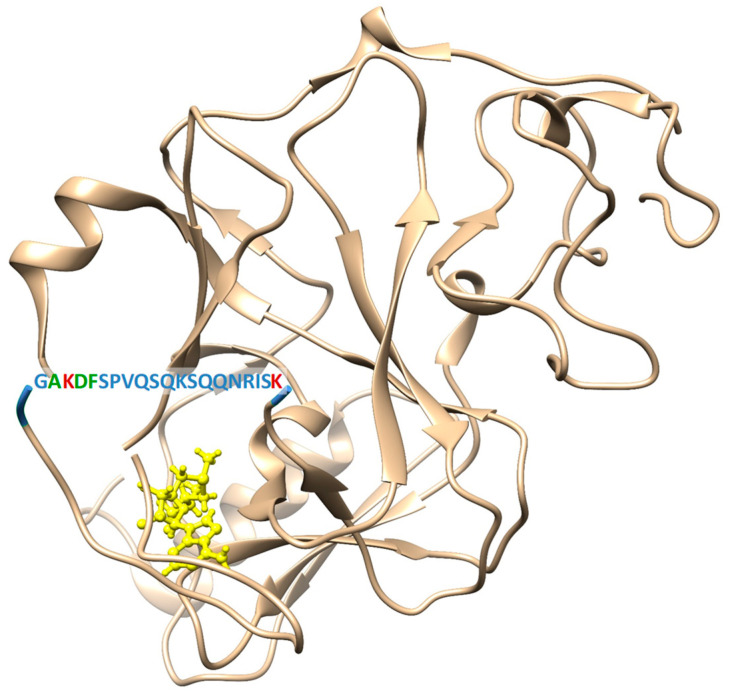
Figure 1
Figure 1
Crystal structure of the Su(var)3-9, Enhancer-of-zeste and Trithorax domain (SET domain) of Clr4 showing the sequence and approximate position of its autoregulatory loop (ARL), which is disordered in the structure (pdb 6BP4, [40]). The automethylated lysines K455 and K472 are marked in red, the amino acids surrounding K455 at −1, +1 and +2 positions which were mutated are marked in green.
Figure 2
Figure 2
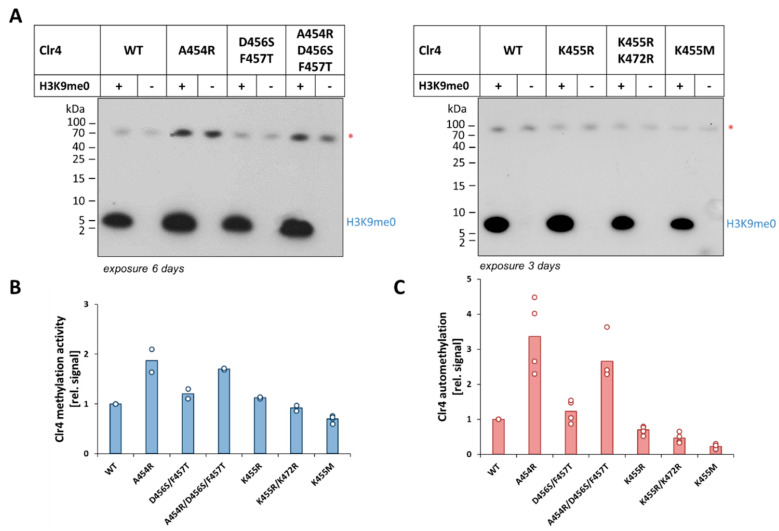
Methyltransferase activity and automethylation of different engineered Clr4 variants compared to wild type (WT). Exemplary autoradiographic gel images of in vitro methyltransferase assays with Clr4 WT and its mutants A454R, D456S/F457T, A454R/D456S/F457T, K455R, K455R/K472R and K455M (A). The red asterisks indicate the Clr4 automethylation signal. Quantitative analysis of two to four independent experiments revealed the histone peptide methylation activity (B) and automethylation levels (C) of all mutants, which are represented relative to WT enzyme. The mean values are indicated by the bars and the individual data points as circles. In panel (C), results obtained with and without peptide were combined. The p-values of the differences in automethylation and methyltransferase activities between WT and mutants are listed in Supplementary Table S1.
Figure 3
Figure 3
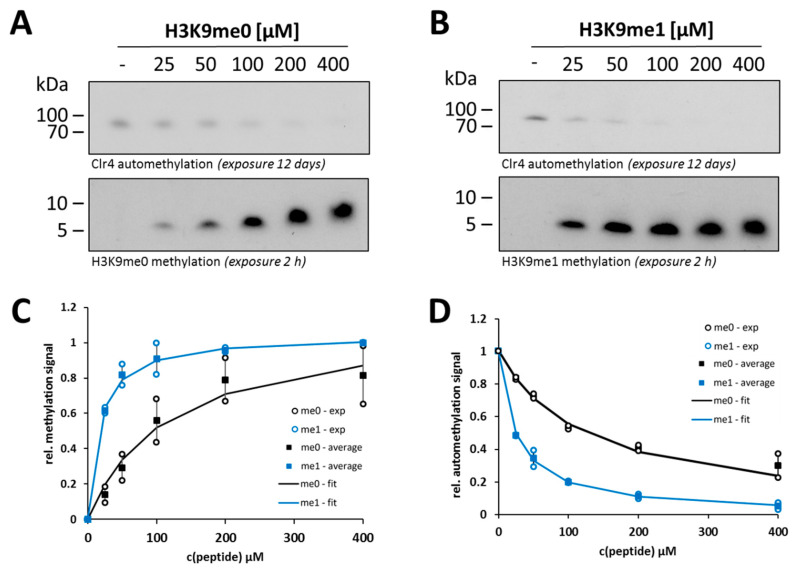
Methyltransferase activity and automethylation level of Clr4 WT at different concentrations of the H3K9me0 and H3K9me1 histone peptides. Exemplary autoradiographic gel images of in vitro methyltransferase assays with Clr4 WT using 25–400 µM H3K9me0 (A) or H3K9me1 (B) as substrate. (C) Michaelis–Menten model fit of the data for the histone peptide methylation activity observed in two independent repeats of the experiments shown in panel (A,B). All values are represented relative to the enzyme activity at 400 µM H3K9me1 peptide. (D) Analysis of the inhibition of automethylation by H3K9me0 and H3K9me1 peptides detected in two independent repeats of the experiments shown in panels (A,B). Data were fitted to an inhibition model and are represented relative to Clr4 enzyme automethylation in the absence of peptide. In panels (C,D), averages are shown as squares, error bars represent the SEM and individual data points are shown as circles. The kinetic parameters and inhibition constants are listed in Table 1.
Figure 4
Figure 4
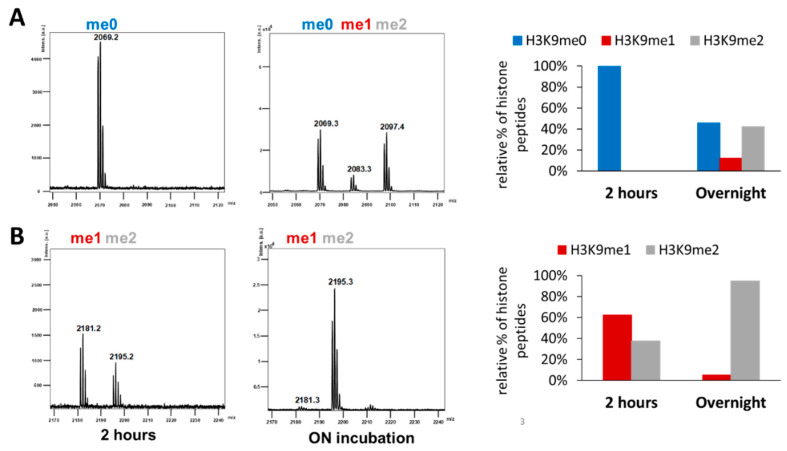
Detection of Clr4 activity on H3K9me0 and H3K9me1 histone peptides using MALDI-TOF mass spectrometry. Example of mass spectra for the different methylated histone peptides detected after 2 h or overnight (ON) methylation using Clr4 WT enzyme and 4.5 µM H3K9me0 (A) or H3K9me1 (B) in the presence of 1 mM unlabeled AdoMet. The relative fractions of histone peptides with different methylation states are indicated in the right panels. Mass spectra of the H3K9me0 and H3K9me1 histone peptides without enzyme incubation are shown in Supplementary Figure S3.
Figure 5
Figure 5
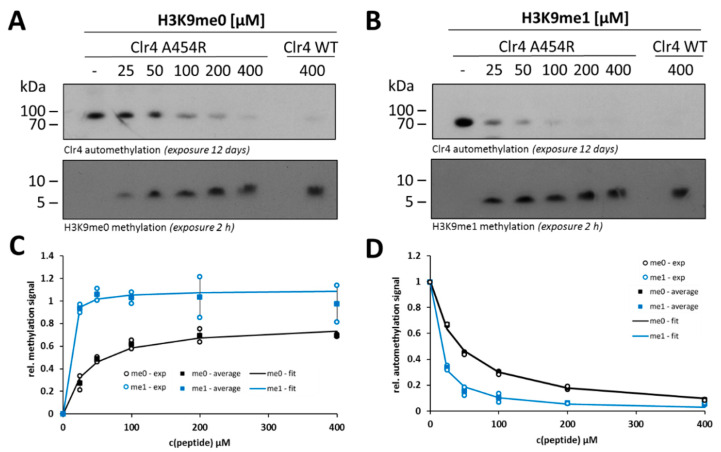
Methyltransferase activity and automethylation level of Clr4 A454R at different concentrations of H3K9me0 and H3K9me1 histone peptides. Autoradiography of the in vitro methyltransferase assay of A454R using 25–400 µM H3K9me0 (A) or H3K9me1 (B) as substrate. A reaction of WT enzyme incubated with 400 µM peptide was loaded on each gel as reference for the quantitative analysis. (C) Michaelis–Menten model fit of the data for the histone peptide methylation activity observed in two independent repeats of the experiments shown in panels (A,B). All values are represented relative to the WT enzyme activity at 400 µM H3K9me1 peptide. (D) Analysis of the inhibition of A454R automethylation by H3K9me0 and H3K9me1 peptides detected in two independent repeats of the experiments shown in panels (A,B). Data were fitted to an inhibition model and are represented relative to Clr4 enzyme automethylation in the absence of peptide. In panels (C,D), averages are shown as squares, error bars represent the SEM and individual data points are shown as circles. The kinetic parameters and inhibition constants are listed in Table 1.
Figure 6
Figure 6
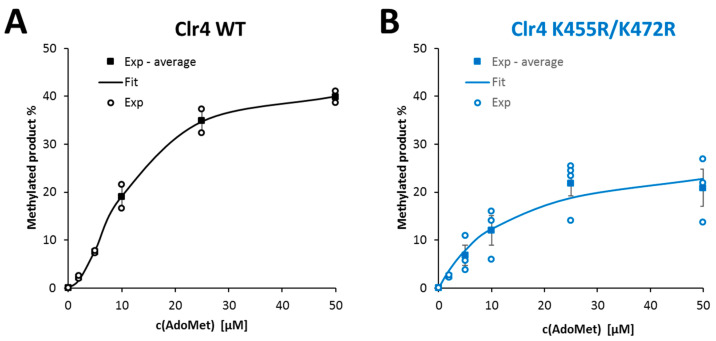
AdoMet dependence of the activity of Clr4 WT and the K455R/K472R mutant. Fractions of methylated products observed with increasing AdoMet concentrations (2–50 µM) for Clr4 WT (A) or the automethylation-deficient K455R/K472R mutant (B). Data were obtained from the analysis of corresponding relative peak intensities measured by MALDI-TOF mass spectrometry in two to four independent experiments (see Supplementary Figure S5). Averages are shown as squares, error bars represent the SEM and individual data points are shown as circles. The kinetic parameters obtained in the fitting are listed in Table 2.
Figure 7
Figure 7
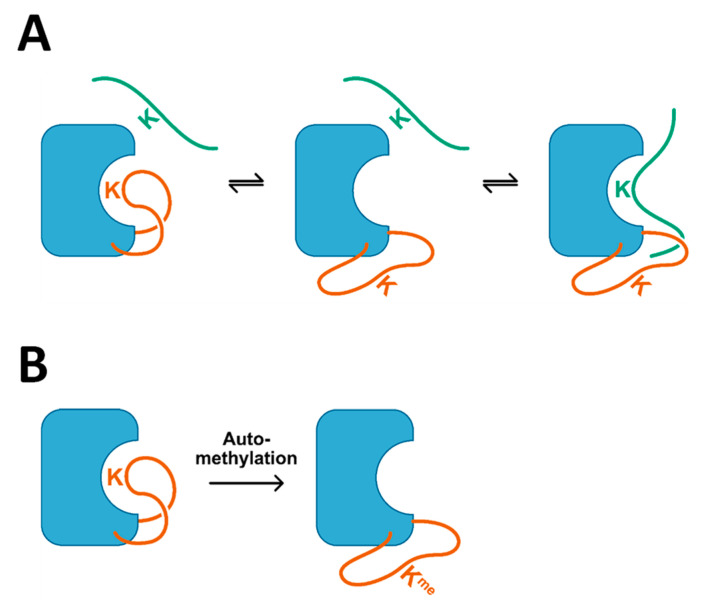
Model depicting the competition of the ARL (orange) and external peptide substrate (green) for access to the active site (A) and the shift of the conformation of the ARL towards the non-autoinhibited state by automethylation (B).

References

    1. Walsh C.T., Garneau-Tsodikova S., Gatto G.J., Jr. Protein posttranslational modifications: The chemistry of proteome diversifications. Angew. Chem. 2005;44:7342–7372. doi: 10.1002/anie.200501023. - DOI - PubMed
    1. Murn J., Shi Y. The winding path of protein methylation research: Milestones and new frontiers. Nat. Rev. Mol. Cell Biol. 2017;18:517–527. doi: 10.1038/nrm.2017.35. - DOI - PubMed
    1. Huang H., Lin S., Garcia B.A., Zhao Y. Quantitative proteomic analysis of histone modifications. Chem. Rev. 2015;115:2376–2418. doi: 10.1021/cr500491u. - DOI - PMC - PubMed
    1. Chan J.C., Maze I. Nothing Is yet Set in (Hi)stone: Novel Post-Translational Modifications Regulating Chromatin Function. Trends Biochem. Sci. 2020 doi: 10.1016/j.tibs.2020.05.009. - DOI - PMC - PubMed
    1. Biggar K.K., Li S.S. Non-histone protein methylation as a regulator of cellular signalling and function. Nat. Rev. Mol. Cell Biol. 2015;16:5–17. doi: 10.1038/nrm3915. - DOI - PubMed

MeSH terms