


Effects of Ibudilast on MRI Measures in the Phase 2 SPRINT-MS Study
- PMID: 33268562
- PMCID: PMC7905793
- DOI: 10.1212/WNL.0000000000011314
Effects of Ibudilast on MRI Measures in the Phase 2 SPRINT-MS Study
Abstract
Objective: To determine whether ibudilast has an effect on brain volume and new lesions in progressive forms of multiple sclerosis (MS).
Methods: A randomized, placebo-controlled, blinded study evaluated ibudilast at a dose of up to 100 mg over 96 weeks in primary and secondary progressive MS. In this secondary analysis of a previously reported trial, secondary and tertiary endpoints included gray matter atrophy, new or enlarging T2 lesions as measured every 24 weeks, and new T1 hypointensities at 96 weeks. Whole brain atrophy measured by structural image evaluation, using normalization, of atrophy (SIENA) was a sensitivity analysis.
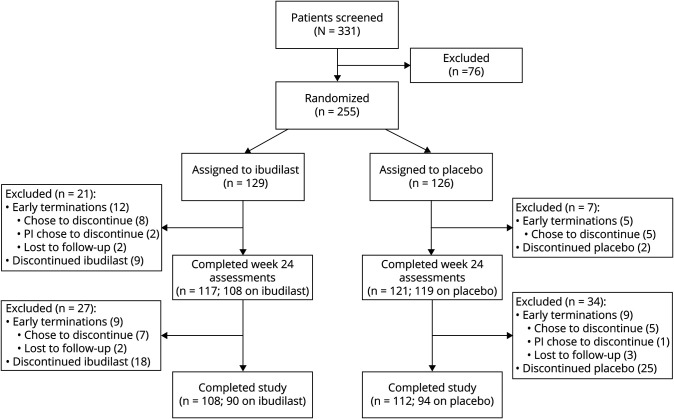
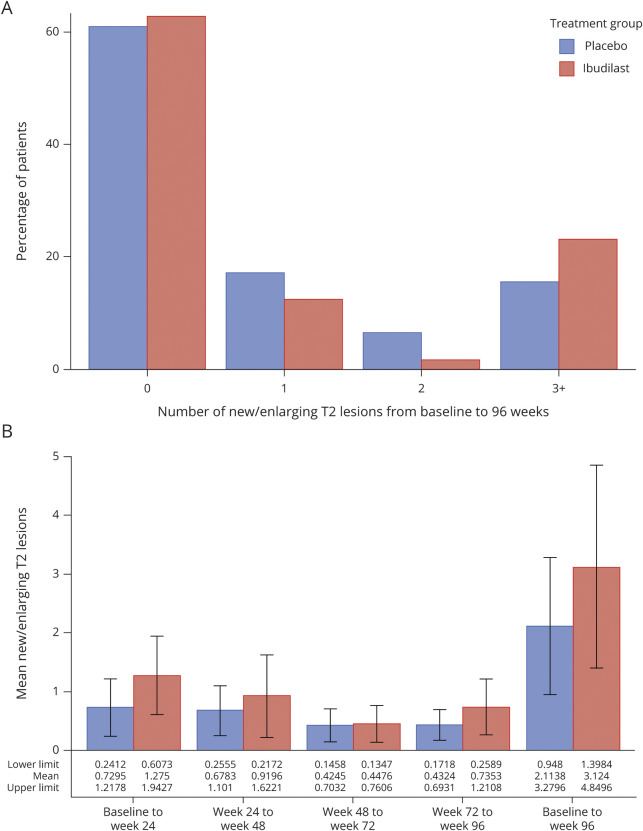
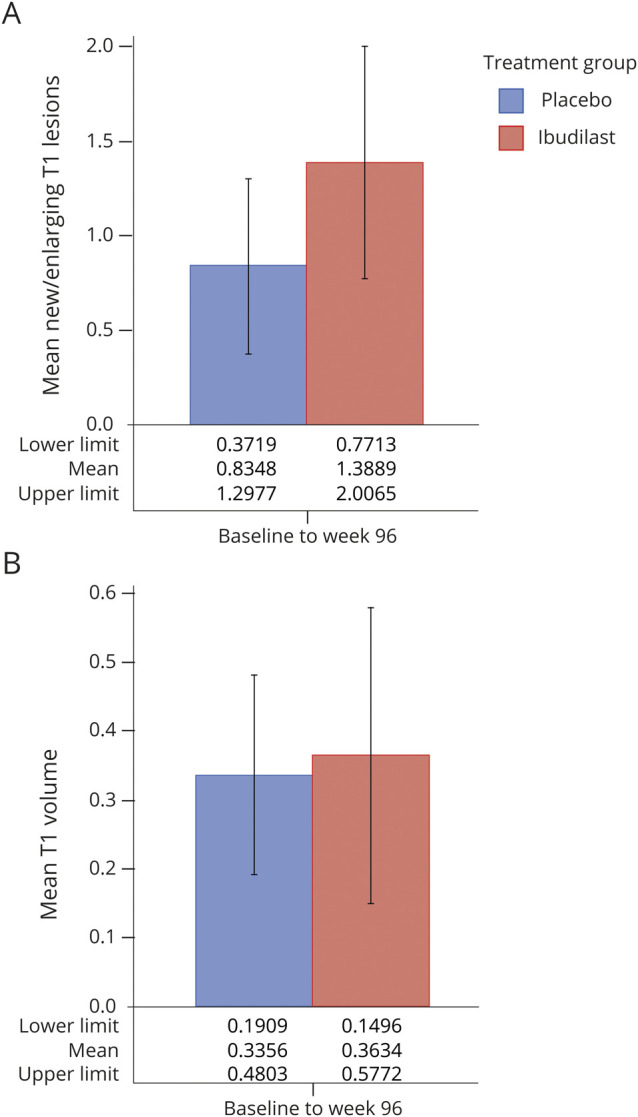
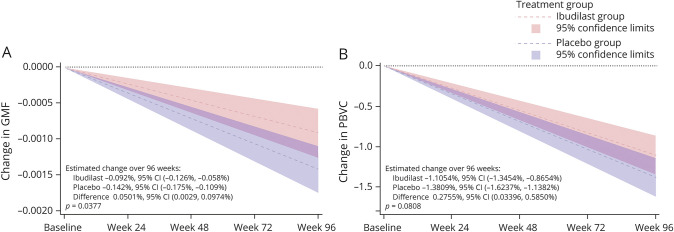
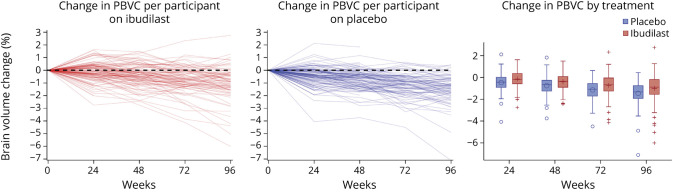
Results: A total of 129 participants were assigned to ibudilast and 126 to placebo. New or enlarging T2 lesions were observed in 37.2% on ibudilast and 29.0% on placebo (p = 0.82). New T1 hypointense lesions at 96 weeks were observed in 33.3% on ibudilast and 23.5% on placebo (p = 0.11). Gray matter atrophy was reduced by 35% for those on ibudilast vs placebo (p = 0.038). Progression of whole brain atrophy by SIENA was slowed by 20% in the ibudilast group compared with placebo (p = 0.08).
Conclusion: Ibudilast treatment was associated with a reduction in gray matter atrophy. Ibudilast treatment was not associated with a reduction in new or enlarging T2 lesions or new T1 lesions. An effect on brain volume contributes to prior data that ibudilast appears to affect markers associated with neurodegenerative processes, but not inflammatory processes.
Classification of evidence: This study provides Class II evidence that for people with MS, ibudilast does not significantly reduce new or enlarging T2 lesions or new T1 lesions.
© 2020 American Academy of Neurology.
Figures
Comment in
-
Ibudilast: A Paradigm Shift for Progressive Multiple Sclerosis?Neurology. 2021 Jan 26;96(4):141-142. doi: 10.1212/WNL.0000000000011312. Epub 2020 Dec 2. Neurology. 2021. PMID: 33268561 No abstract available.
References
-
- Ruiz-Pérez D, Benito J, Polo G, et al. The effects of the toll-like receptor 4 antagonist, ibudilast, on sevoflurane's minimum alveolar concentration and the delayed remifentanil-induced increase in the minimum alveolar concentration in rats. Anesth Analgesia 2016;122:1370–1376. - PubMed
-
- Gibson LCD, Hastings SF, McPhee I, et al. The inhibitory profile of Ibudilast against the human phosphodiesterase enzyme family. Eur J Pharmacol 2006;538:39–42. - PubMed
-
- Barkhof F, Hulst HE, Drulović J, Uitdehaag BMJ, Matsuda K, Landin R. Ibudilast in relapsing-remitting multiple sclerosis a neuroprotectant? Neurology 2010;74:1033–1040. - PubMed
