


Risk Factors for Ebola Exposure in Health Care Workers in Boende, Tshuapa Province, Democratic Republic of the Congo
- PMID: 33269402
- PMCID: PMC9441197
- DOI: 10.1093/infdis/jiaa747
Risk Factors for Ebola Exposure in Health Care Workers in Boende, Tshuapa Province, Democratic Republic of the Congo
Abstract
Background: Health care workers (HCW) are more likely to be exposed to Ebola virus (EBOV) during an outbreak compared to people in the general population due to close physical contact with patients and potential exposure to infectious fluids. However, not all will fall ill. Despite evidence of subclinical and paucisymptomatic Ebola virus disease (EVD), prevalence and associated risk factors remain unknown.
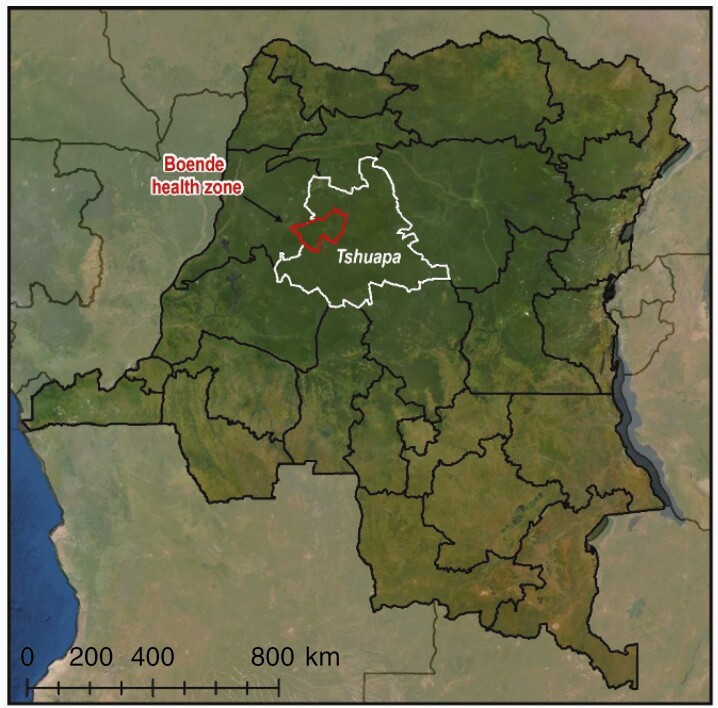
Methods: We conducted a serosurvey among HCW in Boende, Tshuapa Province, Democratic Republic of Congo. Human anti-EBOV glycoprotein IgG titers were measured using a commercially available ELISA kit. We assessed associations between anti-EBOV IgG seroreactivity, defined as ≥2.5 units/mL, and risk factors using univariable and multivariable logistic regression. Sensitivity analyses explored a more conservative cutoff, >5 units/mL.
Results: Overall, 22.5% of HCWs were seroreactive for EBOV. In multivariable analyses, using any form of personal protective equipment when interacting with a confirmed, probable, or suspect EVD case was negatively associated with seroreactivity (adjusted odds ratio, 0.23; 95% confidence interval, .07-.73).
Discussion: Our results suggest high exposure to EBOV among HCWs and provide additional evidence for asymptomatic or minimally symptomatic EVD. Further studies should be conducted to determine the probability of onward transmission and if seroreactivity is associated with immunity.
Keywords: Democratic Republic of the Congo; Ebola; health care workers; risk factors.
© The Author(s) 2020. Published by Oxford University Press for the Infectious Diseases Society of America.
Figures
References
-
- Feldmann H, Sprecher A, Geisbert TW. Ebola. N Engl J Med 2020; 382:1832–42. - PubMed
-
- World Health Organization (WHO). Ebola virus disease fact sheet. Geneva, Switzerland: WHO, 2018.
